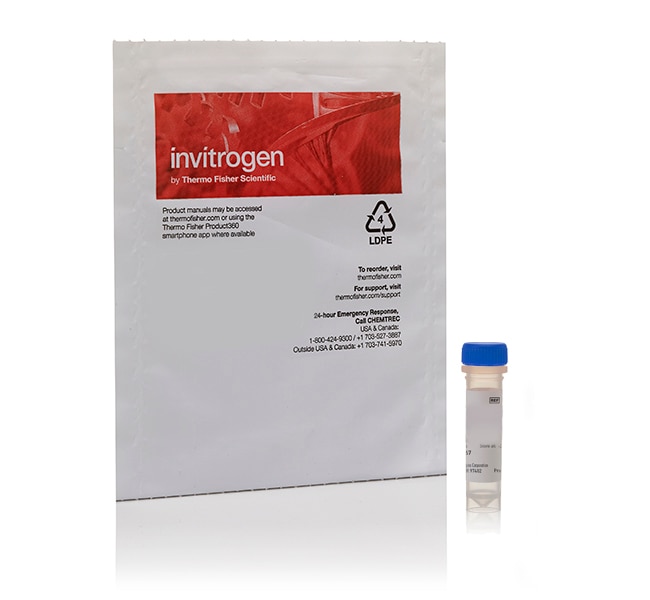
Qdot™ 525 Streptavidin Conjugate
Invitrogen™

Qdot™ 525 Streptavidin Conjugate

Qdot™ 525 streptavidin conjugateは、蛍光標識(Qdot™ナノ結晶)に共有結合したビオチン結合タンパク質(ストレプトアビジン)で構成されています。ストレプトアビジンはビオチンとの結合親和性が非常に高く詳細を見る
製品番号(カタログ番号)数量
Q10143MP50 μL
Q10141MP200 μL
製品番号(カタログ番号) Q10143MP
価格(JPY)
53,700
Each
お問い合わせください ›
数量:
50 μL
Qdot™ 525 streptavidin conjugateは、蛍光標識(Qdot™ナノ結晶)に共有結合したビオチン結合タンパク質(ストレプトアビジン)で構成されています。ストレプトアビジンはビオチンとの結合親和性が非常に高く、ストレプトアビジンのコンジュゲートは一般に、ビオチンのコンジュゲートと組み合わせてさまざまなタンパク質、タンパク質モチーフ、核酸、その他の分子の特異的検出に使用できます(たとえば、あるタンパク質標的に結合したビオチン化一次抗体を、蛍光標識したストレプトアビジンで検出できます)。これに類似した方法は、ウェスタンブロット、フローサイトメトリー、イメージングと顕微鏡検査、マイクロプレートアッセイなどの多くの検出プロトコルで使用され、標的分画化を行う精製ワークフローでも使用されています。Qdot™ナノクリスタルコンジュゲートは、1 µM溶液として使用できます。

Qdot™ストレプトアビジンコンジュゲートには、以下のような重要な特長があります。
ストレプトアビジン Qdot™ 525 コンジュゲートは、励起極大 ∼525 nmにあります
Qdot™ナノクリスタル1個あたり約5~10個のストレプトアビジン
非常に光安定性が高く、明るい蛍光
シングルライン励起源で効率的に励起
狭い発光、大きなストークスシフト
複数の色をご用意
ウェスタンブロット、フローサイトメトリー、イメージングと顕微鏡検査、マイクロプレートアッセイなどに最適

Qdot™ ナノクリスタルの特長
Qdot™ ストレプトアビジンコンジュゲートは、大きなサイズの高分子またはタンパク質 (∼15~20 nm) であり、ストレプトアビジン検出試薬の中で最も明るいクラスとなります。Qdot™ストレプトアビジンコンジュゲートは、半導体材料(CdSe)のナノメートルスケールの結晶を、材料の光学特性を向上させる半導体シェル(ZnS)でコーティングして作られています。CdSeTeを含むQdot™ 705およびQdot™ 800ストレプトアビジンコンジュゲートの製造方法も同様です。このコアシェル材料はさらにポリマーシェルでコーティングされており、生体分子に結合して、その光学特性を保持できます。

ストレプトアビジンの他の蛍光コンジュゲート
他にも数種類のQdot™カラーをご用意しています。6色のQdot™ストレプトアビジンコンジュゲート(525、565、585、605、655、705)を含むQdot™ストレプトアビジンサンプラーキットもお試しください。ナノクリスタルコンジュゲートに加えて、Alexa Fluor™色素、Oregon Green™色素、酵素コンジュゲート、Texas Red™色素、フルオレセイン(FITC)などの従来のフルオロフォアに結合した幅広いストレプトアビジンを提供しています。

ビオチン化コンジュゲートを探す
当社では、ビオチン-ストレプトアビジン検出戦略に使用するビオチン化コンジュゲートの幅広いラインアップを提供しています。
一次抗体検索ツールを使用して、ビオチン化一次抗体を見つけます
二次抗体セレクターツールを使用して、ビオチン化二次抗体、ビオチン化抗色素、抗ハプテン抗体を見つけます

内因性ビオチンのブロック
天然に存在するビオチンは、ビオチン-ストレプトアビジン検出スキームを妨げる可能性があります。固定および透過処理した細胞が必要な実験では、この干渉を最小限に抑えるために、当社の内因性ビオチンブロッキングキットをお試しください。

本製品は研究用試薬です。ヒトまたは動物の治療または診断用には使用できません。

関連リンク:

Avidin-Biotin Detectionの詳細を見る

Qdot™ナノクリスタルの詳細を見る
研究用にのみ使用できます。診断用には使用いただけません。
仕様
濃度1 μm
製品タイプストレプトアビジンコンジュゲート(蛍光)
数量50 μL
出荷条件室温
コンジュゲートQdot 525
形状液体
製品ラインQdot
Unit SizeEach
組成および保存条件
1チューブ—2~6°Cで保管します;凍結させないでください

よくあるご質問(FAQ)

I used a neuron-specific antibody to label my neurons. I can't get enough signal from my fluorescent dye conjugated primary antibody. What can I do to improve it?

Here are our recommendations:

Use one of our extensive selection of secondary antibodies conjugated to bright, photostable Alexa Fluor dyes. The degree of labeling for each conjugate is 2-8 fluorophores per IgG molecule, with potentially three secondary antibody-binding sites per primary antibody, providing signal amplification of approximately 10-20 fluorophores per primary antibody.
Alternatively, primary antibody labeling can be detected with a biotinylated secondary antibody in conjunction with either a fluorescent streptavidin or a streptavidin bridge followed by a biotinylated reporter such as Qdot biotin. Although processing times increase with additional incubation and endogenous biotin-blocking steps, detection sensitivity also improves as a result of the labeled streptavidin.
For low-abundance targets, signal amplification may be necessary for optimal signal-to-noise ratios. Tyramide signal amplification (TSA) is an enzyme-mediated detection method that utilizes the catalytic activity of horseradish peroxidase (HRP) to generate reactive fluorophore-labeled tyramide radicals. These short-lived tyramide radicals covalently couple to nearby residues, producing an amplified fluorescent signal localized at the HRP-target interaction site.
For improved detection sensitivity with rapidly bleaching dyes, our SlowFade Diamond or ProLong Diamond antifade reagents have been shown to increase photostability and reduce initial fluorescence quenching in fixed cells, fixed tissues, and cell-free preparations.
Please review this web page for further optimization tips (https://www.thermofisher.com/us/en/home/references/newsletters-and-journals/bioprobes-journal-of-cell-biology-applications/bioprobes-issues-2011/bioprobes-66-october-2011/guide-to-immunocytochemistry.html).

Find additional tips, troubleshooting help, and resources within our Cell Analysis Support Center.

I have a very low-abundance antigen. How can I amplify my signal?

A common method for amplifying antibody detection is biotin-streptavidin detection, where a biotinylated secondary antibody is combined with subsequent labeling with a dye-conjugated streptavidin. This will amplify the signal by approximately 2-8 times, but endogenous biotin must be blocked beforehand. Another option is to use tyramide-signal amplification, where a horseradish peroxidase conjugate is used with a dye-labeled tyramide. This will amplify the signal by approximately 10-20 times, but endogenous peroxidase will need to be blocked. A final option may be to use a Qdot nanoparticle antibody or streptavidin conjugate, which can yield a signal as much as 40 times higher than a standard organic dye conjugate, depending on the Qdot color.

Find additional tips, troubleshooting help, and resources within our Cell Analysis Support Center.

I am getting very high background with my Qdot streptavidin conjugate. Do you have any suggestions?

Here are some suggestions: Use the Qdot Incubation Buffer (Cat. No. Q20001MP). The included buffer is formulated specifically for improved signal-to-background ratios in most immunolabeling applications using the Qdot streptavidin conjugates. Alternate buffers may result in more variable staining and, in particular, may increase background staining. However, some specific applications may require other buffer conditions. Please see the protocol "Double-labeling Using Qdot Streptavidin conjugates."
Determine if the sample has a high level of endogenous biotin. Block the sample using an avidin-biotin pre-blocking step.
If you have used the Qdot Incubation Buffer and still get high nonspecific background, then it may be necessary to check other steps of your procedure. Blocking the sample with BSA or normal animal serum will generally decrease nonspecific binding of both antibodies and Qdot streptavidin conjugates. It is a good practice to dilute your primary and secondary antibodies in the blocking buffer. Some tissues such as spleen and kidney sections may contain endogenous biotin, which may contribute to non-specific signal. Endogenous biotin can be blocked with an avidin/biotin blocking kit (Cat. No. E21390).
Grainy staining or clumps of fluorescent material appear in the background.
Occasionally the BSA within the Qdot Incubation Buffer shows slight aggregation over time. It is necessary to remove this aggregate prior to labeling the sample with the Qdot streptavidin conjugate. Spin down the incubation mixture before addition to the sample. This can be accomplished by spinning the samples in a benchtop centrifuge (Eppendorf 5415) at 5,000 x g for 2 minutes. The material can also be passed over a 0.2 µm spin filter unit before you add it to the sample for staining to remove microscopic precipitates. If you are using a buffer that is different than the Qdot Incubation Buffer, this behavior can often be attributed to higher levels of NaCl or other salts in the incubation buffer, and may not be easily fixed with filtration. In this case, reduce the overall salt concentration.
Optimize concentration of biotinylated secondary antibodies.
Optimizing specific signal can often be achieved by adjusting the level of biotinylated antibody used instaining. High levels of biotinylated antibody are necessary to obtain specific labeling, but overly high levels will contribute to nonspecific binding of the antibody to the sample. Nonspecifically bound biotinylated antibody will bind to the Qdot streptavidin conjugate, resulting in higher staining of the background.
Optimize concentration of Qdot streptavidin conjugate.
Just as titration of primary and secondary antibodies is necessary to achieve optimal specific signal in immunolabeling applications, the level of the final probe should be optimized for each conjugate. In general, concentrations at or slightly below saturation should have the optimal signal-to-background ratio, while concentrations substantially higher than saturation will compromise the assay with higher background levels.

Find additional tips, troubleshooting help, and resources within our Cell Analysis Support Center.

I am getting no signal with my Qdot streptavidin conjugate. What should I do?

Here are some suggestions:

Confirm imaging/detection setup suitability.
Make sure that you are using an appropriate filter set to detect the signal. Please consult Table 1 in the Qdot Biotin User Manual for a list of appropriate and optimal filters.
Check to see that Qdot conjugate is fluorescing using an alternative light source.
Qdot conjugates will normally fluoresce brightly under a hand-held ultraviolet lamp (long wave, such as the type used to visualize ethidium bromide on agarose gels). Although we have not seen pronounced loss of fluorescence of these materials under any storage conditions that we have investigated, we have not been able to examine all storage conditions. If the Qdot product does not appear to fluoresce under the long wave UV excitation, please contact Technical Support at techsupport@qdots.com. For a microscope, perform a spot test: place a small droplet (2 to 5 µL) of the quantum dot solution onto a clean slide (no coverslip) and examine under the appropriate filter set at low magnification.
Confirm the specificity and titer of primary antibody.
Make sure the antibody will recognize the intended targets. Make sure there is sufficient primary antibody bound to the targets. This verification can be performed by ELISA-based capture of the antigen of interest, or by other techniques that can be found in lab manuals such as the Current Protocols in Immunology.
For Qdot streptavidin conjugates, confirm biotinylation of antibody.
Make sure your antibodies are effectively biotinylated. It may be necessary to independently adjust the concentration of both the primary and secondary antibodies used in the assay to obtain optimal signal and minimal background.
PAP pen ink may quench signal.
Use an alternate method for isolating target areas on the slide. If your protocol requires the use of a PAP pen, we recommend the ImmEdge Hydrophobic Barrier Pen (Cat. No. H-4000) from Vector Labs.

Find additional tips, troubleshooting help, and resources within our Cell Analysis Support Center.

What is the best way to remove white precipitate from my ITK Qdot nanocrystals?

Spinning your ITK Qdot nanocrystals at approximately 3,000 rpm for 3-5 minutes should remove the white precipitate from the supernatant. Use the supernatant immediately.

Find additional tips, troubleshooting help, and resources within our Cell Analysis Support Center.

引用および参考文献 (3)

引用および参考文献
Abstract
Immunomodulatory effects of HSV-2 infection on immature macaque dendritic cells modify innate and adaptive responses.
Authors:Peretti S, Shaw A, Blanchard J, Bohm R, Morrow G, Lifson JD, Gettie A, Pope M,
Journal:Blood
PubMed ID:15845898
'Herpes simplex viruses (HSV) infect human and murine dendritic cells (DCs) and interfere with their immunostimulatory functions in culture. HSV-2 infection increases human immunodeficiency virus (HIV) spread in patients, and DCs also promote HIV infection. We have studied these topics in rhesus macaque monocyte-derived DCs (moDCs) to set the stage ... More
TDAG51 mediates epithelial-to-mesenchymal transition in human proximal tubular epithelium.
Authors:Carlisle RE, Heffernan A, Brimble E, Liu L, Jerome D, Collins CA, Mohammed-Ali Z, Margetts PJ, Austin RC, Dickhout JG,
Journal:Am J Physiol Renal Physiol
PubMed ID:22592641
'Epithelial-to-mesenchymal transition (EMT) contributes to renal fibrosis in chronic kidney disease. Endoplasmic reticulum (ER) stress, a feature of many forms of kidney disease, results from the accumulation of misfolded proteins in the ER and leads to the unfolded protein response (UPR). We hypothesized that ER stress mediates EMT in human ... More
Delivery of siRNA and other macromolecules into skin and cells using a peptide enhancer.
Authors:Hsu T, Mitragotri S,
Journal:Proc Natl Acad Sci U S A
PubMed ID:21903933
'Delivery of macromolecules into cells and tissues such as skin is a major challenge. This obstacle poses a particular challenge for the delivery of siRNA where cellular and tissue level transport barriers need to be overcome. siRNAs are potential therapeutics for various dermatological diseases including psoriasis, atopic dermatitis, and cancer; ... More