Search


Citations & References (32)
Invitrogen™
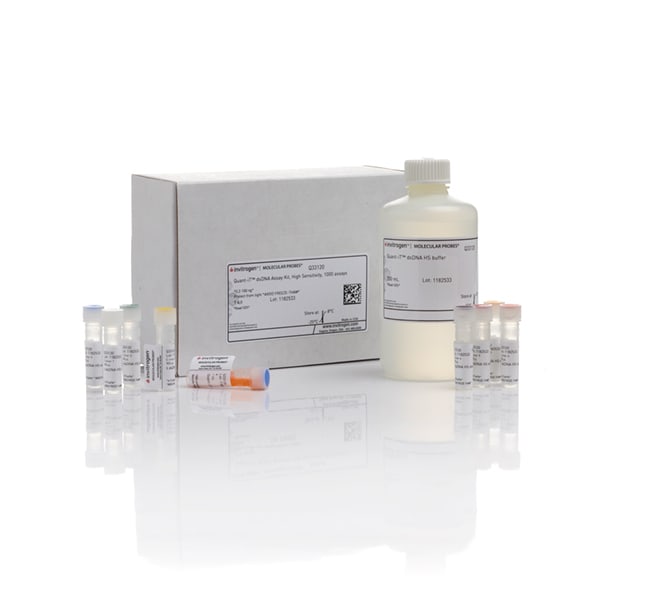
Quant-iT™ dsDNA Assay Kits, high sensitivity (HS) and broad range (BR)
RNAを介した二本鎖DNAの高選択的定量を目的として、高感度かつ幅広い定量用のQuant-iT dsDNAアッセイキットは、それぞれ0.2∼100 ngおよび2∼1,000 ngのDNA範囲で直線的な蛍光シグナルを生成します。


製品番号(カタログ番号) Q33120
価格(JPY)
144,400
Each
アッセイ:
dsDNA定量、高感度
定量範囲:
0.2∼100 ng
Quant-iT dsDNAアッセイキットを使用すると、dsDNA定量を簡単かつ迅速に実行できます。Quant-iT High-Sensitivity dsDNA Assay KitおよびQuant-iT Broad-Range dsDNA Assay Kitには、濃縮アッセイ試薬、希釈バッファー、および希釈済みDNA標準液が含まれます。これらのDNAアッセイキットは、RNAを介したニ本鎖DNAに対して高い選択性を有し、0.2∼100 ng DNA(HS dsDNA Assay Kit用)および2∼1,000 ng DNA(BR dsDNA Assay Kit用)の範囲において蛍光シグナルは線形です。
Quant-iT dsDNA High-Sensitivity Assay KitおよびQuant-iT dsDNA Broad Range Assay Kitを使用すると、DNA定量を簡単かつ正確に行うことができます。キットには、濃縮アッセイ試薬、希釈バッファー、および希釈済みDNA標準液が含まれています。試薬を1:200で希釈し、200 μLをマイクロプレートのウェルに重点します。1~20 μLのサンプルを加えて混合し、蛍光を読み取ります。
このアッセイは、RNAよりも二本鎖DNAに対して高い選択性を有し、HSアッセイでは0.2~100 ng、BRアッセイでは2~1,000 ngの範囲において蛍光シグナルはDNAで線形となります。サンプル調製から測定まで室温で行うことができ、シグナルは3時間安定しています。これらのアッセイでは、塩、溶媒、界面活性剤、タンパク質などの一般的な汚染物質は十分に耐性があります。
このアッセイは、RNAよりも二本鎖DNAに対して高い選択性を有し、HSアッセイでは0.2~100 ng、BRアッセイでは2~1,000 ngの範囲において蛍光シグナルはDNAで線形となります。サンプル調製から測定まで室温で行うことができ、シグナルは3時間安定しています。これらのアッセイでは、塩、溶媒、界面活性剤、タンパク質などの一般的な汚染物質は十分に耐性があります。
For Research Use Only. Not for use in diagnostic procedures.
仕様
アッセイdsDNA定量、高感度
使用対象 (装置)マイクロプレートリーダー
反応数1,000(200 μLアッセイ容量)
製品ラインQuant-iT
定量範囲0.2∼100 ng
数量1 kit
出荷条件室温
検出法蛍光
Unit SizeEach
よくあるご質問(FAQ)
Why am I getting negative fluorescence values with my Qubit Assays?
I have a Quant-iT DNA Kit and want to use it for the Qubit Fluorometer. Can I?
What is the useful pH range for Quant-iT DNA kits?
I'm trying to quantify some DNA labeled with a fluorophore. Will this work?
Does DNA length have an effect on the dsDNA assays?
引用および参考文献 (32)
引用および参考文献
Abstract
Natural transformation of Myxococcus xanthus.
Journal:J Bacteriol
PubMed ID:21378184
'Myxococcus xanthus belongs to the delta class of the proteobacteria and is notable for its complex life-style with social behaviors and relatively large genome. Although previous observations have suggested the existence of horizontal gene transfer in M. xanthus, its ability to take up exogenous DNA via natural transformation has not
Gastroenteritis outbreak caused by waterborne norovirus at a New Zealand ski resort.
Journal:Appl Environ Microbiol
PubMed ID:17965205
'In July 2006, public health services investigated an outbreak of acute gastroenteritis among staff and visitors of a popular ski resort in southern New Zealand. The source of the outbreak was a drinking water supply contaminated by human sewage. The virological component of the investigation played a major role in
Expression/localization patterns of sirtuins (SIRT1, SIRT2, and SIRT7) during progression of cervical cancer and effects of sirtuin inhibitors on growth of cervical cancer cells.
Journal:
PubMed ID:25794641
'Sirtuins belong to the family of class III histone deacetylases; its role in neoplasia is controversial as both tumor-suppressive and promoting functions have been reported. There are very few reports available, where expressions of sirtuin isoforms are comprehensively analyzed during neoplasia. Therefore, in the present study, the expression of SIRT1,
The altered landscape of the human skin microbiome in patients with primary immunodeficiencies.
Journal:
PubMed ID:24170601
'While landmark studies have shown that microbiota activate and educate host immunity, how immune systems shape microbiomes and contribute to disease is incompletely characterized. Primary immunodeficiency (PID) patients suffer recurrent microbial infections, providing a unique opportunity to address this issue. To investigate the potential influence of host immunity on the
Effect of the metabolic environment at key stages of follicle development in cattle: focus on steroid biosynthesis.
Journal:Physiol Genomics
PubMed ID:22414914
'Cellular mechanisms that contribute to low estradiol concentrations produced by the preovulatory ovarian follicle in cattle with a compromised metabolic status are largely unknown. To gain insight into the main metabolic mechanisms affecting preovulatory follicle function, two different animal models were used. Experiment 1 compared Holstein-Friesian nonlactating heifers (n =