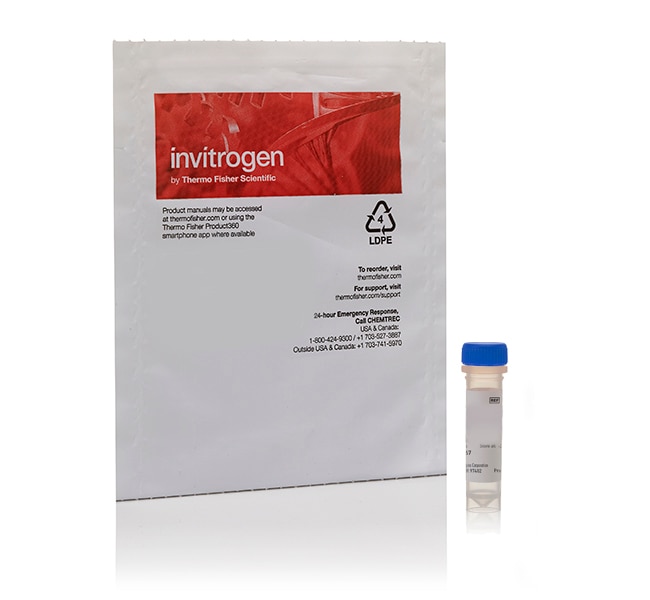
SYTO™ 84 Orange Fluorescent Nucleic Acid Stain - 5 mM Solution in DMSO
Invitrogen™

SYTO™ 84 Orange Fluorescent Nucleic Acid Stain - 5 mM Solution in DMSO

細胞透過性SYTO84オレンジ蛍光核酸染色剤は、核酸に結合すると明るいオレンジ色の蛍光を示します。生細胞におけるSYTO色素の染色パターンは細胞タイプによって異なる可能性があるため、当社ではSYTOオレンジ色の蛍光核酸染色サンプラーキット(S-11360)を提供しており、研究者はシステムに最適なオレンジ蛍光SYTO染色を見つけることができます詳細を見る
製品番号(カタログ番号)数量
S11365250 μL
製品番号(カタログ番号) S11365
価格(JPY)
44,400
キャンペーン価格
Ends: 27-Mar-2026
74,100
割引額 29,700 (40%)
Each
お問い合わせください ›
数量:
250 μL
細胞透過性SYTO84オレンジ蛍光核酸染色剤は、核酸に結合すると明るいオレンジ色の蛍光を示します。生細胞におけるSYTO色素の染色パターンは細胞タイプによって異なる可能性があるため、当社ではSYTOオレンジ色の蛍光核酸染色サンプラーキット(S-11360)を提供しており、研究者はシステムに最適なオレンジ蛍光SYTO染色を見つけることができます。
研究用にのみ使用できます。診断用には使用いただけません。
仕様
オレンジ
概要SYTO™ 84 Orange Fluorescent Nucleic Acid Stain - 5 mM Solution in DMSO
検出法蛍光
染色剤タイプ細胞透過性
発光582 nm
励起波長域567⁄582
使用対象 (装置)蛍光顕微鏡
製品ラインSYTO
数量250 μL
出荷条件室温
容量(メートル法)250 μL
標識タイプFluorescent Dye
製品タイプ核酸染色
SubCellular Localization核酸
Unit SizeEach
組成および保存条件
フリーザー(-5℃~-30℃)に保存し、遮光してください。

よくあるご質問(FAQ)

How do SYTO dyes bind to DNA?

The binding mode of SYTO nucleic acid stains is unknown. However, the behavior of these and related nucleic acid dyes suggests the following binding properties:

1.They appear to contact the solvent (suggested by sensitivity to salt, divalent cations, and in particular, SDS) and thus are likely to have contacts in the grooves.
2.All SYTO dyes appear to show some base selectivity and are thus likely to have minor groove contacts.
3.They can be removed from nucleic acid via ethanol precipitation; this characteristic is not shared by ethidium bromide and other intercalators. Likewise, the dyes are not removed from nucleic acid via butanol or chloroform extraction. These extraction methods do remove ethidium bromide from nucleic acid. 4. SYTO binding is not affected by nonionic detergents.
5. SYTO dyes are not quenched by BrdU, so they do not bind nucleic acids in precisely the same way as Hoechst 33342 and DAPI ((4′,6-diamidino-2-phenylindole).

SYBR Green I has shown little mutagenicity on frameshift indicator strains, indicating that it isn't likely to strongly intercalate.

Find additional tips, troubleshooting help, and resources within our Cell Analysis Support Center.

引用および参考文献 (1)

引用および参考文献
Abstract
Multiparameter assessments to determine the effects of sugars and antimicrobials on a polymicrobial oral biofilm.
Authors:Yang Y, Sreenivasan PK, Subramanyam R, Cummins D,
Journal:Appl Environ Microbiol
PubMed ID:17021225
Clinical studies indicate relationships between dental plaque, a naturally formed biofilm, and oral diseases. The crucial role of nonmicrobial biofilm constituents in maintaining biofilm structure and biofilm-specific attributes, such as resistance to shear and viscoelasticity, is increasingly recognized. Concurrent analyses of the diverse nonmicrobial biofilm components for multiparameter assessments formed ... More