Search


Citations & References (41)
Invitrogen™
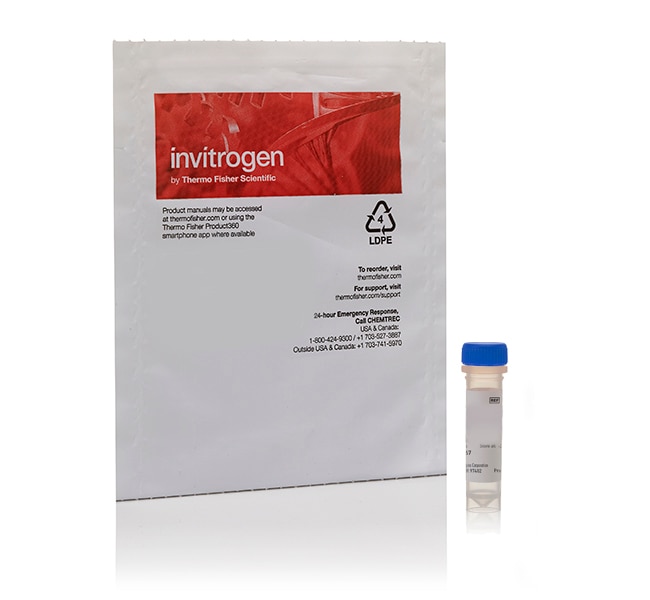
SYTOX™ Orange Nucleic Acid Stain - 5 mM Solution in DMSO
SYTOXオレンジ色素は、膜が損傷した細胞の核酸を染色します。この染色剤1304は細胞死のインジケーターとして有用で、ヨウ化物プロピジウム(P-1304)よりもはるかに明るくなっています。詳細を見る
| 製品番号(カタログ番号) | 数量 |
|---|---|
| S11368 | 250 μL |
製品番号(カタログ番号) S11368
価格(JPY)
77,000
Each
数量:
250 μL
SYTOXオレンジ色素は、膜が損傷した細胞の核酸を染色します。この染色剤1304は細胞死のインジケーターとして有用で、ヨウ化物プロピジウム(P-1304)よりもはるかに明るくなっています。
研究用にのみ使用できます。診断用には使用いただけません。
仕様
色Orange
検出法蛍光
染色剤タイプ細胞透過性
発光570 nm
励起波長域547⁄570
使用対象 (装置)フローサイトメーター
形状溶液
フォーマットチューブ
製品ラインSYTOX
数量250 μL
出荷条件室温
容量(メートル法)250 μL
標識タイプFluorescent Dye
製品タイプ核酸染色
Sub Cellular Localization核、核酸
Unit SizeEach
組成および保存条件
SYTOXオレンジ核酸染色液(DMSO中の5 mM溶液)のバイアルが1つ含まれています。
フリーザー(-5∼-30°C)で保管、乾燥した状態で、光から保護してください。
フリーザー(-5∼-30°C)で保管、乾燥した状態で、光から保護してください。
よくあるご質問(FAQ)
How do SYTO dyes bind to DNA?
引用および参考文献 (41)
引用および参考文献
Abstract
Nucleosomes are exposed at the cell surface in apoptosis.
Journal:J Immunol
PubMed ID:15153485
'Apoptotic cells are considered the source of DNA, histones, and nucleoprotein complexes that drive the production of autoantibodies in systemic lupus erythematosus. However, the role of apoptotic cells in the activation of the immune system is not clear. To explore interactions that may initiate or sustain the production of anti-nuclear
Peroxisome proliferator-activated receptor gamma-mediated regulation of neural stem cell proliferation and differentiation.
Journal:J Biol Chem
PubMed ID:16524877
'Peroxisome proliferator-activated receptor gamma (PPARgamma) plays an important role in insulin sensitivity, tissue homeostasis, and regulating cellular functions. We found high-level expression of PPARgamma in embryo mouse brain and neural stem cells (NSCs), in contrast to extremely low levels in adult mouse brain. Here, we show that PPARgamma mediates the
Diverse microglial motility behaviors during clearance of dead cells in hippocampal slices.
Journal:Glia
PubMed ID:15042586
'We used two-channel three-dimensional time-lapse fluorescence confocal imaging in live rat hippocampal slice cultures (1-7 days in vitro) to determine the motility behaviors of activated microglia as they engage dead and dying cells following traumatic brain tissue injury. Live microglia were labeled with a fluorescently conjugated lectin (IB(4)), and dead
Probing the kinetics of SYTOX Orange stain binding to double-stranded DNA with implications for DNA analysis.
Journal:Anal Chem
PubMed ID:15924389
'Rapid binding kinetics of SYTOX Orange stain with double-stranded DNA (dsDNA) was revealed on the DNA fragment sizing flow cytometer. We demonstrated for the first time that the dye molecules could be adsorbed onto the capillary surface and native DNA fragments can be dynamically stained while passing through the capillary.
Droplet microfluidic technology for single-cell high-throughput screening.
Journal:Proc Natl Acad Sci U S A
PubMed ID:19617544
'We present a droplet-based microfluidic technology that enables high-throughput screening of single mammalian cells. This integrated platform allows for the encapsulation of single cells and reagents in independent aqueous microdroplets (1 pL to 10 nL volumes) dispersed in an immiscible carrier oil and enables the digital manipulation of these reactors