Search



Citations & References (10)
Invitrogen™
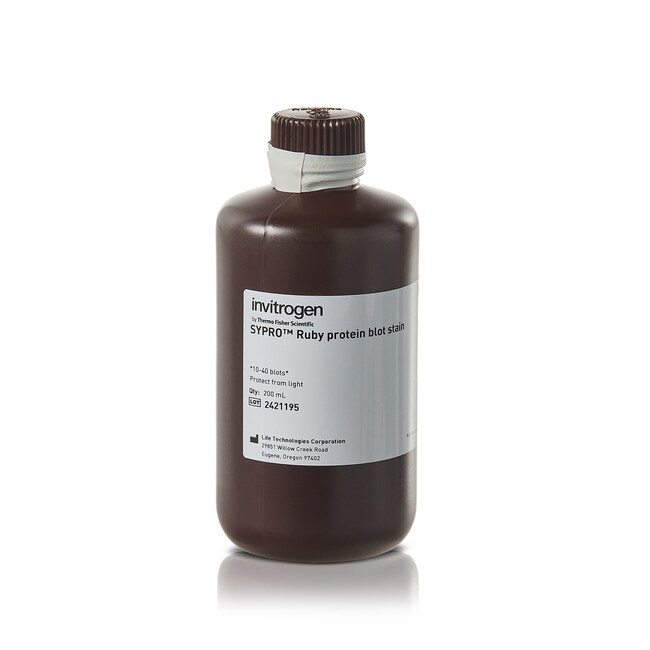
SYPRO™ Ruby Protein Blot Stain
SYPRO ルビータンパク質ブロット染色剤は、ニトロセルロース膜または PVDF 膜上のタンパク質用の高感度ですぐに使用できる蛍光染色剤で、ブロットへのタンパク質の転写効率を評価し、レーンが均等にロードされているかどうかを簡単に判断できます。免疫染色(ウェスタンブロッティング)詳細を見る
| 製品番号(カタログ番号) | 数量 |
|---|---|
| S11791 | 200 mL |
製品番号(カタログ番号) S11791
価格(JPY)
40,600
Online offer
Ends: 25-Dec-2026
58,000割引額 17,400 (30%)
Each
数量:
200 mL
SYPRO ルビータンパク質ブロット染色剤は、ニトロセルロース膜または PVDF 膜上のタンパク質用の高感度ですぐに使用できる蛍光染色剤で、ブロットへのタンパク質の転写効率を評価し、レーンが均等にロードされているかどうかを簡単に判断できます。免疫染色(ウェスタンブロッティング)、マイクロシーケンシング、および質量分析に対応しています。染色したタンパク質は、青色 LED または UV トランスイルミネーター、または適切なフィルターやレーザーを備えたイメージング装置で確認できます。
すべての蛍光染色を比較 ›
すべての蛍光染色を比較 ›
研究用にのみ使用できます。診断用には使用いただけません。
仕様
検出位置インブロット検出
検出法蛍光
数量200 mL
出荷条件室温
標的分子タンパク質
標識または色素SYPRO ルビー
製品ラインSYPRO
製品タイプタンパク質ブロット染色
Unit SizeEach
組成および保存条件
室温で保存し、光から保護します。
よくあるご質問(FAQ)
I have stained my blot with Pro-Q Diamond Phosphoprotein Blot Stain. Can I also stain the blot with SYPRO Ruby Blot Stain for total protein detection?
引用および参考文献 (10)
引用および参考文献
Abstract
Laser capture microdissection and protein microarray analysis of human non-small cell lung cancer: differential epidermal growth factor receptor (EGPR) phosphorylation events associated with mutated EGFR compared with wild type.
Journal:Mol Cell Proteomics
PubMed ID:18687633
'Little is known about lung carcinoma epidermal growth factor (EGF) kinase pathway signaling within the context of the tissue microenvironment. We quantitatively profiled the phosphorylation and abundance of signal pathway proteins relevant to the EGF receptor within laser capture microdissected untreated, human non-small cell lung cancer (NSCLC) (n = 25)
Novel observations of Thiobacterium, a sulfur-storing Gammaproteobacterium producing gelatinous mats.
Journal:ISME J
PubMed ID:20220790
The genus Thiobacterium includes uncultivated rod-shaped microbes containing several spherical grains of elemental sulfur and forming conspicuous gelatinous mats. Owing to the fragility of mats and cells, their 16S ribosomal RNA genes have not been phylogenetically classified. This study examined the occurrence of Thiobacterium mats in three different sulfidic marine
Herp, a new ubiquitin-like membrane protein induced by endoplasmic reticulum stress.
Journal:J Biol Chem
PubMed ID:10922362
Hyperhomocysteinemia, a risk factor for vascular disease, injures endothelial cells through undefined mechanisms. We previously identified several homocysteine-responsive genes in cultured human vascular endothelial cells, including the endoplasmic reticulum (ER)-resident molecular chaperone GRP78/BiP. Here, we demonstrate that homocysteine induces the ER stress response and leads to the expression of a
TrkB has a cell-autonomous role in the establishment of hippocampal Schaffer collateral synapses.
Journal:J Neurosci
PubMed ID:15829629
Neurotrophin signaling has been implicated in the processes of synapse formation and plasticity. To gain additional insight into the mechanism of BDNF and TrkB influence on synapse formation and synaptic plasticity, we generated a conditional knock-out for TrkB using the cre/loxp system. Using three different cre-expressing transgenic mice, three unique
A thousand points of light: the application of fluorescence detection technologies to two-dimensional gel electrophoresis and proteomics.
Journal:Electrophoresis
PubMed ID:10786886
As proteomics evolves into a high-throughput technology for the study of global protein regulation, new demands are continually being placed upon protein visualization and quantitation methods. Chief among these are increased detection sensitivity, broad linear dynamic range and compatibility with modern methods of microchemical analyses. The limitations of conventional protein