Search


Citations & References (40)
Invitrogen™
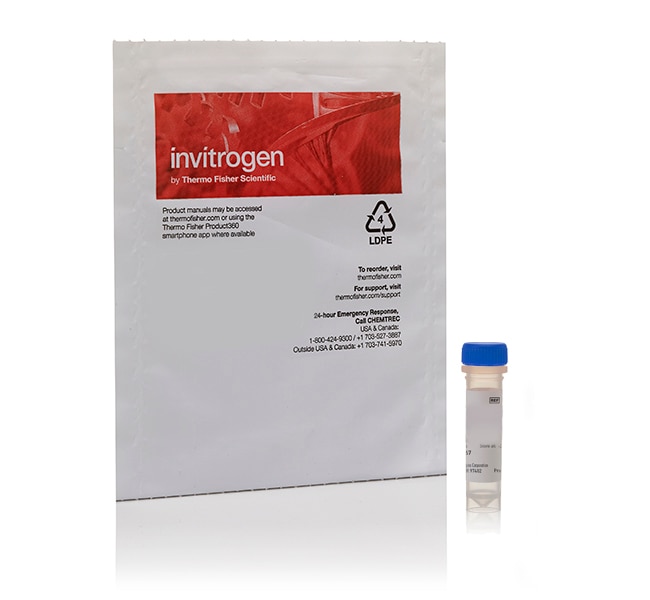
Streptavidin, Alexa Fluor™ 594 Conjugate
Alexa Fluor™ 594ストレプトアビジンは、蛍光標識(Alexa Fluor™色素)に共有結合しているビオチン結合タンパク質(ストレプトアビジン)で構成されています。ストレプトアビジンはビオチンとの結合親和性が非常に高く詳細を見る


製品番号(カタログ番号) S32356
価格(JPY)
62,600
Online offer
Ends: 25-Dec-2026
89,500割引額 26,900 (30%)
Each
数量:
0.5 mL
形状:
液体
Alexa Fluor™ 594ストレプトアビジンは、蛍光標識(Alexa Fluor™色素)に共有結合しているビオチン結合タンパク質(ストレプトアビジン)で構成されています。ストレプトアビジンはビオチンとの結合親和性が非常に高く、ストレプトアビジンのコンジュゲートは一般に、ビオチンのコンジュゲートと組み合わせてさまざまなタンパク質、タンパク質モチーフ、核酸、その他の分子の特異的検出に使用できます(たとえば、あるタンパク質標的に結合したビオチン化一次抗体を、蛍光標識したストレプトアビジンで検出できます)。これに類似した方法は、ウェスタンブロット、フローサイトメトリー、イメージングと顕微鏡検査、マイクロプレートアッセイなどの多くの検出プロトコルで使用されています。Alexa Fluor™色素ストレプトアビジンコンジュゲートは、1 mgの凍結乾燥製品または0.5 mLの2 mg/mL溶液で提供します。
Alexa Fluor™ 594 Streptavidin Conjugatesの重要な特長:
•Alexa Fluor™ 594 ストレプトアビジンコンジュゲートは、励起/発光極大 ∼ (590/617)にあります
• 明るく光安定性が高い蛍光
• 水溶液に高い溶解性
• 複数の色をご用意
• ウェスタンブロット、フローサイトメトリー、イメージングと顕微鏡検査、マイクロプレートアッセイなどに最適
Alexa Fluor™ 色素の特長
Alexa Fluor™ 色素は、イメージングや他の標識プロトコルの成績を向上させるために開発された有機蛍光色素です。光安定性および輝度 の向上、水溶液への溶解性の向上を示します。幅広い色で利用でき、ほとんどのイメージングアプリケーションに適しています。
内因性ビオチンのブロック
天然に存在するビオチンは、ビオチン-ストレプトアビジン検出スキームを妨げる可能性があります。固定および透過処理した細胞が必要な実験では、この干渉を最小限に抑えるために、当社の内因性ビオチンブロッキングキットをお試しください。
本製品は研究用試薬です。ヒトまたは動物の治療または診断用には使用できません。
関連リンク:
アビジン-ビオチン検出についての詳細はこちら
Alexa Fluor™色素についての詳細はこちら
他の標識Streptavidin Conjugateの詳細についてはこちら
分子プローブハンドブックのアビジンとストレプトアビジンのコンジュゲート-セクション7.6を読む
Alexa Fluor™ 594 Streptavidin Conjugatesの重要な特長:
•Alexa Fluor™ 594 ストレプトアビジンコンジュゲートは、励起/発光極大 ∼ (590/617)にあります
• 明るく光安定性が高い蛍光
• 水溶液に高い溶解性
• 複数の色をご用意
• ウェスタンブロット、フローサイトメトリー、イメージングと顕微鏡検査、マイクロプレートアッセイなどに最適
Alexa Fluor™ 色素の特長
Alexa Fluor™ 色素は、イメージングや他の標識プロトコルの成績を向上させるために開発された有機蛍光色素です。光安定性および輝度 の向上、水溶液への溶解性の向上を示します。幅広い色で利用でき、ほとんどのイメージングアプリケーションに適しています。
内因性ビオチンのブロック
天然に存在するビオチンは、ビオチン-ストレプトアビジン検出スキームを妨げる可能性があります。固定および透過処理した細胞が必要な実験では、この干渉を最小限に抑えるために、当社の内因性ビオチンブロッキングキットをお試しください。
本製品は研究用試薬です。ヒトまたは動物の治療または診断用には使用できません。
関連リンク:
アビジン-ビオチン検出についての詳細はこちら
Alexa Fluor™色素についての詳細はこちら
他の標識Streptavidin Conjugateの詳細についてはこちら
分子プローブハンドブックのアビジンとストレプトアビジンのコンジュゲート-セクション7.6を読む
研究用にのみ使用できます。診断用には使用いただけません。
仕様
濃度2 mg/mL
標識または色素Alexa Fluor色素
製品タイプストレプトアビジンコンジュゲート(蛍光)
数量0.5 mL
出荷条件湿氷
コンジュゲートAlexa Fluor 594
形状液体
製品ラインAlexa Fluor
Unit SizeEach
組成および保存条件
冷蔵庫(2∼8°C)に保存し、遮光。
よくあるご質問(FAQ)
I am planning to use a fluorescent streptavidin labeled conjugate. What are the storage conditions and shelf life for the lyophilized powder and reconstituted solution?
I am planning to use a fluorescent streptavidin labeled conjugate. How should I prepare the working solution of the conjugate?
引用および参考文献 (40)
引用および参考文献
Abstract
Avian flu: influenza virus receptors in the human airway.
Journal:Nature
PubMed ID:16554799
The membrane-bound histidine acid phosphatase TbMBAP1 is essential for endocytosis and membrane recycling in Trypanosoma brucei.
Journal:J Cell Sci
PubMed ID:15855239
'In the parasitic protozoan Trypanosoma brucei, endocytosis and exocytosis occur exclusively at an invagination of the plasma membrane around the base of the flagellum, called the flagellar pocket, which actively communicates by vesicular membrane flow with cisternal/tubulovesicular endosomes. The division of the cell surface into three morphologically distinct sub-domains and
Cyclin I protects podocytes from apoptosis.
Journal:J Biol Chem
PubMed ID:16847066
'The limited regenerative capacity of the glomerular podocyte following injury underlies the development of glomerulosclerosis and progressive renal failure in a diverse range of kidney diseases. We discovered that, in the kidney, cyclin I is uniquely expressed in the glomerular podocyte, and have constructed cyclin I knock-out mice to explore
Identification of nicotinic acetylcholine receptor recycling and its role in maintaining receptor density at the neuromuscular junction in vivo.
Journal:J Neurosci
PubMed ID:16251443
'In the CNS, receptor recycling is critical for synaptic plasticity; however, the recycling of receptors has never been observed at peripheral synapses. Using a novel imaging technique, we show here that nicotinic acetylcholine receptors (AChRs) recycle into the postsynaptic membrane of the neuromuscular junction. By sequentially labeling AChRs with biotin-bungarotoxin
Development of homogeneous binding assays based on fluorescence resonance energy transfer between quantum dots and Alexa Fluor fluorophores.
Journal:Anal Biochem
PubMed ID:16860286
'We studied the fluorescence resonance energy transfer (FRET) between quantum dots emitting at 565, 605, and 655 nm as energy donors and Alexa Fluor fluorophores with absorbance maxima at 594, 633, 647, and 680 nm as energy acceptors. As a first step, we prepared covalent conjugates between all three types