Search


Citations & References (22)
Invitrogen™
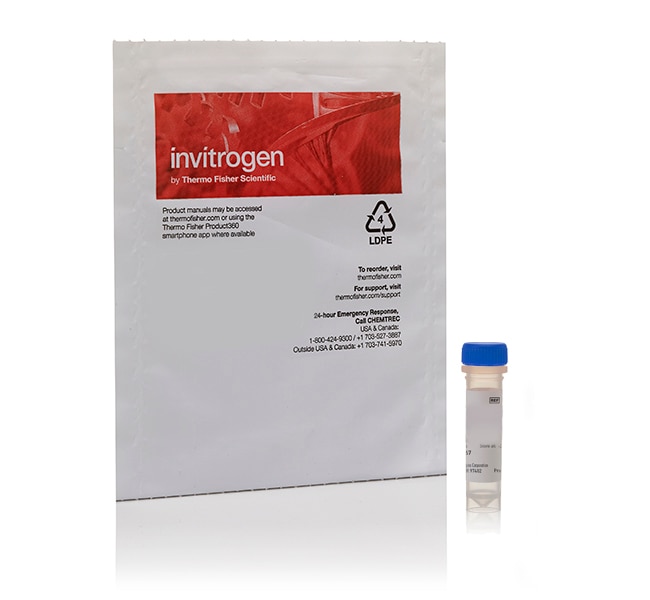
SYTO™ 17 Red Fluorescent Nucleic Acid Stain - 5 mM Solution in DMSO
蛍光顕微鏡での使用に適している
| 製品番号(カタログ番号) | 数量 |
|---|---|
| S7579 | 250 μL |
製品番号(カタログ番号) S7579
価格(JPY)
46,200
Exklusiv online
Ends: 25-Sep-2026
77,000割引額 30,800 (40%)
Each
数量:
250 μL
The cell-permeant SYTO 17 red fluorescent nucleic acid stain exhibits bright, red fluorescence upon binding to nucleic acids. Because the staining pattern of the SYTO dyes in live cells may vary between cell types, we offer the SYTO Red Fluorescent Nucleic Acid Stain Sampler Kit (Cat. No. S-11340) to enable researchers to find the most appropriate red-fluorescent SYTO stain for their system.
Any physiological buffer between pH 7.0–8.0, including PBS, can be used to dilute the SYTO dyes for the staining solution.
細胞透過型SYTO17赤色蛍光核酸染色剤は、核酸に結合すると明るく赤色の蛍光を示します。生細胞におけるSYTO色素の染色パターンは細胞タイプによって異なる場合があるため、当社はSYTO Red Fluorescent Nucleic Acid Stain Sampler Kit(カタログ番号S-11340)を提供しています。これを使用することで、研究者は使用している系に最適な赤色蛍光SYTO色素を見つけることができます。
研究用にのみ使用できます。診断用には使用いただけません。
仕様
色Red
概要SYTO™ 17 Red Fluorescent Nucleic Acid Stain - 5 mM Solution in DMSO
検出法蛍光
染色剤タイプ細胞透過性
発光634 nm
励起波長域621⁄634
使用対象 (装置)蛍光顕微鏡
製品ラインSYTO
数量250 μL
出荷条件室温
容量(メートル法)250 μL
標識タイプFluorescent Dye
製品タイプ核酸染色
Sub Cellular Localization核酸
Unit SizeEach
組成および保存条件
フリーザー(-5℃~-30℃)に保存し、遮光してください。
よくあるご質問(FAQ)
How do SYTO dyes bind to DNA?
引用および参考文献 (22)
引用および参考文献
Abstract
Multiparameter detection of apoptosis using red-excitable SYTO probes.
Journal:Cytometry A
PubMed ID:18431792
'Functional assays allowing phenotypic characterization of different cell death parameters at a single-cell level are important tools for preclinical anticancer drug screening. Currently, the selection of cytometric assays is limited by the availability of fluorescent probes with overlapping spectral characteristics. Following on our earlier reports on green and orange fluorescent
Liver fatty acid-binding protein colocalizes with peroxisome proliferator activated receptor alpha and enhances ligand distribution to nuclei of living cells.
Journal:Biochemistry
PubMed ID:14992586
'Although it is hypothesized that long-chain fatty acyl CoAs (LCFA-CoAs) and long-chain fatty acids (LCFAs) regulate transcription in the nucleus, little is known regarding factors that determine the distribution of these ligands to nuclei of living cells. Immunofluorescence colocalization showed that liver fatty acid-binding protein (L-FABP; binds LCFA-CoA as well
Confocal laser scanning microscopy of urinary bladder after intravesical instillation of a fluorescent dye.
Journal:Urology
PubMed ID:12837458
'OBJECTIVES: To assess the potential of confocal laser scanning microscopy for imaging of the urinary bladder after intravesical instillation of a fluorescent dye. METHODS: The study was performed on the bladder of male Copenhagen rats. For confocal fluorescence microscopy (CFM), a standard confocal laser scanning microscope (Zeiss LSM 410) was
Induction of DNA damage response by the supravital probes of nucleic acids.
Journal:Cytometry A
PubMed ID:19373929
'The aim of this study was to assess the potential DNA damage response (DDR) to four supravitally used biomarkers Hoechst 33342 (Ho 42), DRAQ5, DyeCycle Violet (DCV), and SYTO 17. A549 cells were exposed to these biomarkers at concentrations generally applied to live cells and their effect on histone H2AX
Fiber cell denucleation in the primate lens.
Journal:Invest Ophthalmol Vis Sci
PubMed ID:9286256
'PURPOSE: To determine the morphologic and biochemical events preceding the breakdown of fiber cell nuclei in the primate lens. METHODS: Monkey lens slices were labeled with fluorescent probes and optically sectioned using a confocal microscope. The distribution of nuclear histones was visualized by immunofluorescence. DNA and cellular membranes were imaged