Search


Citations & References (28)
Invitrogen™
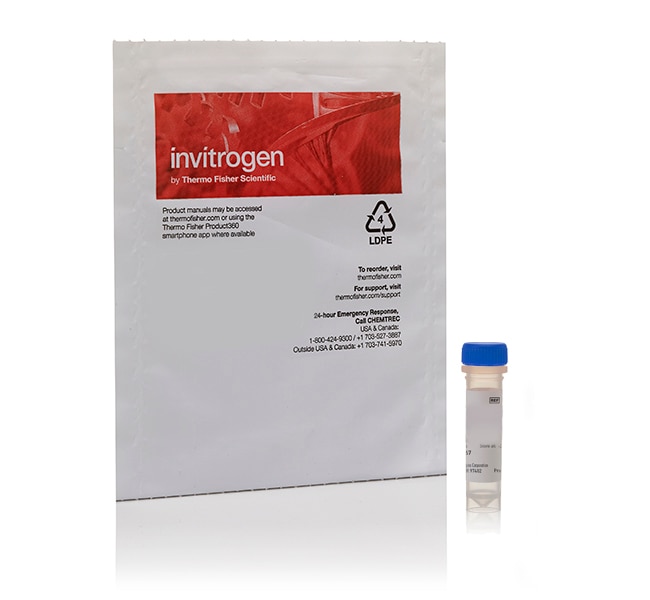
TetraSpeck™ Microspheres, 0.1 μm, fluorescent blue/green/orange/dark red
0.1 µm TetraSpeck™ミクロスフェアはすべて、4種類の蛍光色素(360/430nm(青)、505/515nm(緑)詳細を見る
| 製品番号(カタログ番号) | 数量 |
|---|---|
| T7279 | 0.5 mL |
製品番号(カタログ番号) T7279
価格(JPY)
78,400
0.5 mL
数量:
0.5 mL
0.1 µm TetraSpeck™ミクロスフェアはすべて、4種類の蛍光色素(360/430nm(青)、505/515nm(緑)、560/580nm(オレンジ)、660/680nm(ダークレッド))で染色され、それぞれが4つの適切に分離された励起ピークと発光ピークを表示するビーズを生じます。これらのミクロスフェアにより、特にマルチカラーでの使用について、科学的イメージングと商業的イメージングの両方に対し、従来の蛍光顕微鏡、共焦点レーザースキャン顕微鏡、関連する画像処理装置の校正を非常に容易に行うことができます。
当社の顕微鏡校正試薬の全コレクションを見る›
当社の顕微鏡校正試薬の全コレクションを見る›
研究用にのみ使用できます。診断用には使用いただけません。
仕様
校正タイプ共焦点顕微鏡キャリブレーション、蛍光顕微鏡キャリブレーション
フォーマット懸濁液ビーズ
製品ラインTetraSpeck
数量0.5 mL
出荷条件室温
色オレンジ、暗赤色、青、緑, Dark Red, Blue, Green
直径(メートル法)0.1 μm
製品タイプミクロスフェア
Unit Size0.5 mL
組成および保存条件
冷蔵庫(2℃~8℃)に保存し、遮光してください。
よくあるご質問(FAQ)
What are the excitation/emission peaks for TetraSpeck Microspheres?
The TetraSpeck Microspheres (Cat. Nos. T7279, T7280, T7281, T7283, T7284, T14792) are stained throughout with four different fluorescent dyes, yielding beads that each display four well-separated excitation/emission peaks at 360/430 nm (blue), 505/515 nm (green), 560/580 nm (orange) and 660/680 nm (dark red).
TetraSpeck Blue Dye Spectra
Fluorescence excitation and emission spectra of bead encapsulated TetraSpeck blue dye.

TetraSpeck Orange Dye Spectra

TetraSpeck Green Dye Spectra

TetraSpeck Dark Red Dye Spectra

Find additional tips, troubleshooting help, and resources within our Cell Analysis Support Center.
引用および参考文献 (28)
引用および参考文献
Abstract
Nuclear pore scaffold structure analyzed by super-resolution microscopy and particle averaging.
Journal:
PubMed ID:23845946
'Much of life''s essential molecular machinery consists of large protein assemblies that currently pose challenges for structure determination. A prominent example is the nuclear pore complex (NPC), for which the organization of its individual components remains unknown. By combining stochastic super-resolution microscopy, to directly resolve the ringlike structure of the
The cohesion protein ORD is required for homologue bias during meiotic recombination.
Journal:J Cell Biol
PubMed ID:15007062
'During meiosis, sister chromatid cohesion is required for normal levels of homologous recombination, although how cohesion regulates exchange is not understood. Null mutations in orientation disruptor (ord) ablate arm and centromeric cohesion during Drosophila meiosis and severely reduce homologous crossovers in mutant oocytes. We show that ORD protein localizes along
Exocytosis of IgG as mediated by the receptor, FcRn: an analysis at the single-molecule level.
Journal:Proc Natl Acad Sci U S A
PubMed ID:15258288
'IgG transport within and across cells is essential for effective humoral immunity. Through a combination of biochemical and in vivo analyses, the MHC class I-related neonatal Fc receptor (FcRn) is known to play a central role in delivering IgGs within and across cells. However, little is known about the molecular
Fast, three-dimensional super-resolution imaging of live cells.
Journal:Nat Methods
PubMed ID:21552254
'We report super-resolution fluorescence imaging of live cells with high spatiotemporal resolution using stochastic optical reconstruction microscopy (STORM). By labeling proteins either directly or via SNAP tags with photoswitchable dyes, we obtained two-dimensional (2D) and 3D super-resolution images of living cells, using clathrin-coated pits and the transferrin cargo as model
Practical confocal microscopy and the evaluation of system performance.
Journal:Methods
PubMed ID:10491274
'The laser scanning confocal microscope has enormous potential in many fields of biology. Currently there is a subjective nature in the assessment of a confocal microscope''s performance by primarily evaluating the system with a specific test slide provided by the user''s laboratory. To achieve better performance from the equipment, it