Search


Citations & References (7)
Invitrogen™
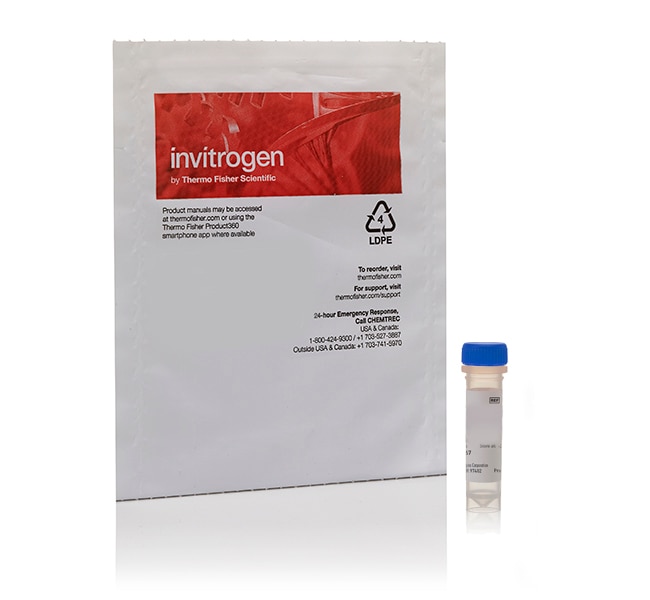
TransFluoSpheres™ Carboxylate-Modified Microspheres, 1.0 μm (488/645), 2% solids
ミクロスフェア(ラテックスビーズまたはラテックス粒子とも呼ばれる)は、ポリスチレンなどの非晶質ポリマーから形成されるコロイドサイズ範囲の球状粒子です。当社のMolecular Probes™ TransFluoSpheres™ビーズは、高品質で超清浄なポリスチレンを使用して製造されています。また、2つ詳細を見る
| 製品番号(カタログ番号) | 数量 |
|---|---|
| T8883 | 0.5 mL |
製品番号(カタログ番号) T8883
価格(JPY)
129,200
0.5 mL
数量:
0.5 mL
ミクロスフェア(ラテックスビーズまたはラテックス粒子とも呼ばれる)は、ポリスチレンなどの非晶質ポリマーから形成されるコロイドサイズ範囲の球状粒子です。当社のMolecular Probes™ TransFluoSpheres™ビーズは、高品質で超清浄なポリスチレンを使用して製造されています。また、2つ(またはそれ以上)の蛍光色素を充填することで、アルゴンイオンレーザーの488 nmまたは514 nmのスペクトル線で励起可能でありながら、それよりずっと長い波長で発光するミクロスフェアを生成しています。これによりマルチカラー実験が容易になり、広帯域励起および発光フィルターの使用が可能となります。TransFluoSpheres™ミクロスフェアは、蛍光顕微鏡に必要な強い照射で励起した場合でも、通常、光退色がほとんどまたは全く見られません。
TransFluoSpheres™ミクロスフェアの仕様:
•標識(Ex/Em):クリムゾン蛍光(488/645)
• 公称ビーズ直径:1.0 µm
• 結合表面:カルボン酸
• 固体:2%
カルボン酸結合表面の特性
カルボン酸修飾FluoSpheres™ビーズは、表面に高密度のペンダントカルボン酸を有しており、EDACなどの水溶性カルボジイミド試薬を使用したタンパク質およびその他のアミン含有生体分子の共有結合に適しています。
ミクロスフェアの主要アプリケーション:
• 機器のキャリブレーション(フローサイトメトリー、顕微鏡、HTS、HCS)
• 流量試験(マイクロ流体、血流、水流、および空気流量)
• 細胞生物学用トレーサー(細胞分化および細胞トレーシング)
• イムノアッセイ(凝集検査、ELISA、粒子捕捉、およびコントラスト試薬)
蛍光ミクロスフェアの選択肢
蛍光ミクロスフェア製品の全製品’として、以下のようなさまざまな種類の蛍光ビーズをご用意しています。
•10種類の蛍光色
• 10種類の公称ビーズ直径:0.02 µm、0.04 µm、0.1 µm、0.2 µm、0.5 µm、1.0 µm、2.0 µm、4.0 µm、10.0 µm、および15.0 µm
•タンパク質結合の4つの表面修飾:カルボキシル基、硫酸、アルデヒド硫酸、アミン
•ストレプトアビジン、ニュートラアビジン、ビオチン、ユーロピウム、およびプラチナと追加的に結合したミクロスフェア
未染色のミクロスフェアの選択肢
研究および商業アプリケーション用に、UltraClean™浄界面活性剤フリーミクロスフェアを多数ご用意しています。
ミクロスフェア製品をご注文に応じてお作りします。
ご要望に応じてカスタムオーダーでご用意いたします。当社のカスタム結合サービスは効率的かつ機密性が確保され、品質が保証されています。当社はISO 9001:2000の認証を取得済みです。
研究用途にのみ使用できます。動物またはヒトの治療または診断用途には使用できません。
TransFluoSpheres™ミクロスフェアの仕様:
•標識(Ex/Em):クリムゾン蛍光(488/645)
• 公称ビーズ直径:1.0 µm
• 結合表面:カルボン酸
• 固体:2%
カルボン酸結合表面の特性
カルボン酸修飾FluoSpheres™ビーズは、表面に高密度のペンダントカルボン酸を有しており、EDACなどの水溶性カルボジイミド試薬を使用したタンパク質およびその他のアミン含有生体分子の共有結合に適しています。
ミクロスフェアの主要アプリケーション:
• 機器のキャリブレーション(フローサイトメトリー、顕微鏡、HTS、HCS)
• 流量試験(マイクロ流体、血流、水流、および空気流量)
• 細胞生物学用トレーサー(細胞分化および細胞トレーシング)
• イムノアッセイ(凝集検査、ELISA、粒子捕捉、およびコントラスト試薬)
蛍光ミクロスフェアの選択肢
蛍光ミクロスフェア製品の全製品’として、以下のようなさまざまな種類の蛍光ビーズをご用意しています。
•10種類の蛍光色
• 10種類の公称ビーズ直径:0.02 µm、0.04 µm、0.1 µm、0.2 µm、0.5 µm、1.0 µm、2.0 µm、4.0 µm、10.0 µm、および15.0 µm
•タンパク質結合の4つの表面修飾:カルボキシル基、硫酸、アルデヒド硫酸、アミン
•ストレプトアビジン、ニュートラアビジン、ビオチン、ユーロピウム、およびプラチナと追加的に結合したミクロスフェア
未染色のミクロスフェアの選択肢
研究および商業アプリケーション用に、UltraClean™浄界面活性剤フリーミクロスフェアを多数ご用意しています。
ミクロスフェア製品をご注文に応じてお作りします。
ご要望に応じてカスタムオーダーでご用意いたします。当社のカスタム結合サービスは効率的かつ機密性が確保され、品質が保証されています。当社はISO 9001:2000の認証を取得済みです。
研究用途にのみ使用できます。動物またはヒトの治療または診断用途には使用できません。
研究用にのみ使用できます。診断用には使用いただけません。
仕様
製品ラインTransFluoSpheres
数量0.5 mL
出荷条件室温
表面修飾カルボン酸塩
色クリムゾン
直径(メートル法)1 μm
材料ポリスチレン
製品タイプカルボン酸修飾ミクロスフェア
Unit Size0.5 mL
組成および保存条件
冷蔵庫(2∼8°C)に保存し、遮光。
よくあるご質問(FAQ)
What is the warranty for FluoSpheres microspheres?
After washing and centrifugation, there was only a very small pellet left of my microsphere beads and the solution was transparent. Why is this?
I've had my microspheres for over a year, and I'm wondering if they're still good to use. What are some good ways to check their functionality?
I accidentally froze my microspheres; can I still use them?
My protein-coated microspheres appear to be non-specifically binding in my experimental system. Do you have a product that can help reduce these non-specific interactions?
引用および参考文献 (7)
引用および参考文献
Abstract
A single amino acid in the cytoplasmic domain of the beta 2 integrin lymphocyte function-associated antigen-1 regulates avidity-dependent inside-out signaling.
Journal:J Biol Chem
PubMed ID:11134023
'The leukocyte-specific beta(2) integrin lymphocyte function-associated antigen-1 (LFA-1) (alpha(L)/beta(2)) mediates activation-dependent adhesion to intercellular adhesion molecule (ICAM)-1. In leukocytes, LFA-1 requires activation by intracellular messengers to bind ICAM-1. We observed malfunctioning of LFA-1 activation in leukemic T cells and K562-transfected cells. This defective inside-out integrin activation is only restricted to
DC-SIGN-ICAM-2 interaction mediates dendritic cell trafficking.
Journal:Nat Immunol
PubMed ID:11017109
'Dendritic cells (DCs) are recruited from blood into tissues to patrol for foreign antigens. After antigen uptake and processing, DCs migrate to the secondary lymphoid organs to initiate immune responses. We now show that DC-SIGN, a DC-specific C-type lectin, supports tethering and rolling of DC-SIGN-positive cells on the vascular ligand
Comparison of methods for monitoring bacterial transport in the subsurface.
Journal:J Microbiol Methods
PubMed ID:11576686
'The purpose of this study was to compare in a laboratory experiment, a suite of methods developed to track viable bacteria during field transport experiments. The criteria for development and selection of these methods included: (1) the ability to track bacteria within the environment from which they were isolated; (2)
Identification of DC-SIGN, a novel dendritic cell-specific ICAM-3 receptor that supports primary immune responses.
Journal:Cell
PubMed ID:10721994
Contact between dendritic cells (DC) and resting T cells is essential to initiate a primary immune response. Here, we demonstrate that ICAM-3 expressed by resting T cells is important in this first contact with DC. We discovered that instead of the common ICAM-3 receptors LFA-1 and alphaDbeta2, a novel DC-specific
DC-SIGN, a dendritic cell-specific HIV-1-binding protein that enhances trans-infection of T cells.
Journal:Cell
PubMed ID:10721995
Dendritic cells (DC) capture microorganisms that enter peripheral mucosal tissues and then migrate to secondary lymphoid organs, where they present these in antigenic form to resting T cells and thus initiate adaptive immune responses. Here, we describe the properties of a DC-specific C-type lectin, DC-SIGN, that is highly expressed on