Search


Citations & References (8)
Invitrogen™
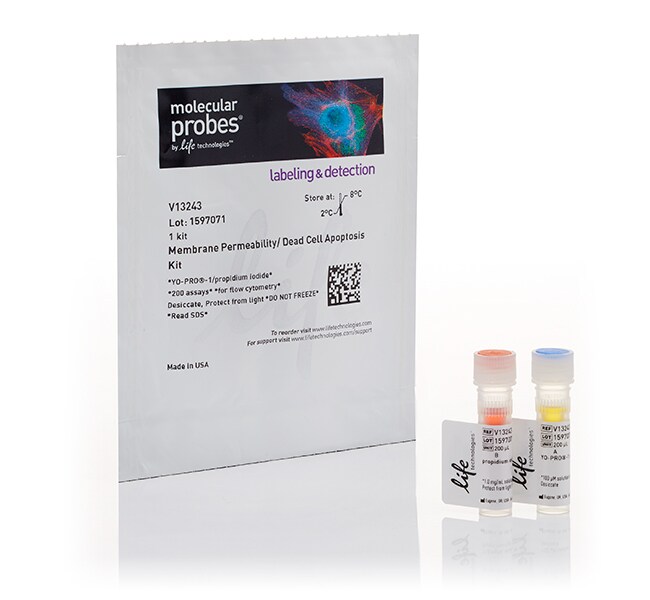
Vybrant™ Apoptosis Assay Kits for apoptotic and necrotic cell staining
アポトーシスおよび壊死細胞染色用のYO-PRO-1やHoechst 33342などの色素を付属するVybrant Apoptosis Assay Kitを使用することで、アポトーシスにある細胞を容易に識別できます。


製品番号(カタログ番号) V13243
価格(JPY)
74,100
200 assays
標識または色素:
YO-PRO-1、ヨウ化プロピジウム
概要:
Vybrant Apoptosis Assay Kit #4
アポトーシス細胞は、細胞膜透過性やクロマチン凝縮の変化など複数の生理学的過程を経ており、アポトーシス細胞および壊死細胞染色プロトコルにおいて異なる色素を使用することでその識別が可能となります。Vybrant Apoptosis Assayキットには、ストレプトアビジンビオチン-アネキシンV、ヨウ化プロピジウム(PI)、YO-PRO-1、およびHoechst 33342色素が含まれており、アポトーシス細胞や壊死細胞から生細胞を識別することができます。これらの色素はフローサイトメトリーで視覚化が可能です。
Vybrant Apoptosis Assayキットは、アポトーシス細胞および壊死細胞を健常細胞から識別するための迅速かつ便利な細胞染色色素ベースの方法を採用しており、フローサイトメトリーで視覚化が可能です。
Vybrant Apoptosis Assay Kit #4は、細胞膜透過性に生じる変化によりアポトーシスを検出します。このキットには、すぐに使用できる溶液としてYO-PRO-1とヨウ化プロピジウム(PI)核酸染色剤の両方が含まれています。YO-PRO-1 染色剤は、アポトーシス細胞のプラズマ膜を選択的に通過し、アポトーシス細胞を中程度の緑色蛍光で標識します。壊死性細胞は、PIで蛍光レッドで染色されます。
Vybrant Apoptosis Assay Kit #5、またはChromatin Condensation/Dead Cell Apoptosis Kit with Hoechst 33342 and PI for Flow Cytometryは、アポトーシス細胞におけるクロマチンのコンパクト状態の蛍光検出をベースにした迅速かつ便利なアポトーシス用アッセイとして使用できます。このキットには、すぐに使用できる溶液として、青色蛍光Hoechst 33342色素(アポトーシスを起こしていない細胞のクロマチンよりもアポトーシスを起こしている細胞の凝縮クロマチンを大幅に明るく染色する)のほか、赤色蛍光ヨウ化プロピジウム色素(死細胞を染色する)が含まれています。
Vybrant Apoptosis Assay Kit #6は、迅速かつ便利なアポトーシスアッセイであり、ストレプトアビジンの明るい青色蛍光Alexa Fluor 350コンジュゲートをビオチン-XアネキシンVと組み合わせて使用し、フローサイトメトリーまたはイメージングによりアポトーシスを起こしている細胞集団を検出します。このほか、本キットには、すぐに使用できる溶液として蛍光赤色のPI核酸結合色素が含まれます。PIは生細胞やアポトーシス細胞には不要ですが、死細胞に対しては赤色蛍光で染色し、核酸にしっかりと結合します。このキットには、約50種類のフローサイトメトリーアッセイ用の試薬が十分に含まれています。
Vybrant Apoptosis Assay Kit #4は、細胞膜透過性に生じる変化によりアポトーシスを検出します。このキットには、すぐに使用できる溶液としてYO-PRO-1とヨウ化プロピジウム(PI)核酸染色剤の両方が含まれています。YO-PRO-1 染色剤は、アポトーシス細胞のプラズマ膜を選択的に通過し、アポトーシス細胞を中程度の緑色蛍光で標識します。壊死性細胞は、PIで蛍光レッドで染色されます。
Vybrant Apoptosis Assay Kit #5、またはChromatin Condensation/Dead Cell Apoptosis Kit with Hoechst 33342 and PI for Flow Cytometryは、アポトーシス細胞におけるクロマチンのコンパクト状態の蛍光検出をベースにした迅速かつ便利なアポトーシス用アッセイとして使用できます。このキットには、すぐに使用できる溶液として、青色蛍光Hoechst 33342色素(アポトーシスを起こしていない細胞のクロマチンよりもアポトーシスを起こしている細胞の凝縮クロマチンを大幅に明るく染色する)のほか、赤色蛍光ヨウ化プロピジウム色素(死細胞を染色する)が含まれています。
Vybrant Apoptosis Assay Kit #6は、迅速かつ便利なアポトーシスアッセイであり、ストレプトアビジンの明るい青色蛍光Alexa Fluor 350コンジュゲートをビオチン-XアネキシンVと組み合わせて使用し、フローサイトメトリーまたはイメージングによりアポトーシスを起こしている細胞集団を検出します。このほか、本キットには、すぐに使用できる溶液として蛍光赤色のPI核酸結合色素が含まれます。PIは生細胞やアポトーシス細胞には不要ですが、死細胞に対しては赤色蛍光で染色し、核酸にしっかりと結合します。このキットには、約50種類のフローサイトメトリーアッセイ用の試薬が十分に含まれています。
For Research Use Only. Not for use in diagnostic procedures.
仕様
色緑、赤
概要Vybrant Apoptosis Assay Kit #4
励起/発光YO-PRO-1:491/509
ヨウ化プロピジウム:535/617
ヨウ化プロピジウム:535/617
フローサイトメーターレーザーライン488
使用対象 (装置)フローサイトメーター
標識タイプその他の標識または色素
標識または色素YO-PRO-1、ヨウ化プロピジウム
製品ラインVybrant
製品タイプApoptosis Assay Kit
数量200 assays
出荷条件室温
検出法蛍光
フォーマットチューブ
Unit Size200 assays
組成および保存条件
YO-PRO-1を1バイアル、ヨウ化プロピジウムを1バイアル含みます。遮光し、冷蔵庫(2~8℃)に保存
よくあるご質問(FAQ)
What are the fluorescence excitation/emission maxima for the dyes in the Membrane Permeability/Dead Cell Apoptosis Kit with YO-PRO-1 and PI for Flow Cytometry aka Vybrant Apoptosis Assay Kit #4, YO-PRO-1/Propidium Iodide)?
What is the relative time-frame of apoptosis progression, and what products can I use to detect the different apoptotic events?
引用および参考文献 (8)
引用および参考文献
Abstract
Contribution of membrane localization to the apoptotic activity of PUMA.
Journal:Apoptosis
PubMed ID:17968660
'The BH3-only protein PUMA plays an important role in the activation of apoptosis in response to p53. In different studies, PUMA has been described to function by either directly activating the pro-apoptotic proteins Bax and Bak, or by neutralizing anti-apoptotic members of the Bcl2 family. We have examined the contribution
Release of hypoacetylated and trimethylated histone H4 is an epigenetic marker of early apoptosis.
Journal:J Biol Chem
PubMed ID:16531610
'Nuclear events such as chromatin condensation, DNA cleavage at internucleosomal sites, and histone release from chromatin are recognized as hallmarks of apoptosis. However, there is no complete understanding of the molecular events underlying these changes. It is likely that epigenetic changes such as DNA methylation and histone modifications that are
Chlorophenols and chlorocatechols induce apoptosis in human lymphocytes (in vitro).
Journal:Toxicol Lett
PubMed ID:19766705
In this work the effect of 2,4,5-trichlorophenol (2,4,5-TCP), pentachlorophenol (PCP), 4,6-dichloroguaiacol (4,6-DCG), tetrachloroguaiacol (TeCG), 4,5-dichlorocatechol (4,5-DCC) and tetrachlorocatechol (TeCC) on the induction of apoptosis in human peripheral blood lymphocytes was examined. The analysis of the changes in mitochondrial transmembrane potential (DeltaPsi(m)) was performed using JC-9 fluorescent probe. It was noted
Comparison of apoptosis and mortality measurements in peripheral blood mononuclear cells (PBMCs) using multiple methods.
Journal:Cell Prolif
PubMed ID:16202038
Death through apoptosis is the main process by which aged cells that have lost their function are eliminated. Apoptotic cells are usually detected microscopically by changes in their morphology. However, determination of early apoptotic events is important for in vitro (and ex vivo) studies. The main objective of the present
Relocalization of STIM1 for activation of store-operated Ca(2+) entry is determined by the depletion of subplasma membrane endoplasmic reticulum Ca(2+) store.
Journal:J Biol Chem
PubMed ID:17298947
STIM1 (stromal interacting molecule 1), an endoplasmic reticulum (ER) protein that controls store-operated Ca(2+) entry (SOCE), redistributes into punctae at the cell periphery after store depletion. This redistribution is suggested to have a causal role in activation of SOCE. However, whether peripheral STIM1 punctae that are involved in regulation of