Search


Citations & References (7)
Invitrogen™
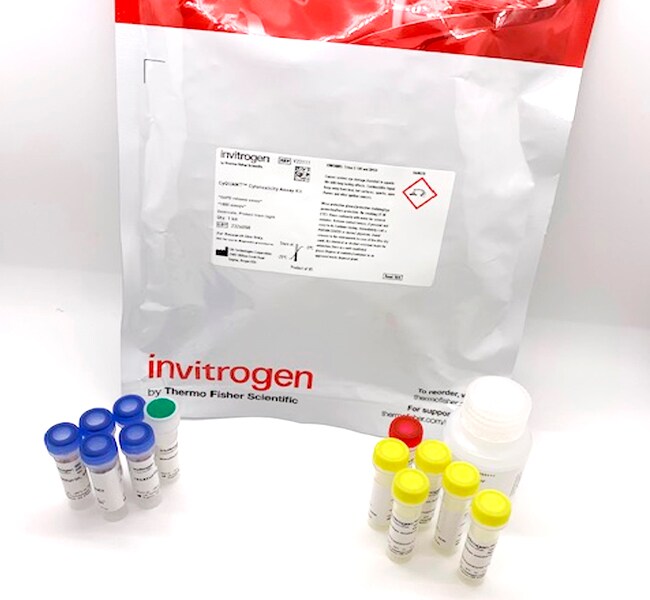
CyQUANT™ Cytotoxicity Assay Kit (G6PD Release Assay)
CyQUANT細胞毒性アッセイでは、グルコース6-リン酸脱水素酵素を周囲の培地に放出することで、損傷細胞および死につつある細胞を検出します。わずか500個の細胞を検出でき、LDHリリースアッセイよりも高感度です。このアッセイは、レサズリンを赤色蛍光レゾルフィンに還元する2ステップの酵素プロセスにより、グルコース6-リン酸脱水素酵素を検出します。得られた蛍光シグナルは、細胞培地中に放出されたグルコース6-リン酸脱水素酵素の量に比例し詳細を見る
| 製品番号(カタログ番号) | 数量 |
|---|---|
| V23111 | 1000 Assays |
製品番号(カタログ番号) V23111
価格(JPY)
109,700
1 kit
数量:
1000 Assays
CyQUANT細胞毒性アッセイでは、グルコース6-リン酸脱水素酵素を周囲の培地に放出することで、損傷細胞および死につつある細胞を検出します。わずか500個の細胞を検出でき、LDHリリースアッセイよりも高感度です。
このアッセイは、レサズリンを赤色蛍光レゾルフィンに還元する2ステップの酵素プロセスにより、グルコース6-リン酸脱水素酵素を検出します。得られた蛍光シグナルは、細胞培地中に放出されたグルコース6-リン酸脱水素酵素の量に比例し、放出量はサンプル中の死細胞の数と相関します。レゾルフィンの蛍光発光(ex/em 563/587 nm)は、ほとんどの生物学的サンプルの自家蛍光に勝ります。さらに、このアッセイのバックグラウンドシグナルは、乳酸脱水素酵素ベースのアッセイで一般的に観察されるものよりも低くなります。
このアッセイは、レサズリンを赤色蛍光レゾルフィンに還元する2ステップの酵素プロセスにより、グルコース6-リン酸脱水素酵素を検出します。得られた蛍光シグナルは、細胞培地中に放出されたグルコース6-リン酸脱水素酵素の量に比例し、放出量はサンプル中の死細胞の数と相関します。レゾルフィンの蛍光発光(ex/em 563/587 nm)は、ほとんどの生物学的サンプルの自家蛍光に勝ります。さらに、このアッセイのバックグラウンドシグナルは、乳酸脱水素酵素ベースのアッセイで一般的に観察されるものよりも低くなります。
研究用にのみ使用できます。診断用には使用いただけません。
仕様
細胞透過性Cell-impermeant
検出法Fluorescence
染色剤タイプResorufin
放射波長580 to 600 nm
励起波長530 to 560 nm
フォーマット96-ウェルプレート
数量1000 Assays
出荷条件室温
色Red
使用対象(アプリケーション)Cytotoxicity Assay
使用対象 (装置)マイクロプレートリーダー
製品ラインCyQUANT
製品タイプG6PD Release Cytotoxicity Assay
Unit Size1 kit
組成および保存条件
フリーザー(-5°C~-30°C)に保存し、遮光してください。
よくあるご質問(FAQ)
What are the fluorescence excitation/emission maxima for Resorufin that is generated in the Vybrant Cytotoxicity Assay Kit (G6PD Release Assay)?
How many assays can I perform using the CyQUANT Cytotoxicity Assay Kit (G6PD Release Assay) (Cat. No. V23111)?
Can I use flash-frozen supernatant from the cell culture for the CyQUANT Cytotoxicity Assay (Cat. No. V23111)?
引用および参考文献 (7)
引用および参考文献
Abstract
Use of cellular glucose-6-phosphate dehydrogenase for cell quantitation: applications in cytotoxicity and apoptosis assays.
Journal:Anal Biochem
PubMed ID:15136165
'A fluorescence-based microplate assay was developed to quantify cell death based upon the measurement of glucose-6-phosphate dehydrogenase (G6PD) activity. G6PD is a cytosolic enzyme and leaks from cells when plasma membrane integrity is compromised. In this assay, cell death is measured by correlating the activity of extracellular G6PD to the
Development of a comprehensive human immunodeficiency virus type 1 screening algorithm for discovery and preclinical testing of topical microbicides.
Journal:Antimicrob Agents Chemother
PubMed ID:18316528
'Topical microbicides are self-administered, prophylactic products for protection against sexually transmitted pathogens. A large number of compounds with known anti-human immunodeficiency virus type 1 (HIV-1) inhibitory activity have been proposed as candidate topical microbicides. To identify potential leads, an in vitro screening algorithm was developed to evaluate candidate microbicides in
In vivo imaging platform for tracking immunotherapeutic cells.
Journal:Nat Biotechnol
PubMed ID:16041364
Cellular therapeutics show great promise for the treatment of disease, but few noninvasive techniques exist for monitoring the cells after administration. Here we present a magnetic resonance imaging (MRI) technology that uses perfluoropolyether (PFPE) agents to track cells in vivo. Fluorine MRI selectively images only the labeled cells, and a
Kaposi's sarcoma-associated herpesvirus induces rapid release of angiopoietin-2 from endothelial cells.
Journal:J Virol
PubMed ID:23536671
Kaposi sarcoma-associated herpesvirus (KSHV) stimulates proliferation, angiogenesis, and inflammation to promote Kaposi sarcoma (KS) tumor growth, which involves various growth factors and cytokines. Previously, we found that KSHV infection of human umbilical vein endothelial cells (HUVECs) induces a transcriptional induction of the proangiogenic and proinflammatory cytokine angiopoietin-2 (Ang-2). Here, we
Extracellular DNA, Neutrophil Extracellular Traps, and Inflammasome Activation in Severe Asthma.
Journal:Am J Respir Crit Care Med
PubMed ID:30888839