Search


Citations & References (4)
Invitrogen™
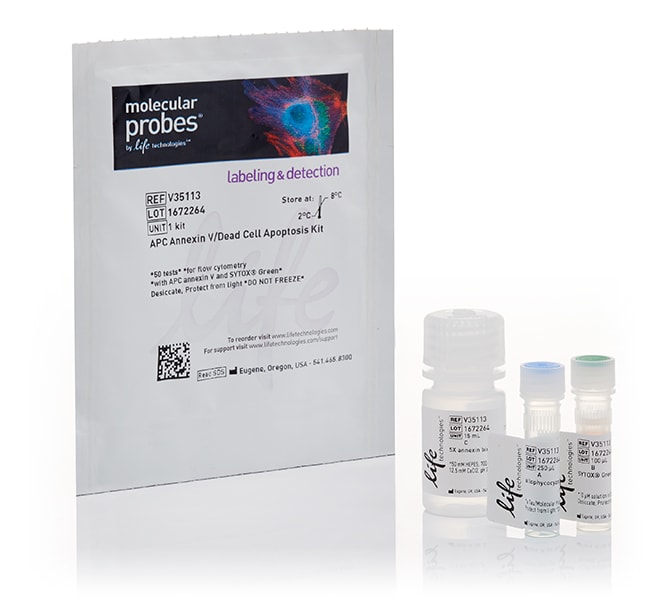
Dead Cell Apoptosis Kits with Annexin V for Flow Cytometry
Annexin VおよびAlexa Fluor 488、FITC、PI、PE、APC、SYTOX Greenなどのコンジュゲート蛍光色素を使用したDead Cell Apoptosisキットで細胞生存率を評価します。


製品番号(カタログ番号) V35113
価格(JPY)
200,400
1 kit
数量:
1 Kit
標識または色素:
SYTOX Green, APC
Alexa Fluor 488、FITC、ヨウ化プロピジウム、PE、APC、SYTOX GreenなどのAnnexin Vコンジュゲートを備えたDead Cell Apoptosisキットを使用すると、フローサイトメトリーにて生細胞、死細胞、アポトーシス細胞を簡単に識別できます。こうしたコンジュゲートは、生細胞、死細胞、またはアポトーシス細胞を異なる色素で識別するため、マルチパラメトリック解析を用いた細胞生存率およびアポトーシスの評価に不可欠です。
細胞生存率をアッセイするために、アネキシンVを用いたDead Cell Apoptosisキットをフローサイトメトリーで使用することには、いくつかの利点があります:
優れた輝度
タンパク質濃度や精製レベルが低い他のアネキシンVキットとは異なり、Annexin V Alexa Fluor 488コンジュゲートはフローサイトメトリー用に最適化されており、アポトーシスを起こしている細胞と生細胞の間を最大限に分離します。Alexa Fluor 488色素は、フルオレセイン(FITC)に類似したスペクトルを持つ優れたグリーン蛍光色素です。
高結合効率
アネキシンVコンジュゲートは、高純度のcys-アネキシンから作製されており、高い結合効率を実現し、アポトーシスプロセスの非常に高精度な特性評価を実現します。
マルチパラメーター
多くの出版物では、細胞がアポトーシスであることを特定するために、少なくとも2つの方法が必要です。このマルチパラメーターキットは、細胞膜の細胞質表面にあるホスファチジルセリン(PS)を検出するほか、ヨウ化プロピジウムを介して膜の完全性を評価します。
Dead Cell Apoptosis Kit with Annexin V Alexa Fluor 488 & PI
Dead Cell Apoptosis Kit with Annexin V Alexa Fluor 488 & Propidium Iodide(PI)(V13241, V13245)は、フローサイトメトリーでリンファチジルセリン(PS)の発現および膜透過性を検出することにより初期アポトーシスを測定するために使用されます。細胞をアネキシンVおよびヨウ化プロピジウムで染色する場合、PSを発現するアポトーシスを起こしている細胞は、FITCチャンネル、低レベルの赤色蛍光で検出可能な緑色蛍光を示します。死細胞または壊死細胞は明るい赤色蛍光を示し、緑色蛍光は示しませんが、生細胞は緑色蛍光も赤色蛍光も示しません。
Dead Cell Apoptosis Kit with Annexin V PE and SYTOX Green
Dead Cell Apoptosis Kit with Annexin V PE and SYTOX Greenは、オレンジ色の蛍光フィコビリプロテインR-PEに結合した組み換えアネキシンVを使用したフローサイトメトリーでアポトーシス細胞のPS外在化を検出し、死細胞はSYTOX Green核酸染色剤で検出します。両方のプローブで処理した後、アポトーシスを起こしている細胞はオレンジ色蛍光を示し、死細胞は緑色の蛍光を示し、生細胞は蛍光をほとんど示さないか、まったく示しません。これらの集団は、488 nmのレーザーフローサイトメーターを使用して、530/30 nmおよび585/42 nmのバンドパスフィルターで簡単に識別できます。
Dead Cell Apoptosis Kit with Annexin V APC and SYTOX Green
Dead Cell Apoptosis Kit with Annexin V APC and SYTOX Greenは、赤色レーザー励起アロフィコシアニンに結合した組み換えアネキシンVを用いて、フローサイトメトリー中のアポトーシス細胞におけるPSの外部化を検出し、SYTOX Green核酸染色剤を用いて死細胞を検出します。アポトーシス細胞は、外部化PSに結合するアネキシンVによって検出されます。生細胞は蛍光をほとんどまたはまったく示さず、アポトーシス細胞は赤色蛍光とごくわずかな緑色蛍光を示し、後期アポトーシス細胞は赤色とオレンジ色の蛍光をより高いレベルで示します。これらの集団は、633 nmと488 nmの励起源(アルゴンイオンレーザーとHeNeレーザー)の両方を備えたフローサイトメーターを使用して簡単に識別できます。
Dead Cell Apoptosis Kit with Annexin V FITC and PI
Dead Cell Apoptosis Kit with Annexin V FITC and PIは、緑色蛍光FITC色素に結合した組み換えアネキシンVを使用してアポトーシス細胞のPS外在化を検出し、PIを使用して死細胞を検出します。PIで染色する壊死性細胞は赤色蛍光を示します。両方のプローブで処理した後、アポトーシスを起こしている細胞は緑色蛍光を示し、死細胞は赤色と緑色の蛍光を示し、生細胞は蛍光をほとんど示さないか、まったく示しません。
優れた輝度
タンパク質濃度や精製レベルが低い他のアネキシンVキットとは異なり、Annexin V Alexa Fluor 488コンジュゲートはフローサイトメトリー用に最適化されており、アポトーシスを起こしている細胞と生細胞の間を最大限に分離します。Alexa Fluor 488色素は、フルオレセイン(FITC)に類似したスペクトルを持つ優れたグリーン蛍光色素です。
高結合効率
アネキシンVコンジュゲートは、高純度のcys-アネキシンから作製されており、高い結合効率を実現し、アポトーシスプロセスの非常に高精度な特性評価を実現します。
マルチパラメーター
多くの出版物では、細胞がアポトーシスであることを特定するために、少なくとも2つの方法が必要です。このマルチパラメーターキットは、細胞膜の細胞質表面にあるホスファチジルセリン(PS)を検出するほか、ヨウ化プロピジウムを介して膜の完全性を評価します。
Dead Cell Apoptosis Kit with Annexin V Alexa Fluor 488 & PI
Dead Cell Apoptosis Kit with Annexin V Alexa Fluor 488 & Propidium Iodide(PI)(V13241, V13245)は、フローサイトメトリーでリンファチジルセリン(PS)の発現および膜透過性を検出することにより初期アポトーシスを測定するために使用されます。細胞をアネキシンVおよびヨウ化プロピジウムで染色する場合、PSを発現するアポトーシスを起こしている細胞は、FITCチャンネル、低レベルの赤色蛍光で検出可能な緑色蛍光を示します。死細胞または壊死細胞は明るい赤色蛍光を示し、緑色蛍光は示しませんが、生細胞は緑色蛍光も赤色蛍光も示しません。
Dead Cell Apoptosis Kit with Annexin V PE and SYTOX Green
Dead Cell Apoptosis Kit with Annexin V PE and SYTOX Greenは、オレンジ色の蛍光フィコビリプロテインR-PEに結合した組み換えアネキシンVを使用したフローサイトメトリーでアポトーシス細胞のPS外在化を検出し、死細胞はSYTOX Green核酸染色剤で検出します。両方のプローブで処理した後、アポトーシスを起こしている細胞はオレンジ色蛍光を示し、死細胞は緑色の蛍光を示し、生細胞は蛍光をほとんど示さないか、まったく示しません。これらの集団は、488 nmのレーザーフローサイトメーターを使用して、530/30 nmおよび585/42 nmのバンドパスフィルターで簡単に識別できます。
Dead Cell Apoptosis Kit with Annexin V APC and SYTOX Green
Dead Cell Apoptosis Kit with Annexin V APC and SYTOX Greenは、赤色レーザー励起アロフィコシアニンに結合した組み換えアネキシンVを用いて、フローサイトメトリー中のアポトーシス細胞におけるPSの外部化を検出し、SYTOX Green核酸染色剤を用いて死細胞を検出します。アポトーシス細胞は、外部化PSに結合するアネキシンVによって検出されます。生細胞は蛍光をほとんどまたはまったく示さず、アポトーシス細胞は赤色蛍光とごくわずかな緑色蛍光を示し、後期アポトーシス細胞は赤色とオレンジ色の蛍光をより高いレベルで示します。これらの集団は、633 nmと488 nmの励起源(アルゴンイオンレーザーとHeNeレーザー)の両方を備えたフローサイトメーターを使用して簡単に識別できます。
Dead Cell Apoptosis Kit with Annexin V FITC and PI
Dead Cell Apoptosis Kit with Annexin V FITC and PIは、緑色蛍光FITC色素に結合した組み換えアネキシンVを使用してアポトーシス細胞のPS外在化を検出し、PIを使用して死細胞を検出します。PIで染色する壊死性細胞は赤色蛍光を示します。両方のプローブで処理した後、アポトーシスを起こしている細胞は緑色蛍光を示し、死細胞は赤色と緑色の蛍光を示し、生細胞は蛍光をほとんど示さないか、まったく示しません。
For Research Use Only. Not for use in diagnostic procedures.
仕様
概要フローサイトメトリー用Dead Cell Apoptosis Kit with Annexin V APC and SYTOX Green
励起/発光503、650/524、660
フローサイトメーターレーザーライン633/635、488
使用対象 (装置)蛍光顕微鏡、フローサイトメーター
標識または色素SYTOX Green, APC
反応数50
製品タイプアポトーシス検出キット
数量1 Kit
出荷条件湿氷
Unit Size1 kit
組成および保存条件
1バイアルのアネキシンV、APCコンジュゲート(250 μL)、1バイアルのSYTOXグリーン染色(100 μL)、および1ボトルのアネキシン結合バッファー(5倍の溶液、15 mL)を含みます。冷蔵庫(2℃~8℃)に保存し、遮光してください。
よくあるご質問(FAQ)
How do SYTO dyes bind to DNA?
When using Dead Cell Apoptosis Kits with Annexin V for Flow Cytometry, what does a PI+ only population (hence Annexin V negative) correspond to?
I trypsinized my adherent cells and labeled with annexin V, and now my flow data is showing a high percentage of apoptotic cells even for control, untreated cells. What is the problem?
Can I detect annexin V staining in an imaging assay?
When should I stain adherent cells with annexin V for flow cytometric analysis? Before or after I trypsinize them?
引用および参考文献 (4)
引用および参考文献
Abstract
Preclinical Evaluation of AMG 925, a FLT3/CDK4 Dual Kinase Inhibitor for Treating Acute Myeloid Leukemia.
Journal:
PubMed ID:24526162
'Acute myeloid leukemia (AML) remains a serious unmet medical need. Despite high remission rates with chemotherapy standard-of-care treatment, the disease eventually relapses in a major proportion of patients. Activating Fms-like tyrosine kinase 3 (FLT3) mutations are found in approximately 30% of patients with AML. Targeting FLT3 receptor tyrosine kinase has
Temozolomide-mediated DNA methylation in human myeloid precursor cells: differential involvement of intrinsic and extrinsic apoptotic pathways.
Journal:Clin Cancer Res
PubMed ID:23536437
'An understanding of how hematopoietic cells respond to therapy that causes myelosuppression will help develop approaches to prevent this potentially life-threatening toxicity. The goal of this study was to determine how human myeloid precursor cells respond to temozolomide (TMZ)-induced DNA damage. We developed an ex vivo primary human myeloid precursor
Peiminine serves as an adriamycin chemosensitizer in gastric cancer by modulating the EGFR/FAK pathway.
Journal:Oncol Rep
PubMed ID:29328433
Gastric cancer (GC) is one of the most common malignancies of the digestive tract. Adriamycin (ADR) has been widely utilized in various chemotherapy regimens for treating GC, yet its long-term application may increase drug resistance resulting in treatment failure. Increasing evidence shows that bioactive natural products can be used as
LncRNA HOTTIP Participates in Cisplatin Resistance of Tumor Cells by Regulating miR-137 Expression in Pancreatic Cancer.
Journal:Onco Targets Ther
PubMed ID:32280243
This study aimed to investigate the effect of HOTTIP and miR-137 on cisplatin resistance of pancreatic cancer cells, and study the mechanism of the effect of HOTTIP on the resistance to cisplatin in pancreatic cancer cells, so as to provide new targets for clinical treatment of pancreatic cancer.