Search
Invitrogen
mTOR Recombinant Rabbit Monoclonal Antibody (7H13L18)
{{$productOrderCtrl.translations['antibody.pdp.commerceCard.promotion.promotions']}}
{{$productOrderCtrl.translations['antibody.pdp.commerceCard.promotion.viewpromo']}}
{{$productOrderCtrl.translations['antibody.pdp.commerceCard.promotion.promocode']}}: {{promo.promoCode}} {{promo.promoTitle}} {{promo.promoDescription}}. {{$productOrderCtrl.translations['antibody.pdp.commerceCard.promotion.learnmore']}}
Additional Information:
{{banner.description}}

FIGURE: 1 / 4
mTOR Antibody (701483) in ICC/IF
Immunofluorescent analysis of mTOR in HeLa cells using a mTOR recombinant rabbit monoclonal antibody (Product # 701483) followed by detection using an Alexa Fluor 488-conjugated goat anti-rabbit secondary antibody (green) (Image A). Nuclei were stained using DAPI (Image B) and actin stained with Alexa Fluor 594 phalloidin (red) (image C). Image D is a composite image showing cytoplasmic and nuclear localization of mTOR.


Product Details
701483
Applications
Tested Dilution
Publications
Product Specifications
Species Reactivity
Human
Published species
Human
Host/Isotype
Rabbit
/ IgG
Expression System
Expi293
Class
Recombinant Monoclonal
Type
Antibody
Clone
7H13L18
Immunogen
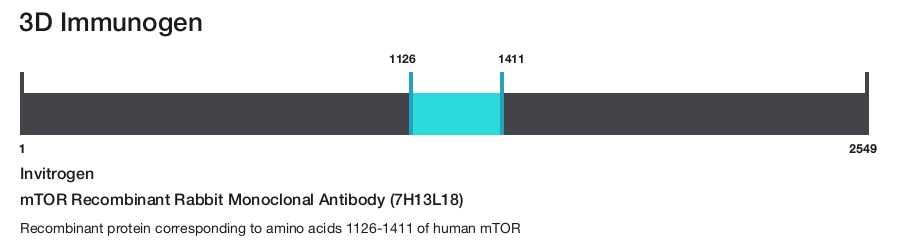
Recombinant protein corresponding to amino acids 1126-1411 of human mTOR
Conjugate
Form
Liquid
Concentration
0.5 mg/mL
Amount
100 µg
Purification
Protein A
Storage buffer
PBS
Contains
0.09% sodium azide
Storage conditions
Store at 4°C short term. For long term storage, store at -20°C, avoiding freeze/thaw cycles.
Shipping conditions
Wet ice
RRID
Product Specific Information
Intact IgG appears on a non-reducing gel as ~150 kDa band and upon reduction generating a ~25 kDa light chain band and a ~50 kDa heavy chain.
Recombinant rabbit monoclonal antibodies are produced using in vitro expression systems. The expression systems are developed by cloning in the specific antibody DNA sequences from immunoreactive rabbits. Then, individual clones are screened to select the best candidates for production. The advantages of using recombinant rabbit monoclonal antibodies include: better specificity and sensitivity, lot-to-lot consistency, animal origin-free formulations, and broader immunoreactivity to diverse targets due to larger rabbit immune repertoire.
Target Information
FRAP1 (mTOR) is a serine/threonine kinase that plays a critical role in cellular growth and proliferation. Perturbations in the mTOR/PI3-kinase/AKT pathway are associated with numerous forms of cancer. FRAP1 is also the target of rapamycin and its analogues, which are currently used as immunosuppressants and cancer therapeutics. Mutations affecting the gene results in Smith-Kingsmore syndrome.
For Research Use Only. Not for use in diagnostic procedures. Not for resale without express authorization.
Bioinformatics
Protein Aliases: FK506 binding protein 12-rapamycin associated protein 2; FK506-binding protein 12-rapamycin complex-associated protein 1; FKBP-rapamycin associated protein; FKBP12-rapamycin complex-associated protein; FKBP12-rapamycin complex-associated protein 1; m-TOR; Mammalian target of rapamycin; Mechanistic target of rapamycin; mechanistic target of rapamycin (serine/threonine kinase); mTOR; mTORC1; Rapamycin and FKBP12 target 1; rapamycin associated protein FRAP2; Rapamycin target protein 1; RAPT1; Serine/threonine-protein kinase mTOR; Tyrosine-protein kinase mTOR; unnamed protein product
Gene Aliases: FRAP; FRAP1; FRAP2; MTOR; RAFT1; RAPT1; SKS
UniProt ID: (Human) P42345
Entrez Gene ID: (Human) 2475
nucleotide binding
inositol hexakisphosphate binding
RNA polymerase III type 1 promoter sequence-specific DNA binding
RNA polymerase III type 2 promoter sequence-specific DNA binding
RNA polymerase III type 3 promoter sequence-specific DNA binding
TFIIIC-class transcription factor binding
protein kinase activity
protein serine/threonine kinase activity
protein tyrosine kinase activity
protein binding
ATP binding
kinase activity
transferase activity
identical protein binding
ribosome binding
ion channel binding
macromolecular complex binding
phosphoprotein binding
protein serine kinase activity
autophagosome assembly
regulation of cell growth
cytoplasmic translation
T-helper 1 cell lineage commitment
heart morphogenesis
heart valve morphogenesis
energy reserve metabolic process
'de novo' pyrimidine nucleobase biosynthetic process
regulation of translational initiation
ubiquitin-dependent protein catabolic process
inflammatory response
cellular response to DNA damage stimulus
cytoskeleton organization
lysosome organization
germ cell development
positive regulation of cell proliferation
insulin receptor signaling pathway
regulation of cell size
cellular response to starvation
response to heat
response to virus
post-embryonic development
positive regulation of biosynthetic process
regulation of autophagy
negative regulation of autophagy
positive regulation of autophagy
positive regulation of lamellipodium assembly
positive regulation of epithelial to mesenchymal transition
positive regulation of myotube differentiation
macroautophagy
regulation of macroautophagy
negative regulation of macroautophagy
regulation of lipid metabolic process
neuronal action potential
cell projection organization
positive regulation of cell growth
positive regulation of actin filament polymerization
SCF-dependent proteasomal ubiquitin-dependent protein catabolic process
T cell costimulation
ruffle organization
regulation of myelination
protein destabilization
response to nutrient levels
cellular response to nutrient levels
cellular response to nutrient
TOR signaling
response to insulin
cellular response to insulin stimulus
regulation of actin cytoskeleton organization
calcineurin-NFAT signaling cascade
cellular response to amino acid starvation
multicellular organism growth
TORC1 signaling
TORC2 signaling
regulation of circadian rhythm
negative regulation of apoptotic process
response to amino acid
anoikis
protein kinase B signaling
positive regulation of cell differentiation
regulation of osteoclast differentiation
positive regulation of translation
negative regulation of cell size
positive regulation of glycolytic process
negative regulation of innate immune response
positive regulation of transcription from RNA polymerase III promoter
negative regulation of translational initiation
positive regulation of translational initiation
negative regulation of insulin receptor signaling pathway
positive regulation of lipid biosynthetic process
behavioral response to pain
oligodendrocyte differentiation
positive regulation of oligodendrocyte differentiation
cardiac muscle tissue development
protein stabilization
voluntary musculoskeletal movement
positive regulation of multicellular organismal process
positive regulation of stress fiber assembly
positive regulation of keratinocyte migration
regulation of protein kinase B signaling
positive regulation of protein kinase B signaling
cardiac cell development
cardiac muscle cell development
cardiac muscle contraction
cellular response to methionine
positive regulation of SCF-dependent proteasomal ubiquitin-dependent catabolic process
negative regulation of calcineurin-NFAT signaling cascade
cellular response to amino acid stimulus
cellular response to leucine
cellular response to hypoxia
cellular response to osmotic stress
regulation of cellular response to stress
regulation of membrane permeability
vascular endothelial cell response to laminar fluid shear stress
antibacterial innate immune response
regulation of cellular response to heat
negative regulation of protein localization to nucleus
regulation of signal transduction by p53 class mediator
positive regulation of transcription of nuclear large rRNA transcript from RNA polymerase I promoter
positive regulation of wound healing, spreading of epidermal cells
negative regulation of TORC2 signaling
regulation of locomotor rhythm
negative regulation of TORC1 signaling
positive regulation of TORC1 signaling
positive regulation of cytoplasmic translational initiation
regulation of lysosome organization
negative regulation of lysosome organization
positive regulation of pentose-phosphate shunt
cellular response to leucine starvation
negative regulation of protein ubiquitination involved in ubiquitin-dependent protein catabolic process
positive regulation of protein ubiquitination involved in ubiquitin-dependent protein catabolic process
positive regulation of cytoplasmic translation
regulation of autophagosome assembly
Disclaimer

Clicking the images or links will redirect you to a website hosted by BenchSci that provides third-party scientific content. Neither the content nor the BenchSci technology and processes for selection have been evaluated by us; we are providing them as-is and without warranty of any kind, including for use or application of the Thermo Fisher Scientific products presented.

Performance Guarantee
If an Invitrogen™ antibody doesn't perform as described on our website or datasheet,we'll replace the product at no cost to you, or provide you with a credit for a future purchase.*
Learn more
We're here to help
Get expert recommendations for common problems or connect directly with an on staff expert for technical assistance related to applications, equipment and general product use.
Contact tech support