Search
Bioss
TGF beta 2 Propeptide Polyclonal Antibody
{{$productOrderCtrl.translations['antibody.pdp.commerceCard.promotion.promotions']}}
{{$productOrderCtrl.translations['antibody.pdp.commerceCard.promotion.viewpromo']}}
{{$productOrderCtrl.translations['antibody.pdp.commerceCard.promotion.promocode']}}: {{promo.promoCode}} {{promo.promoTitle}} {{promo.promoDescription}}. {{$productOrderCtrl.translations['antibody.pdp.commerceCard.promotion.learnmore']}}
Additional Information:
{{banner.description}}


Product Details
BS-0100R
Applications
Tested Dilution
Publications
Product Specifications
Species Reactivity
Human,
Mouse,
Rat
Host/Isotype
Rabbit
/ IgG
Class
Polyclonal
Type
Antibody
Immunogen
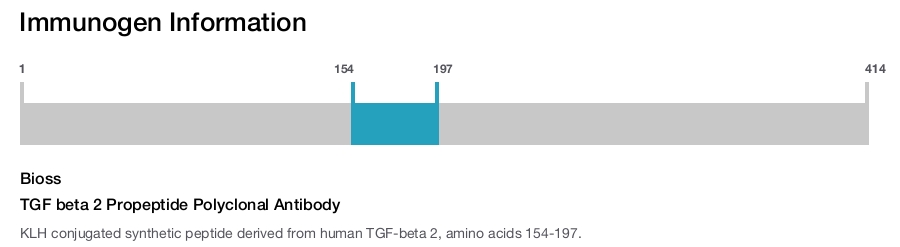
KLH conjugated synthetic peptide derived from human TGF-beta 2, amino acids 154-197.
Conjugate
Form
Liquid
Concentration
1 mg/mL
Amount
100 µg
Purification
Protein A
Storage buffer
0.01M TBS, pH 7.4, with 50% glycerol, 1% BSA
Contains
0.02% ProClin 300
Storage conditions
-20°C
Shipping conditions
Ambient (domestic); Wet ice (international)
Target Information
Transforming Growth Factor (TGF) betas mediate many cell to cell interactions that occur during embryonic development. Three TGF betas have been identified in mammals. TGF beta 1, TGF beta 2 and TGF beta 3 are each synthesized as precursor proteins that are very similar in that each is cleaved to yield a 112 amino acid polypeptide that remains associated with the latent portion of the molecule. The TGF beta polypeptides are multifunctional; capable of influencing cell proliferation, differentiation, and other functions in a wide range of cell types. Transformed, as well as nonneoplastic tissues, release transforming growth factors; and essentially all mammalian cells possess a specific TGF receptor. The multi modal nature of TGF beta is seen in its ability to stimulate or inhibit cellular proliferation. In general, cells of mesenchymal origin appear to be stimulated by TGF beta whereas cells of epithelial or neuroectodermal origin are inhibited by the peptide. TGF beta 1, TGF beta 2, and TGF beta 1.2 appear to be equivalent in biological activity, although there does appear to be differences in binding to certain types of receptors. TGF beta 2 is produced by many cell types and has been found in the highest concentration in porcine platelets and mammalian bone. Latent TGF beta 2 is the prominent isoform found in body fluids such as amniotic fluid, breast milk, and the aqueous and vitreous humor of the eye.
For Research Use Only. Not for use in diagnostic procedures. Not for resale without express authorization.
References (0)
Have you cited this product in a publication?
Let us know so we can reference it here.
Bioinformatics
Protein Aliases: BSC-1 cell growth inhibitor; Cetermin; G-TSF; Glioblastoma-derived T-cell suppressor factor; polyergin; prepro-transforming growth factor beta-2; TGF beta 2 protein; TGF-beta-2; TGFB; TGFβ2; Transforming growth factor; transforming growth factor beta-2; Transforming growth factor beta-2 proprotein; transforming growth factor-beta-2 precursor; unnamed protein product
Gene Aliases: BB105277; G-TSF; LDS4; TGF-B2; TGF-beta2; Tgfb-2; TGFB2
UniProt ID: (Human) P61812, (Mouse) P27090, (Rat) Q07257
Entrez Gene ID: (Human) 7042, (Mouse) 21808, (Rat) 81809
beta-amyloid binding
receptor binding
type II transforming growth factor beta receptor binding
cytokine activity
transforming growth factor beta receptor binding
protein binding
growth factor activity
type III transforming growth factor beta receptor binding
protein homodimerization activity
receptor signaling protein serine/threonine kinase activity
protein heterodimerization activity
protein N-terminus binding
growth factor
cell morphogenesis
skeletal system development
cartilage condensation
blood vessel development
eye development
response to hypoxia
kidney development
epithelial to mesenchymal transition
neural tube closure
hair follicle development
blood vessel remodeling
heart morphogenesis
outflow tract septum morphogenesis
membranous septum morphogenesis
outflow tract morphogenesis
heart valve morphogenesis
atrioventricular valve morphogenesis
pulmonary valve morphogenesis
endocardial cushion morphogenesis
cardiac right ventricle morphogenesis
ventricular trabecula myocardium morphogenesis
endocardial cushion fusion
atrial septum primum morphogenesis
neural retina development
activation-induced cell death of T cells
transforming growth factor beta receptor signaling pathway
axon guidance
sensory organ development
salivary gland morphogenesis
heart development
positive regulation of cell proliferation
negative regulation of cell proliferation
glial cell migration
male gonad development
response to wounding
embryo development ending in birth or egg hatching
cardioblast differentiation
positive regulation of gene expression
negative regulation of gene expression
positive regulation of epithelial cell migration
positive regulation of epithelial to mesenchymal transition
negative regulation of macrophage cytokine production
striated muscle tissue development
cell migration
negative regulation of angiogenesis
signaling
hemopoiesis
extracellular matrix organization
collagen fibril organization
positive regulation of cell growth
negative regulation of cell growth
embryonic limb morphogenesis
neutrophil chemotaxis
epithelial cell differentiation
hair follicle morphogenesis
response to progesterone
positive regulation of stress-activated MAPK cascade
regulation of transforming growth factor beta2 production
regulation of actin cytoskeleton organization
positive regulation of cell adhesion mediated by integrin
ascending aorta morphogenesis
wound healing
regulation of cell proliferation
dopamine biosynthetic process
odontogenesis
uterine wall breakdown
regulation of apoptotic process
positive regulation of apoptotic process
positive regulation of neuron apoptotic process
cell-cell junction organization
positive regulation of cell differentiation
positive regulation of integrin biosynthetic process
positive regulation of Notch signaling pathway
positive regulation of cell cycle
positive regulation of heart contraction
negative regulation of Ras protein signal transduction
somatic stem cell division
embryonic digestive tract development
neuron fate commitment
neuron development
generation of neurons
inner ear development
negative regulation of epithelial cell proliferation
positive regulation of protein secretion
positive regulation of immune response
positive regulation of cellular component organization
positive regulation of multicellular organismal process
positive regulation of cell division
regulation of timing of catagen
positive regulation of catagen
positive regulation of cardioblast differentiation
positive regulation of protein kinase B signaling
cardiac muscle cell proliferation
uterus development
cardiac epithelial to mesenchymal transition
face morphogenesis
positive regulation of SMAD protein import into nucleus
ventricular septum morphogenesis
atrial septum morphogenesis
negative regulation of cartilage development
pharyngeal arch artery morphogenesis
secondary palate development
positive regulation of cardiac epithelial to mesenchymal transition
positive regulation of activation-induced cell death of T cells
cellular response to growth factor stimulus
positive regulation of extracellular matrix disassembly
extrinsic apoptotic signaling pathway
extrinsic apoptotic signaling pathway in absence of ligand
transforming growth factor beta receptor superfamily signaling pathway
positive regulation of protein localization to nucleus
regulation of apoptotic process involved in outflow tract morphogenesis
positive regulation of pri-miRNA transcription from RNA polymerase II promoter
regulation of extracellular matrix organization
regulation of complement-dependent cytotoxicity
substantia propria of cornea development
pericyte cell differentiation
cranial skeletal system development
negative regulation of epithelial to mesenchymal transition involved in endocardial cushion formation
positive regulation of epithelial to mesenchymal transition involved in endocardial cushion formation
positive regulation of extrinsic apoptotic signaling pathway in absence of ligand
cardiac left ventricle morphogenesis
protein phosphorylation
cell cycle arrest
SMAD protein import into nucleus
cell death
negative regulation of alkaline phosphatase activity
positive regulation of pathway-restricted SMAD protein phosphorylation
positive regulation of phosphatidylinositol 3-kinase signaling
cell growth
signal transduction by protein phosphorylation
positive regulation of cell migration
activation of protein kinase activity
intracellular signal transduction
growth
response to drug
catagen
negative regulation of apoptotic process
regulation of MAPK cascade
response to estrogen
negative regulation of keratinocyte differentiation
embryonic neurocranium morphogenesis
negative regulation of immune response
negative regulation of release of sequestered calcium ion into cytosol
pathway-restricted SMAD protein phosphorylation
SMAD protein signal transduction
regulation of cell growth
skeletal muscle tissue development
female pregnancy
aging
response to radiation
response to cold
response to organonitrogen compound
lung development
thyroid gland development
hindbrain development
pancreas development
response to estradiol
response to retinoic acid
response to vitamin D
response to cytokine
response to laminar fluid shear stress
positive regulation of ossification
cell development
digestive tract development
frontal suture morphogenesis
Disclaimer

Clicking the images or links will redirect you to a website hosted by BenchSci that provides third-party scientific content. Neither the content nor the BenchSci technology and processes for selection have been evaluated by us; we are providing them as-is and without warranty of any kind, including for use or application of the Thermo Fisher Scientific products presented.

Performance Guarantee
If an Invitrogen™ antibody doesn't perform as described on our website or datasheet,we'll replace the product at no cost to you, or provide you with a credit for a future purchase.*
Learn more
We're here to help
Get expert recommendations for common problems or connect directly with an on staff expert for technical assistance related to applications, equipment and general product use.
Contact tech support