Search
Invitrogen
p53 Polyclonal Antibody
{{$productOrderCtrl.translations['antibody.pdp.commerceCard.promotion.promotions']}}
{{$productOrderCtrl.translations['antibody.pdp.commerceCard.promotion.viewpromo']}}
{{$productOrderCtrl.translations['antibody.pdp.commerceCard.promotion.promocode']}}: {{promo.promoCode}} {{promo.promoTitle}} {{promo.promoDescription}}. {{$productOrderCtrl.translations['antibody.pdp.commerceCard.promotion.learnmore']}}
Additional Information:
{{banner.description}}


Product Details
PA5-84058
Applications
Tested Dilution
Publications
Product Specifications
Species Reactivity
Human
Host/Isotype
Rabbit
/ IgG
Class
Polyclonal
Type
Antibody
Immunogen
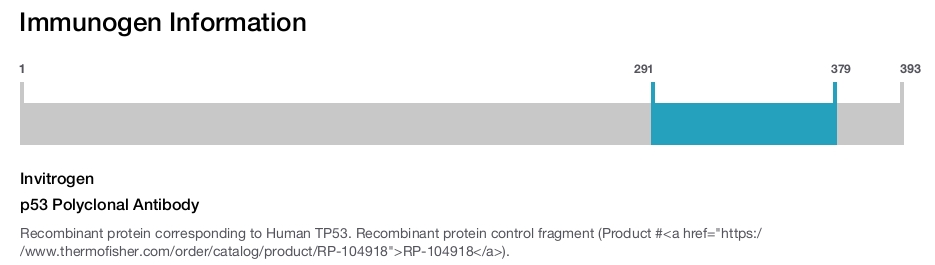
Recombinant protein corresponding to Human TP53. Recombinant protein control fragment (Product #RP-104918).
Conjugate
Unconjugated
Unconjugated
Unconjugated
Form
Liquid
Concentration
0.2 mg/mL
Amount
20 µg
Purification
Antigen affinity chromatography
Storage buffer
PBS, pH 7.2, with 40% glycerol
Contains
0.02% sodium azide
Storage conditions
Store at 4°C short term. For long term storage, store at -20°C, avoiding freeze/thaw cycles.
Shipping conditions
Ambient (domestic); Wet ice (international)
RRID
Product Specific Information
Immunogen sequence: KKGEPHHELP PGSTKRALPN NTSSSPQPKK KPLDGEYFTL QIRGRERFEM FRELNEALEL KDAQAGKEPG GSRAHSSHLK SKKGQSTSR
Highest antigen sequence indentity to the following orthologs: Rat - 91%, Mouse - 75%.
Target Information
The tumor suppressor protein, p53, is a sequence specific transcription factor that is activated by cellular stress. p53 mediates cell cycle arrest or apoptosis in response to DNA damage or starvation for pyrimidine nucleotides. p53 is up-regulated in response to stress signals and stimulated to activate transcription of specific genes, resulting in expression of p21waf1 and other proteins involved in G1 or G2/M arrest. The structure of p53 comprises an N-terminal transactivation domain, a central DNA-binding domain, an oligomerisation domain, and a C-terminal regulatory domain. There are various phosphorylation sites on p53, of which the phosphorylation at Ser15 is important for p53 activation and stabilization. p53 has been characterized to play a role in blocking the proliferative action of damaged cells and act as an anticancer agent. Phosphorylation of Ser392 in p53 has been shown to associate with the formation of human tumors. In addition, p53 has also been linked to the effects of aging and oxidative stress and an increase in p53 has been linked to deficits in LTP (Long Term Potentiation) in learning and memory. p53 is found in very low levels in normal cells, however, in a variety of transformed cell lines, it is expressed in high amounts, and believed to contribute to transformation and malignancy. Mutants of p53 that frequently occur in a number of different human cancers fail to bind the consensus DNA binding site, and cause the loss of tumor suppressor activity. Alterations of the TP53 gene occur not only as somatic mutations in human malignancies, but also as germline mutations in some cancer-prone families such as Li-Fraumeni syndrome.
For Research Use Only. Not for use in diagnostic procedures. Not for resale without express authorization.
References (0)
Have you cited this product in a publication?
Let us know so we can reference it here.
Bioinformatics
Protein Aliases: Antigen NY-CO-13; Cellular tumor antigen p53; Cys 51 Stop; FLJ92943; HGNC11998; mutant tumor protein 53; OTTMUSP00000006194; p53 antigen; Phosphoprotein p53; transcription factor; transcription factor; truncated protein; transformation-related protein 53; tumor protein 53; tumor suppressor; Tumor suppressor p53; tumor supressor p53; Tumour Protein p53; unnamed protein product
Gene Aliases: BCC7; BMFS5; LFS1; P53; TP53; TRP53
UniProt ID: (Human) P04637
Entrez Gene ID: (Human) 7157
transcription regulatory region sequence-specific DNA binding
RNA polymerase II regulatory region sequence-specific DNA binding
RNA polymerase II core promoter proximal region sequence-specific DNA binding
RNA polymerase II transcription factor activity, sequence-specific DNA binding
core promoter proximal region sequence-specific DNA binding
core promoter sequence-specific DNA binding
TFIID-class transcription factor binding
transcription coactivator binding
transcriptional repressor activity, RNA polymerase II transcription regulatory region sequence-specific binding
transcriptional activator activity, RNA polymerase II transcription regulatory region sequence-specific binding
protease binding
p53 binding
DNA binding
chromatin binding
transcription factor activity, sequence-specific DNA binding
mRNA 3'-UTR binding
copper ion binding
protein binding
zinc ion binding
enzyme binding
receptor tyrosine kinase binding
ubiquitin protein ligase binding
histone deacetylase regulator activity
annealing helicase activity
identical protein binding
histone deacetylase binding
metal ion binding
protein heterodimerization activity
chaperone binding
protein phosphatase 2A binding
RNA polymerase II sequence-specific DNA binding transcription factor binding
14-3-3 protein binding
MDM2/MDM4 family protein binding
disordered domain specific binding
general transcription initiation factor binding
molecular function activator activity
molecular condensate scaffold activity
promoter-specific chromatin binding
negative regulation of transcription from RNA polymerase II promoter
mitophagy
in utero embryonic development
somitogenesis
release of cytochrome c from mitochondria
hematopoietic progenitor cell differentiation
T cell proliferation involved in immune response
B cell lineage commitment
T cell lineage commitment
response to ischemia
nucleotide-excision repair
double-strand break repair
regulation of transcription, DNA-templated
regulation of transcription from RNA polymerase II promoter
protein import into nucleus
autophagy
apoptotic process
cellular response to DNA damage stimulus
response to oxidative stress
ER overload response
transforming growth factor beta receptor signaling pathway
Ras protein signal transduction
regulation of mitotic cell cycle
gastrulation
neuroblast proliferation
negative regulation of neuroblast proliferation
central nervous system development
heart development
circadian rhythm
protein localization
negative regulation of DNA replication
cell proliferation
negative regulation of cell proliferation
determination of adult lifespan
mRNA transcription
rRNA transcription
response to xenobiotic stimulus
response to UV
response to salt stress
embryo development ending in birth or egg hatching
response to X-ray
response to ionizing radiation
response to gamma radiation
positive regulation of gene expression
negative regulation of gene expression
cardiac muscle cell apoptotic process
positive regulation of cardiac muscle cell apoptotic process
programmed cell death
glial cell proliferation
viral process
glucose catabolic process to lactate via pyruvate
cerebellum development
negative regulation of cell growth
DNA damage response, signal transduction by p53 class mediator
negative regulation of transforming growth factor beta receptor signaling pathway
mitotic G1 DNA damage checkpoint
negative regulation of telomere maintenance via telomerase
T cell differentiation in thymus
tumor necrosis factor-mediated signaling pathway
cellular response to stress
regulation of tissue remodeling
cellular response to UV
multicellular organism growth
positive regulation of mitochondrial membrane permeability
regulation of cell proliferation
cellular response to glucose starvation
intrinsic apoptotic signaling pathway in response to DNA damage by p53 class mediator
regulation of apoptotic process
positive regulation of apoptotic process
negative regulation of apoptotic process
entrainment of circadian clock by photoperiod
mitochondrial DNA repair
regulation of DNA damage response, signal transduction by p53 class mediator
regulation of neuron apoptotic process
positive regulation of neuron apoptotic process
positive regulation of gene expression, epigenetic
negative regulation of proteolysis
negative regulation of transcription, DNA-templated
positive regulation of transcription, DNA-templated
positive regulation of RNA polymerase II transcriptional preinitiation complex assembly
negative regulation of mitotic cell cycle
positive regulation of transcription from RNA polymerase II promoter
response to antibiotic
fibroblast proliferation
negative regulation of fibroblast proliferation
rhythmic process
circadian behavior
bone marrow development
embryonic organ development
protein stabilization
negative regulation of DNA metabolic process
negative regulation of helicase activity
protein tetramerization
chromosome organization
neuron apoptotic process
regulation of cell cycle
hematopoietic stem cell differentiation
negative regulation of glial cell proliferation
interferon-gamma-mediated signaling pathway
cardiac septum morphogenesis
positive regulation of programmed necrotic cell death
protein-containing complex assembly
intrinsic apoptotic signaling pathway in response to endoplasmic reticulum stress
thymocyte apoptotic process
regulation of thymocyte apoptotic process
positive regulation of thymocyte apoptotic process
necroptotic process
cellular response to hypoxia
cellular response to xenobiotic stimulus
cellular response to ionizing radiation
cellular response to gamma radiation
cellular response to UV-C
stem cell proliferation
signal transduction by p53 class mediator
intrinsic apoptotic signaling pathway by p53 class mediator
reactive oxygen species metabolic process
cellular response to actinomycin D
positive regulation of release of cytochrome c from mitochondria
cellular senescence
replicative senescence
oxidative stress-induced premature senescence
apoptotic signaling pathway
intrinsic apoptotic signaling pathway
oligodendrocyte apoptotic process
positive regulation of execution phase of apoptosis
negative regulation of macromitophagy
regulation of mitochondrial membrane permeability involved in apoptotic process
regulation of intrinsic apoptotic signaling pathway by p53 class mediator
regulation of cell cycle G2/M phase transition
positive regulation of pri-miRNA transcription from RNA polymerase II promoter
negative regulation of G1 to G0 transition
negative regulation of production of miRNAs involved in gene silencing by miRNA
negative regulation of glucose catabolic process to lactate via pyruvate
negative regulation of pentose-phosphate shunt
intrinsic apoptotic signaling pathway in response to hypoxia
regulation of fibroblast apoptotic process
negative regulation of reactive oxygen species metabolic process
positive regulation of reactive oxygen species metabolic process
negative regulation of stem cell proliferation
regulation of cellular senescence
positive regulation of cellular senescence
regulation of intrinsic apoptotic signaling pathway
positive regulation of intrinsic apoptotic signaling pathway
Disclaimer

Clicking the images or links will redirect you to a website hosted by BenchSci that provides third-party scientific content. Neither the content nor the BenchSci technology and processes for selection have been evaluated by us; we are providing them as-is and without warranty of any kind, including for use or application of the Thermo Fisher Scientific products presented.

Performance Guarantee
If an Invitrogen™ antibody doesn't perform as described on our website or datasheet,we'll replace the product at no cost to you, or provide you with a credit for a future purchase.*
Learn more
We're here to help
Get expert recommendations for common problems or connect directly with an on staff expert for technical assistance related to applications, equipment and general product use.
Contact tech support