Search


Citations & References (6)
Thermo Scientific™
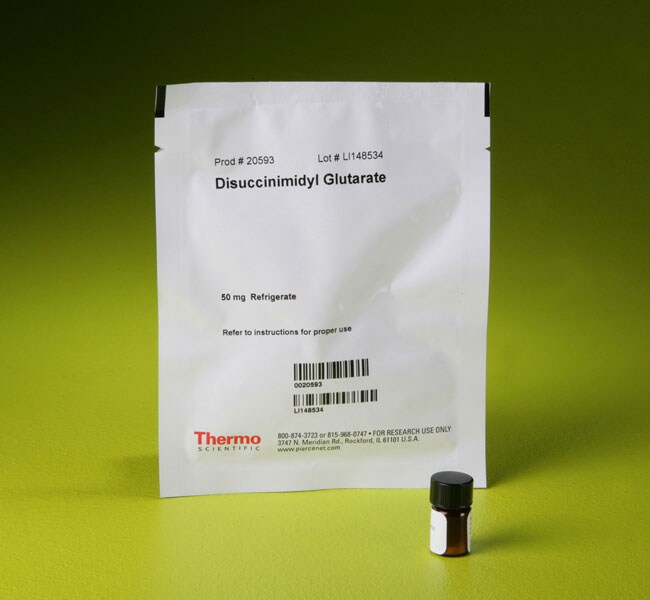
Pierce™ DSG, No-Weigh™ Format
Thermo Scientific Pierce DSGは水溶性のホモ二官能性N-ヒドロキシスクシンイミドエステル(NHSエステル)クロスリンカーで、放射性標識リガンドを細胞表面受容体に結合させるためによく使用されます。NHSエステルは、タンパク質やペプチドのクロスリンクと標識にもっとも一般的に使用される、もっともシンプルな反応基です詳細を見る


製品番号(カタログ番号) 20593
価格(JPY)
29,800
Each
数量:
50 mg
Thermo Scientific Pierce DSGは水溶性のホモ二官能性N-ヒドロキシスクシンイミドエステル(NHSエステル)クロスリンカーで、放射性標識リガンドを細胞表面受容体に結合させるためによく使用されます。NHSエステルは、タンパク質やペプチドのクロスリンクと標識にもっとも一般的に使用される、もっともシンプルな反応基です。NHSエステルは、ペプチドのN末端にある一級アミンおよびリジン残基のアミンと反応して、安定したアミド共役結合を形成し、NHS基を放出します。
Thermo Scientific No-Weigh製品は、分注済みフォーマットで提供される特殊試薬です。計量済みのパッケージではバイアルを繰り返し開閉することがないため、経時的な試薬反応性の喪失や汚染を防ぎます。このフォーマットでは、毎回新しい試薬バイアルを使用できるため、少量の試薬を計量する手間がなくなり、試薬の安定性に対する懸念が軽減します。
グルタル酸ジスクシンイミジルの特長:
•反応基:NHSエステル(両端)
• 反応の対象:アミノ基(一級アミン)
• 非切断性
• 水溶性(まずDMFまたはDMSOに溶解)
• 膜透過性であるため、細胞内クロスリンクが可能
• 一部のアプリケーションでは、DSSと比較してクロスリンク効率を向上
製品リファレンス
クロスリンカーアプリケーションガイド -- この製品に関する最近の参考文献情報を検索できます
Thermo Scientific No-Weigh製品は、分注済みフォーマットで提供される特殊試薬です。計量済みのパッケージではバイアルを繰り返し開閉することがないため、経時的な試薬反応性の喪失や汚染を防ぎます。このフォーマットでは、毎回新しい試薬バイアルを使用できるため、少量の試薬を計量する手間がなくなり、試薬の安定性に対する懸念が軽減します。
グルタル酸ジスクシンイミジルの特長:
•反応基:NHSエステル(両端)
• 反応の対象:アミノ基(一級アミン)
• 非切断性
• 水溶性(まずDMFまたはDMSOに溶解)
• 膜透過性であるため、細胞内クロスリンクが可能
• 一部のアプリケーションでは、DSSと比較してクロスリンク効率を向上
製品リファレンス
クロスリンカーアプリケーションガイド -- この製品に関する最近の参考文献情報を検索できます
研究用途にのみご使用ください。診断目的には使用できません。
仕様
細胞透過性Yes
形状Powder
標識法化学的標識
分子量326.26
PEG化No
製品ラインPierce
数量50 mg
反応性部分NHSエステル
出荷条件Ambient
溶解性DMF、DMSO
スペーサーアーム長7.7 Å
水溶性No
化学反応性Amine-Amine
CleavableNo
クロスリンカータイプホモ二官能性
フォーマットStandard, Single-use
製品タイプ架橋剤
スペーサー短鎖
Unit SizeEach
組成および保存条件
4℃で乾燥した場所に保存。室温で出荷
よくあるご質問(FAQ)
Can you provide the shelf-life for DSG (disuccinimidyl glutarate)?
How should I dissolve and store DSG, No-Weigh Format?
Can NHS-diazirine (Cat. No. 26167) be used for CHIP applications?
引用および参考文献 (6)
引用および参考文献
Abstract
The structural basis for the oligomerization of the N-terminal domain of SATB1.
Journal:Nucleic Acids Res
PubMed ID:22241778
Special AT-rich sequence-binding protein 1 (SATB1) is a global chromatin organizer and gene expression regulator essential for T-cell development and breast cancer tumor growth and metastasis. The oligomerization of the N-terminal domain of SATB1 is critical for its biological function. We determined the crystal structure of the N-terminal domain of
Neurotrophin-mediated degradation of histone methyltransferase by S-nitrosylation cascade regulates neuronal differentiation.
Journal:Proc Natl Acad Sci U S A
PubMed ID:22123949
Epigenetic regulation of histones mediates neurotrophin actions with histone acetylation enhancing cAMP response element-binding (CREB)-associated transcription elicited by brain-derived neurotrophic factor (BDNF) and nerve-growth factor (NGF). Roles for histone methylation in CREB's transcriptional activity have not been well characterized. We show that depletion of the histone methyltransferase suppressor of variegation
Characterizing phospholamban to sarco(endo)plasmic reticulum Ca2+-ATPase 2a (SERCA2a) protein binding interactions in human cardiac sarcoplasmic reticulum vesicles using chemical cross-linking.
Journal:J Biol Chem
PubMed ID:22247554
Chemical cross-linking was used to study protein binding interactions between native phospholamban (PLB) and SERCA2a in sarcoplasmic reticulum (SR) vesicles prepared from normal and failed human hearts. Lys(27) of PLB was cross-linked to the Ca(2+) pump at the cytoplasmic extension of M4 (at or near Lys(328)) with the homobifunctional cross-linker,
A central role for the T1 domain in voltage-gated potassium channel formation and function.
Journal:J Biol Chem
PubMed ID:11312262
To interpret the recent atomic structures of the Kv (voltage-dependent potassium) channel T1 domain in a functional context, we must understand both how the T1 domain is integrated into the full-length functional channel protein and what functional roles the T1 domain governs. The T1 domain clearly plays a role in
RelA Ser276 phosphorylation-coupled Lys310 acetylation controls transcriptional elongation of inflammatory cytokines in respiratory syncytial virus infection.
Journal:J Virol
PubMed ID:21900162
Respiratory syncytial virus (RSV) is a negative-sense single-stranded RNA virus responsible for lower respiratory tract infections (LRTIs) in humans. In experimental models of RSV LRTI, the actions of the nuclear factor ?B (NF-?B) transcription factor mediate inflammation and pathology. We have shown that RSV replication induces a mitogen-and-stress-related kinase 1