Search


Citations & References (15)
Gibco™
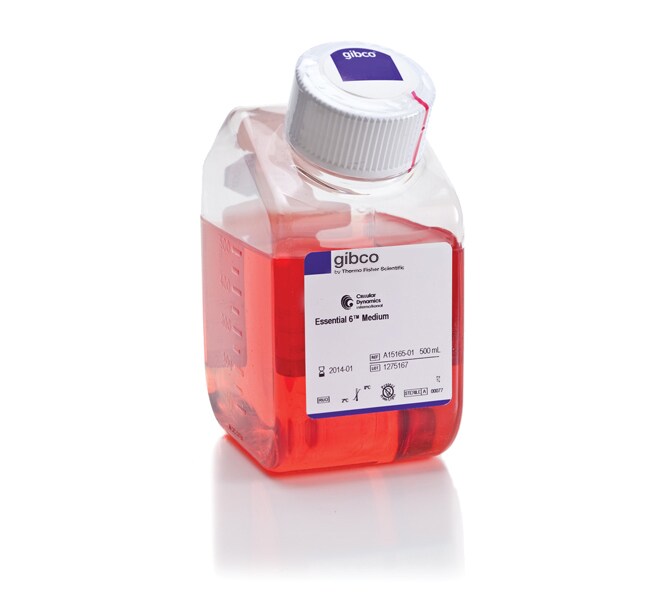
Essential 6™ Medium
Essential 6培地は、体細胞のリプログラミングとヒト多能性幹細胞(PSC)の自然分化または誘導分化をサポートするフィーダーフリーのゼノフリー培地です。さらに、Essential 6培地は、PSCの培養のためのカスタム培地のベースとして使用することができます。配合は詳細を見る
| 製品番号(カタログ番号) | 数量 |
|---|---|
| A1516401 | 500 mL |
製品番号(カタログ番号) A1516401
価格(JPY)
29,300
Each
数量:
500 mL
Essential 6培地は、体細胞のリプログラミングとヒト多能性幹細胞(PSC)の自然分化または誘導分化をサポートするフィーダーフリーのゼノフリー培地です。さらに、Essential 6培地は、PSCの培養のためのカスタム培地のベースとして使用することができます。配合は、ジェームズ・トムソンの研究室でGuokai Chenら(1)によって開発され、(1)「E6」として発表された培地をベースにしています。Essential 6培地は、わずか6つの必須成分で、ばらつきを最小限に抑えることができます。同じ研究室で開発された低変動性PSC培地を使用してワークフローを完成させるには、Essential 8培地を使用してください。
Essential 6培地
• 分化—分化を阻害するbFGFを含みません
• リプログラミング—bTGFを含まないため、リプログラミング効率に悪影響を及ぼします
• 柔軟性—TGFβとbFGF のレベルを調整したり、特定のアプリケーションに合わせて追加成分を追加することができる柔軟なフォーマットを提供します
分化
PSC培養に使用される他の培地とは異なり、Essential 6培地にはbFGFやTGFβは含まれていません。そのため、Essential 6培地は胚体の形成をサポートすることができます。また、運動ニューロン(3)を含む内胚葉、中胚葉、外胚葉系統(2)のさまざまな細胞タイプの指示された分化のためのベースとしても使用されています。
リプログラミング
Essential 6培地は、bFGFと併用することで、定義されたフィーダーフリーのリプログラミングを可能にします。この処方は、エピソームベクター(4 )やCytoTune(センダイウイルス)などのさまざまな方法を用いた体細胞リプログラミングをサポートし、ばらつきを最小限に抑えながら細胞の健康と多能性を最大限に高めるよう最適化されています。
柔軟性
Essential 6培地は、ゼノフリーで、幹細胞培養に必要な必須成分のみを含み、bFGFとTGFβは含まれていません。これにより、TGFβとbFGFのレベルを調整したり、用途に合わせて成分を追加したりすることができ、細胞の健康と多能性を最大限に引き出す基本的な培地を提供します。
セルラー・ダイナミクス・インターナショナルとの提携により商品化されました。
参考文献:
(1) Chen G, Gulbranson DR, Hou Z, Bolin JM, Ruotti V, Probasco MD, Smuga-Otto K, Howden SE, Diol NR, Propson NE, Wagner R, Lee GO, Antosiewicz-Bourget J, Teng JM, Thomson JA。ヒトiPSCの導出および培養のための化学的に定義された条件。Nat Methods。2011 8(5):424-9.
(2) Lippmann ES, Estevez-Silva MC, Ashton RS.ヒト多能性幹細胞培養を明確にすることで、低分子阻害剤を使用することなく、効率の高い神経上皮の誘導が可能になります。Stem Cells。2014 32(4):1032-42.
(3) Lippmann ES, Williams CE, Ruhl DA, Estevez-Silva MC, Chapman ER, Coon JJ, Ashton RS。ヒト多能性幹細胞由来の神経外胚葉における決定論的HOXパターニング。Stem Cell Reports。2015 4(4):632-44.
(4) Yu J, Hu K, Smuga-Otto K, Tian S, Stewart R, Slukvin II, Thomson JA。ベクターおよび導入遺伝子配列を含まないヒト人工多能性幹細胞。Science.2009 324(5928):797-801.
Essential 6培地
• 分化—分化を阻害するbFGFを含みません
• リプログラミング—bTGFを含まないため、リプログラミング効率に悪影響を及ぼします
• 柔軟性—TGFβとbFGF のレベルを調整したり、特定のアプリケーションに合わせて追加成分を追加することができる柔軟なフォーマットを提供します
分化
PSC培養に使用される他の培地とは異なり、Essential 6培地にはbFGFやTGFβは含まれていません。そのため、Essential 6培地は胚体の形成をサポートすることができます。また、運動ニューロン(3)を含む内胚葉、中胚葉、外胚葉系統(2)のさまざまな細胞タイプの指示された分化のためのベースとしても使用されています。
リプログラミング
Essential 6培地は、bFGFと併用することで、定義されたフィーダーフリーのリプログラミングを可能にします。この処方は、エピソームベクター(4 )やCytoTune(センダイウイルス)などのさまざまな方法を用いた体細胞リプログラミングをサポートし、ばらつきを最小限に抑えながら細胞の健康と多能性を最大限に高めるよう最適化されています。
柔軟性
Essential 6培地は、ゼノフリーで、幹細胞培養に必要な必須成分のみを含み、bFGFとTGFβは含まれていません。これにより、TGFβとbFGFのレベルを調整したり、用途に合わせて成分を追加したりすることができ、細胞の健康と多能性を最大限に引き出す基本的な培地を提供します。
セルラー・ダイナミクス・インターナショナルとの提携により商品化されました。
参考文献:
(1) Chen G, Gulbranson DR, Hou Z, Bolin JM, Ruotti V, Probasco MD, Smuga-Otto K, Howden SE, Diol NR, Propson NE, Wagner R, Lee GO, Antosiewicz-Bourget J, Teng JM, Thomson JA。ヒトiPSCの導出および培養のための化学的に定義された条件。Nat Methods。2011 8(5):424-9.
(2) Lippmann ES, Estevez-Silva MC, Ashton RS.ヒト多能性幹細胞培養を明確にすることで、低分子阻害剤を使用することなく、効率の高い神経上皮の誘導が可能になります。Stem Cells。2014 32(4):1032-42.
(3) Lippmann ES, Williams CE, Ruhl DA, Estevez-Silva MC, Chapman ER, Coon JJ, Ashton RS。ヒト多能性幹細胞由来の神経外胚葉における決定論的HOXパターニング。Stem Cell Reports。2015 4(4):632-44.
(4) Yu J, Hu K, Smuga-Otto K, Tian S, Stewart R, Slukvin II, Thomson JA。ベクターおよび導入遺伝子配列を含まないヒト人工多能性幹細胞。Science.2009 324(5928):797-801.
研究用にのみ使用できます。診断用には使用いただけません。
仕様
細胞株Embryonic Stem Cells (ESCs), Induced Pluripotent Stem Cells (iPSCs)
細胞タイプEmbryonic Stem Cells (ESCs), Induced Pluripotent Stem Cells (iPSCs)
製造品質cGMP for medical devices, 21 CFR Part 820 and ISO 13485
製品ラインEssential 6
製品タイプStem Cell Media
数量500 mL
品質保持期間12 Months
出荷条件Ambient
種Human
分類Xeno-free
Culture TypeAdherent Cell Culture, Feeder-free Stem Cell Culture (Human, iPS - Induced Pluripotent Stem, Embryonic), Stem Cell (Human, iPS - Induced Pluripotent Stem, Embryonic)
形状Liquid
Serum LevelSerum-free
無菌性Sterile-filtered
Sterilization MethodSterile-filtered
添加剤ありPhenol Red
Unit SizeEach
組成および保存条件
Store at 2 to 8°C and protect from light.
よくあるご質問(FAQ)
Can I store Gibco Essential 6 Medium (Cat. No. A1516401) at -20 degrees C?
Is it possible to reprogram somatic cells using Essential 7 or Essential 8 medium and transition them into StemFlex Medium upon harvest?
When should I use the full length Human FGF-basic (FGF-2/bFGF) Recombinant Protein or the truncated variant, Human FGF-basic (FGF-2/bFGF) (aa 10-155) Recombinant Protein?
What are induced pluripotent stem cells?
引用および参考文献 (15)
引用および参考文献
Abstract
Long-term xeno-free culture of human pluripotent stem cells on hydrogels with optimal elasticity.
Journal:
PubMed ID:26656754
'The tentative clinical application of human pluripotent stem cells (hPSCs), such as human embryonic stem cells and human induced pluripotent stem cells, is restricted by the possibility of xenogenic contamination resulting from the use of mouse embryonic fibroblasts (MEFs) as a feeder layer. Therefore, we investigated hPSC cultures on biomaterials
Stable enhanced green fluorescent protein expression after differentiation and transplantation of reporter human induced pluripotent stem cells generated by AAVS1 transcription activator-like effector nucleases.
Journal:
PubMed ID:24833591
'Human induced pluripotent stem (hiPS) cell lines with tissue-specific or ubiquitous reporter genes are extremely useful for optimizing in vitro differentiation conditions as well as for monitoring transplanted cells in vivo. The adeno-associated virus integration site 1 (AAVS1) locus has been used as a '
Advanced feeder-free generation of induced pluripotent stem cells directly from blood cells.
Journal:
PubMed ID:25355732
Generation of validated human induced pluripotent stem cells (iPSCs) for biobanking is essential for exploring the full potential of iPSCs in disease modeling and drug discovery. Peripheral blood mononuclear cells (PBMCs) are attractive targets for reprogramming, because blood is collected by a routine clinical procedure and is a commonly stored
Analysis of essential pathways for self-renewal in common marmoset embryonic stem cells.
Journal:
PubMed ID:24649403
Common marmoset (CM) is widely recognized as a useful non-human primate for disease modeling and preclinical studies. Thus, embryonic stem cells (ESCs) derived from CM have potential as an appropriate cell source to test human regenerative medicine using human ESCs. CM ESCs have been established by us and other groups,
Proneural transcription factor Atoh1 drives highly efficient differentiation of human pluripotent stem cells into dopaminergic neurons.
Journal:
PubMed ID:24904172
Human pluripotent stem cells (PSCs) are a promising cell resource for various applications in regenerative medicine. Highly efficient approaches that differentiate human PSCs into functional lineage-specific neurons are critical for modeling neurological disorders and testing potential therapies. Proneural transcription factors are crucial drivers of neuron development and hold promise for