Search


Citations & References (4)
Invitrogen™
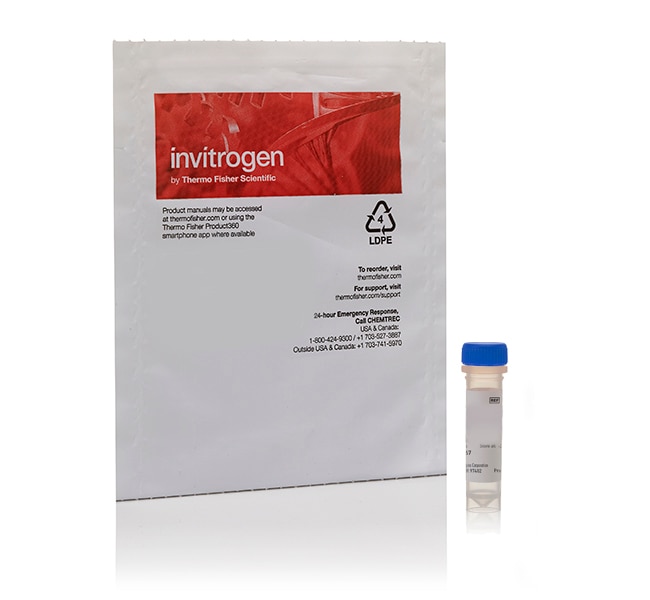
Alexa Fluor™ 555 Cadaverine
Alexa Fluor™ 555カダベリンは、極性トレーサーとして、またカルボン酸部分を介してタンパク質を標識するための反応性色素として有用です。Alexa Fluor™ 555は明るいオレンジ色の色素です。Alexa Fluor™詳細を見る
| 製品番号(カタログ番号) | 数量 |
|---|---|
| A30677 | 1 mg |
製品番号(カタログ番号) A30677
価格(JPY)
70,300
Each
数量:
1 mg
Alexa Fluor™ 555カダベリンは、極性トレーサーとして、またカルボン酸部分を介してタンパク質を標識するための反応性色素として有用です。Alexa Fluor™ 555は明るいオレンジ色の色素です。Alexa Fluor™ 555色素は、イメージングやフローサイトメトリーで安定したシグナルを生成するために使用され、水溶性でpH 4~10の影響を受けません。反応性色素の組成に加えて、細胞の標識および検出用に最適化されたさまざまな抗体、ペプチド、タンパク質、トレーサー、および増幅基質にコンジュゲートしたAlexa Fluor™ 555色素を提供しています。(詳細)
この AlexaFluor™ カダベリンに関する詳細情報:
• フルオロフォア標識:Alexa Fluor™ 555色素
• 反応基:カダベリン
• 反応性:カルボン酸、アルデヒド、ケトン(および酵素触媒反応によるグルタミン残基)
• コンジュゲートのEx/Em:555/572 nm
• 吸光係数:155,000 cm-1M-1
• スペクトルが類似の色素:TRITC
• 分子量:約950
細胞トラッキングおよびトレーシングアプリケーション
Alexa Fluor™カダベリンは、明るく小型で水溶性のため、優れた蛍光極性トレーサーを実現します。アルデヒド固定可能な官能基を持つため、ホルムアルデヒドまたはグルタルアルデヒドでの処理により細胞内で固定できます。これらは、微量注入、パッチピペットからの注入、または当社のInflux™飲作用細胞ローディング試薬によって誘発された取り込みにより、簡単に細胞にロードできます。細胞追跡の詳細をご覧ください。
タンパク質標識アプリケーション
Alexa Fluor™カダベリンは、カルボジイミドなどの結合剤を使用してカルボン酸に蛍光標識を付加する反応分子として使用できます。溶液中のカルボン酸と自然に反応することはありません。しかし、スクシンイミジルエステルやイソチオシアン酸塩などの一般的なアミン反応性官能基と自然に反応します。アミンを含有するAlexa Fluor™カダベリンは、酵素触媒的なトランスアミノ化反応を介して、一部のタンパク質やペプチド中のグルタミン残基の標識にも使用できます。
タンパク質および抗体標識の詳細
当社は、お客様の出発物質および実験設定に適合するMolecular Probes™抗体およびタンパク質標識キットを幅広く取り揃えています。その他の選択肢は、当社の抗体標識キットをご覧になるか、当社の標識化学選択ツールをご利用ください。標識キットの詳細については、Molecular Probes™ハンドブックのタンパク質および核酸の標識キット—セクション 1.2をご覧ください。
当社では、お客様に合わせてカスタムコンジュゲートを実施
当社のオンラインカタログで目的の製品が見つからない場合は、カスタム抗体またはタンパク質コンジュゲートをご用意ください。当社のカスタム結合サービスは効率的かつ機密性が確保され、品質が保証されています。当社はISO 9001:2000認証を取得しています。
関連製品
DMSO(ジメチルスルホキシド)(D12345)
0.5~1 mg用Antibody Conjugate Purification Kit(A33086)
20~50 μg用Antibody Conjugate Purification Kit(A33087)
50~100 μg用Antibody Conjugate Purification Kit(A33088)
この AlexaFluor™ カダベリンに関する詳細情報:
• フルオロフォア標識:Alexa Fluor™ 555色素
• 反応基:カダベリン
• 反応性:カルボン酸、アルデヒド、ケトン(および酵素触媒反応によるグルタミン残基)
• コンジュゲートのEx/Em:555/572 nm
• 吸光係数:155,000 cm-1M-1
• スペクトルが類似の色素:TRITC
• 分子量:約950
細胞トラッキングおよびトレーシングアプリケーション
Alexa Fluor™カダベリンは、明るく小型で水溶性のため、優れた蛍光極性トレーサーを実現します。アルデヒド固定可能な官能基を持つため、ホルムアルデヒドまたはグルタルアルデヒドでの処理により細胞内で固定できます。これらは、微量注入、パッチピペットからの注入、または当社のInflux™飲作用細胞ローディング試薬によって誘発された取り込みにより、簡単に細胞にロードできます。細胞追跡の詳細をご覧ください。
タンパク質標識アプリケーション
Alexa Fluor™カダベリンは、カルボジイミドなどの結合剤を使用してカルボン酸に蛍光標識を付加する反応分子として使用できます。溶液中のカルボン酸と自然に反応することはありません。しかし、スクシンイミジルエステルやイソチオシアン酸塩などの一般的なアミン反応性官能基と自然に反応します。アミンを含有するAlexa Fluor™カダベリンは、酵素触媒的なトランスアミノ化反応を介して、一部のタンパク質やペプチド中のグルタミン残基の標識にも使用できます。
タンパク質および抗体標識の詳細
当社は、お客様の出発物質および実験設定に適合するMolecular Probes™抗体およびタンパク質標識キットを幅広く取り揃えています。その他の選択肢は、当社の抗体標識キットをご覧になるか、当社の標識化学選択ツールをご利用ください。標識キットの詳細については、Molecular Probes™ハンドブックのタンパク質および核酸の標識キット—セクション 1.2をご覧ください。
当社では、お客様に合わせてカスタムコンジュゲートを実施
当社のオンラインカタログで目的の製品が見つからない場合は、カスタム抗体またはタンパク質コンジュゲートをご用意ください。当社のカスタム結合サービスは効率的かつ機密性が確保され、品質が保証されています。当社はISO 9001:2000認証を取得しています。
関連製品
DMSO(ジメチルスルホキシド)(D12345)
0.5~1 mg用Antibody Conjugate Purification Kit(A33086)
20~50 μg用Antibody Conjugate Purification Kit(A33087)
50~100 μg用Antibody Conjugate Purification Kit(A33088)
研究用にのみ使用できます。診断用には使用いただけません。
仕様
化学反応性カルボン酸、ケトン、アルデヒド
発光572 nm
励起555 nm
標識または色素Alexa Fluor™ 555
製品タイプカダベリン
数量1 mg
反応性部分アミン、カダベリン
出荷条件室温
標識タイプAlexa Fluor色素
製品ラインAlexa Fluor
Unit SizeEach
組成および保存条件
フリーザー(-5°C∼-30°C)に保存し、遮光してください。
引用および参考文献 (4)
引用および参考文献
Abstract
Visualization of galectin-3 oligomerization on the surface of neutrophils and endothelial cells using fluorescence resonance energy transfer.
Journal:J Biol Chem
PubMed ID:17082191
'Galectin-3, a member of the galectin family of carbohydrate binding proteins, is widely expressed, particularly in cells involved in the immune response. Galectin-3 has also been indicated to play a role in various biological activities ranging from cell repression to cell activation and adhesion and has, thus, been recognized as
SOI optical microring resonator with poly(ethylene glycol) polymer brush for label-free biosensor applications.
Journal:Biosens Bioelectron
PubMed ID:19200711
Label-free monitoring of biomolecular interactions has become of key importance for the emerging proteomics field. Monitoring real time interaction kinetics and high throughput screening of complex samples is of major importance for a variety of applications. We previously reported the use of Silicon-on-Insulator photonics microring resonators for cheap disposable biosensors
Whole-cell 3D STORM reveals interactions between cellular structures with nanometer-scale resolution.
Journal:Nat Methods
PubMed ID:19029906
The ability to directly visualize nanoscopic cellular structures and their spatial relationship in all three dimensions will greatly enhance our understanding of molecular processes in cells. Here we demonstrated multicolor three-dimensional (3D) stochastic optical reconstruction microscopy (STORM) as a tool to quantitatively probe cellular structures and their interactions. To facilitate
In vivo imaging of membrane-associated glycans in developing zebrafish.
Journal:Science
PubMed ID:18451302
Glycans are attractive targets for molecular imaging but have been inaccessible because of their incompatibility with genetically encoded reporters. We demonstrated the noninvasive imaging of glycans in live developing zebrafish, using a chemical reporter strategy. Zebrafish embryos were treated with an unnatural sugar to metabolically label their cell-surface glycans with