Search


Citations & References (48)
Invitrogen™
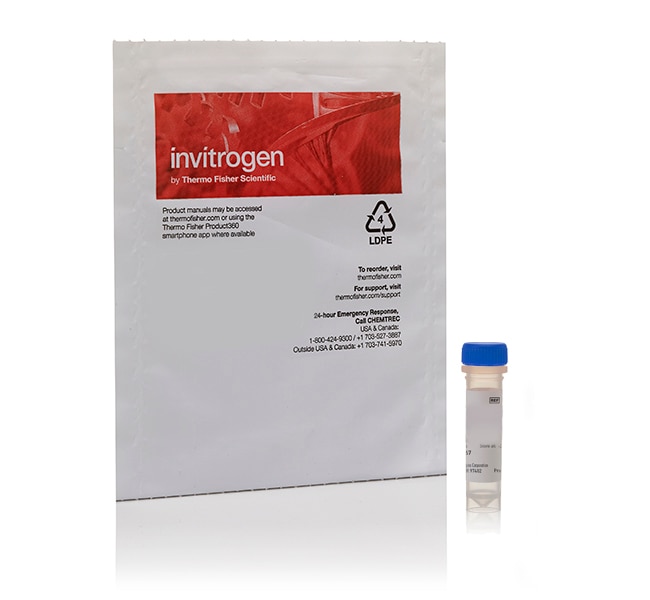
Fluo-4, Pentapotassium Salt, cell impermeant
標識カルシウムインジケーターは、Ca2+と結合すると蛍光が増加する分子です。Fluo-3は、ケージドキレート剤、第二メッセンジャー、神経伝達物質の光活性化を含むフローサイトメトリー実験、および細胞ベースの薬理学的スクリーニングにおいて、Ca2+シグナル伝達の空間力学をイメージングするために使用されています。Fluo-4はFluo-3のアナログで、2つの塩素置換基がフッ素に置き換えられているため詳細を見る
| 製品番号(カタログ番号) | 数量 |
|---|---|
| F14200 | 500 μg |
製品番号(カタログ番号) F14200
価格(JPY)
67,200
Each
数量:
500 μg
標識カルシウムインジケーターは、Ca2+と結合すると蛍光が増加する分子です。Fluo-3は、ケージドキレート剤、第二メッセンジャー、神経伝達物質の光活性化を含むフローサイトメトリー実験、および細胞ベースの薬理学的スクリーニングにおいて、Ca2+シグナル伝達の空間力学をイメージングするために使用されています。Fluo-4はFluo-3のアナログで、2つの塩素置換基がフッ素に置き換えられているため、488 nmでの蛍光励起が増加し、結果的に蛍光シグナルレベルが高くなります。細胞には、パッチピペット、マイクロインジェクション、または当社のInflux™飲作用性細胞ローディング試薬を使用して、これらのインジケーターの細胞不透過性の塩形態を物理的に取り込めます。これらのインジケーターは、蛍光および共焦点顕微鏡、フローサイトメトリー、およびマイクロプレートスクリーニングの各アプリケーションで有用です。
カルシウム、カリウム、pH、膜電位インジケーターなどのイオンインジケーターの詳細をご覧ください›
カルシウムインジケーター(細胞不透過性塩)の仕様:
• 標識(Ca2+–結合型の励起/発光):Fluo-4(494/516 nm)
• Ca2+との結合時の蛍光強度増大:>100倍
• バッファー中のCa2+のKd:約335 nM
• Ca2+結合時に、波長のわずかな変化を伴いながら、蛍光強度が増加
TPENを使用した重金属陽イオンの制御
さらに、BAPTAベースのインジケーターはさまざまな重金属陽イオン(Mn2+、Zn2+、Pb2+など)に結合し、Ca2+よりもはるかに高い親和性を示します。これらのイオンの存在によって引き起こされるカルシウム測定値への摂動は、重金属選択性キレート剤であるTPENを使用して制御できます。
蛍光カルシウムインジケーターの幅広い選択肢
さまざまな実験シナリオで使用できる多様なMolecular Probes™カルシウムインジケーターをご用意しています。詳細については、Molecular Probesハンドブックの「可視光で励起された蛍光Ca2+インジケータ」—セクション19.3™を参照してください。
UV-exitable Ca2+指示薬、タンパク質ベースCa2+指示薬、Ca2+指示薬のコンジュゲート用、その他の金属イオン(Mg2+、Zn2+)の蛍光ベースのインジケータ については、Molecular Probesハンドブック™のCa 2+、Mg 2+、Zn 2+およびその他の金属イオンのインジケータ—第19章を参照してください。
研究用途にのみご使用ください。ヒトまたは動物の治療もしくは診断目的には使用できません。
カルシウム、カリウム、pH、膜電位インジケーターなどのイオンインジケーターの詳細をご覧ください›
カルシウムインジケーター(細胞不透過性塩)の仕様:
• 標識(Ca2+–結合型の励起/発光):Fluo-4(494/516 nm)
• Ca2+との結合時の蛍光強度増大:>100倍
• バッファー中のCa2+のKd:約335 nM
• Ca2+結合時に、波長のわずかな変化を伴いながら、蛍光強度が増加
TPENを使用した重金属陽イオンの制御
さらに、BAPTAベースのインジケーターはさまざまな重金属陽イオン(Mn2+、Zn2+、Pb2+など)に結合し、Ca2+よりもはるかに高い親和性を示します。これらのイオンの存在によって引き起こされるカルシウム測定値への摂動は、重金属選択性キレート剤であるTPENを使用して制御できます。
蛍光カルシウムインジケーターの幅広い選択肢
さまざまな実験シナリオで使用できる多様なMolecular Probes™カルシウムインジケーターをご用意しています。詳細については、Molecular Probesハンドブックの「可視光で励起された蛍光Ca2+インジケータ」—セクション19.3™を参照してください。
UV-exitable Ca2+指示薬、タンパク質ベースCa2+指示薬、Ca2+指示薬のコンジュゲート用、その他の金属イオン(Mg2+、Zn2+)の蛍光ベースのインジケータ については、Molecular Probesハンドブック™のCa 2+、Mg 2+、Zn 2+およびその他の金属イオンのインジケータ—第19章を参照してください。
研究用途にのみご使用ください。ヒトまたは動物の治療もしくは診断目的には使用できません。
研究用にのみ使用できます。診断用には使用いただけません。
仕様
検出法蛍光
染色剤タイプFluo-4
放射波長516 nm
励起波長494 nm
数量500 μg
出荷条件室温
使用対象(アプリケーション)Calcium Indicator
使用対象 (装置)共焦点顕微鏡, 蛍光顕微鏡, ハイコンテント装置, HTSリーダー, マイクロプレートリーダー, 蛍光イメージャー
製品タイプカルシウムインジケーター
Unit SizeEach
組成および保存条件
フリーザー(-5°C~-30°C)に保存し、遮光してください。
よくあるご質問(FAQ)
Can I use Fluo-4, Pentapotassium Salt, cell impermeant (Cat. No. F14200) in low pH conditions (pH 4-5)?
引用および参考文献 (48)
引用および参考文献
Abstract
A component of excitation-contraction coupling triggered in the absence of the T671-L690 and L720-Q765 regions of the II-III loop of the dihydropyridine receptor alpha(1s) pore subunit.
Journal:Biophys J
PubMed ID:11720993
'We conducted a deletion analysis of two regions identified in the II-III loop of alpha(1S), residues 671-690, which were shown to bind to ryanodine receptor type 1 (RyR1) and stimulate RyR1 channels in vitro, and residues 720-765 or the narrower 724-743 region, which confer excitation-contraction (EC) coupling function to chimeric
Initiation and propagation of regenerative Ca(2+)-dependent potentials in dendrites of layer 5 pyramidal neurons.
Journal:J Neurophysiol
PubMed ID:11431528
'The initiation and propagation of dendritic Ca(2+)-dependent regenerative potentials (CDRPs) were investigated by imaging the Ca(2+)-sensitive dye Fluo-4 during whole cell recording from the soma of layer 5 pyramidal neurons visualized in a slice preparation of rat neocortex by the use of infrared-differential interference contrast microscopy. CDRPs were evoked by
Integration of multianalyte sensing functions on a capillary-assembled microchip: simultaneous determination of ion concentrations and enzymatic activities by a "drop-and-sip" technique.
Journal:Anal Chem
PubMed ID:17263315
'A general and simple implementation of simultaneous multiparametric sensing in a single microchip is presented by using a capillary-assembled microchip (CAs-CHIP) integrated with the plural different reagent-release capillaries (RRCs), acting as various biochemical sensors. A novel "drop-and-sip" technique of fluid handling is performed with a microliter droplet of a model
NAADP controls cross-talk between distinct Ca2+ stores in the heart.
Journal:J Biol Chem
PubMed ID:17387177
'In cardiac muscle the sarcoplasmic reticulum (SR) plays a key role in the control of contraction, releasing Ca(2+) in response to Ca(2+) influx across the sarcolemma via voltage-gated Ca(2+) channels. Here we report evidence for an additional distinct Ca(2+) store and for actions of nicotinic acid adenine dinucleotide phosphate (NAADP)
Long-term potentiation of exogenous glutamate responses at single dendritic spines.
Journal:Proc Natl Acad Sci U S A
PubMed ID:16186507
'Long-term increases in the strength of excitatory transmission at Schaffer collateral-CA1 cell synapses of the hippocampus require the insertion of new alpha-amino-3-hydroxy-5-methyl-4-isoxazolepropionate receptors (AMPARs) into the synapse, but the kinetics of this process are not well established. Using microphotolysis of caged glutamate to activate receptors at single dendritic spines in