Search


Citations & References (1)
Invitrogen™
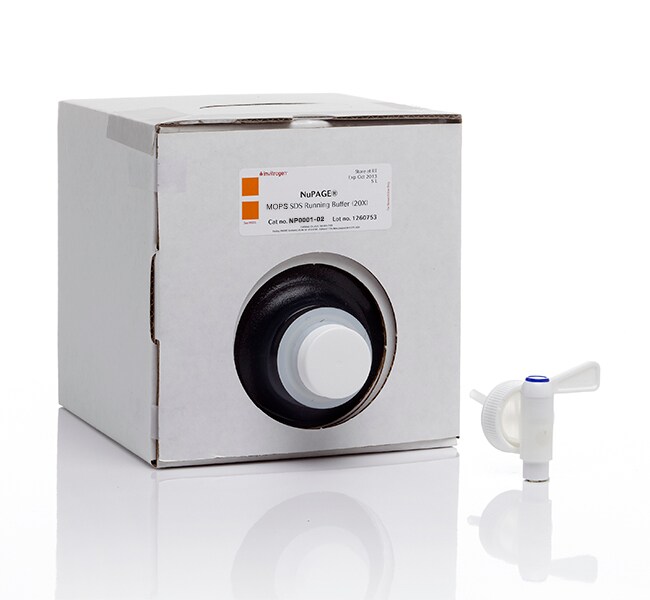
NuPAGE™ MOPS SDS Running Buffer (20X)
NuPAGE MOPS SDS泳動バッファー(20X)は、NuPAGE Novex Bis-Trisゲルでのタンパク質泳動用に調製されています。中~大サイズのタンパク質の分離に推奨されます。タンパク質の分離を最適化する適切なバッファーをご使用ください詳細を見る


製品番号(カタログ番号) NP000102
価格(JPY)
133,100
Each
数量:
5 L
NuPAGE MOPS SDS泳動バッファー(20X)は、NuPAGE Novex Bis-Trisゲルでのタンパク質泳動用に調製されています。中~大サイズのタンパク質の分離に推奨されます。
タンパク質の分離を最適化する適切なバッファーをご使用ください
NuPAGE MES SDS泳動バッファーおよびNuPAGE MOPS SDS泳動バッファーはどちらもNuPAGE Bis-Trisゲルで使用できます。MESのpKaはMOPSよりも低いため、MES SDS泳動バッファーはMOPS SDS泳動バッファーよりも高速です。イオン移動の差異はスタッキングに影響することから、これらのバッファーでのタンパク質の分離範囲に差が生じます。MOPSバッファーを使用すると、MESバッファーを使用する場合よりもタンパク質の泳動速度を遅くすることができます。
MESを使用した場合とMOPSを使用した場合のNuPAGE Bis-Trisゲルでのタンパク質移動の比較
SDS-PAGEに使用可能なすべてのバッファーと試薬の一覧
タンパク質の分離を最適化する適切なバッファーをご使用ください
NuPAGE MES SDS泳動バッファーおよびNuPAGE MOPS SDS泳動バッファーはどちらもNuPAGE Bis-Trisゲルで使用できます。MESのpKaはMOPSよりも低いため、MES SDS泳動バッファーはMOPS SDS泳動バッファーよりも高速です。イオン移動の差異はスタッキングに影響することから、これらのバッファーでのタンパク質の分離範囲に差が生じます。MOPSバッファーを使用すると、MESバッファーを使用する場合よりもタンパク質の泳動速度を遅くすることができます。
MESを使用した場合とMOPSを使用した場合のNuPAGE Bis-Trisゲルでのタンパク質移動の比較
SDS-PAGEに使用可能なすべてのバッファーと試薬の一覧
研究用にのみ使用できます。診断用には使用いただけません。
仕様
化学物質名または材質Running Buffer
組成50 mM MOPS, 50 mM Tris Base, 0.1% SDS, 1 mM EDTA, pH 7.7, 0.01-0.09% N,N-dimethylformamide
推奨保存方法Contents: NuPAGE™ MOPS SDS Running Buffer (20X)
Storage: +4°C to 25°C
Storage: +4°C to 25°C
濃度20X
物理的フォームLiquid
製品ラインNuPAGE
数量5 L
pH7.7
Unit SizeEach
よくあるご質問(FAQ)
Can I prepare my protein sample with the reducing agent and store it for future use?
My LDS or SDS sample buffer precipitates when stored at 4 degrees C. Can I warm it up? Can I store it at room temperature?
How are Bolt gels different than NuPAGE gels?
What is the advantage of NuPAGE Gels over regular Tris-Glycine gels?
Can I use NuPAGE Bis-Tris gels with NuPAGE MOPS or MES Running Buffer prepared without SDS for electrophoresis under native conditions?
引用および参考文献 (1)
引用および参考文献
Abstract
Heat shock protein-70 expressed on the surface of cancer cells binds parathyroid hormone-related protein in vitro.
Journal:Endocrinology
PubMed ID:15878959
Recent studies have shown that the functions of PTH-related protein (PTHrP) and its derived peptides cannot be attributed solely to PTH/PTHrP receptor binding. The present study focused on the identification of other proteins that might bind PTHrP at the cell surface. Using affinity chromatography, we applied extracts of cell-surface biotinylated