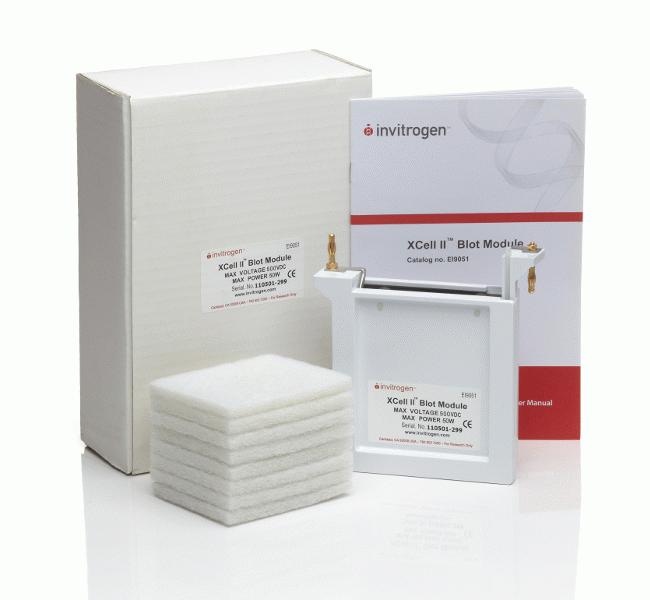
XCell II™ Blot Module
Invitrogen™

XCell II™ Blot Module

XCell IIブロットモジュールは、XCell SureLockまたはXCell IIシステム用のミニゲルウェット式転写モジュールです。XCell IIブロットモジュールを使用すると、200 mL未満の転写バッファーでミニゲルから膜にウェスタン、サザン詳細を見る
製品番号(カタログ番号)数量
EI90511 unit
製品番号(カタログ番号) EI9051
価格(JPY)
93,500
Each
お問い合わせください ›
数量:
1 unit
XCell IIブロットモジュールは、XCell SureLockまたはXCell IIシステム用のミニゲルウェット式転写モジュールです。XCell IIブロットモジュールを使用すると、200 mL未満の転写バッファーでミニゲルから膜にウェスタン、サザン、およびノーザンの各転写でタンパク質や核酸を簡単に転写できます。頑丈な白金めっきチタンとステンレス製の電極により、クランプやヒンジ付きゲルホルダーを使用しなくても均一な電場を形成できます。最大ブロットサイズは9 cm x 9 cmです。

使用可能なすべての転写システムを見る›

研究用にのみ使用できます。診断用には使用いただけません。
仕様
容量最大2枚のミニゲル
使用対象 (装置)XCell SureLock™ミニ
ゲルサイズ最小(8 cmx8 cm)
移送モードウェット
数量1 unit
動作寸法垂直
出荷条件室温
Gel CompatibilityBolt™ Bis-Tris Plusゲル、NuPAGE™ゲル、Novex™ミニゲル
製品ラインXCell II
製品タイプブロットモジュール
Unit SizeEach
組成および保存条件
XCell II™ブロットモジュールには、陽極コア、陰極コア、スポンジパッド(8個/パック)、取扱説明書が含まれています。

よくあるご質問(FAQ)

Are Bolt gels compatible with transfer devices from other suppliers?

Yes. While we would prefer that you use our devices, Bolt gels can also be transferred using devices from Bio-Rad, including the Mini Trans-Blot Cell, Trans-Blot SD Semi-Dry Transfer Cell, or Trans-Blot Turbo Transfer System.

Find additional tips, troubleshooting help, and resources within our Protein Electrophoresis and Western Blotting Support Center.

How can I improve transfer efficiency for larger proteins during western blotting?

Here are some options for obtaining more efficient transfer for larger proteins:

1) Pre-equilibrate the gel with 0.02 to 0.04% SDS in 2X transfer buffer without methanol for 10 min before assembling the sandwich.

2) Increase the blotting time incrementally (in 15 min intervals).

3) Add 0.01% or 0.02% SDS to the transfer buffer to help facilitate the migration of the protein out of the gel.

4) Decrease the methanol content in the transfer buffer.

5) Switch to a more appropriate lower-percentage gel. A lower-percentage gel may allow better transfer than a higher-percentage gel.

Find additional tips, troubleshooting help, and resources within our Protein Electrophoresis and Western Blotting Support Center.

Do I have to run the XCell Blot Module under cold conditions?

No. The solution placed in the outer chamber serves to dissipate the heat generated during blotting. Water is usually used for this purpose. The recommended transfer conditions generate only a minor heat increase, so it is not necessary to run the unit in an ice bucket or to place it in a cold room. However if you are working with very heat-sensitive proteins, you may wish to do so.

Find additional tips, troubleshooting help, and resources within our Protein Electrophoresis and Western Blotting Support Center.

How can I remove residual build-up in the XCell II Blot Module?

Build-up can be removed with 50% nitric acid. Make a solution of 50% nitric acid in deionized water and carefully apply it to areas inside the blot module until residual build-up is removed. Do not submerge the blot module or soak overnight. Use gloves when preparing the solution. Afterwards, rinse the module thoroughly at least three times in fresh deionized water. This treatment should not harm the plastic.

Find additional tips, troubleshooting help, and resources within our Protein Electrophoresis and Western Blotting Support Center.

Can Invitrogen gels be blotted with a Invitrogen Semi-Dry Blotter?

The NuPAGE Invitrogen Bis-Tris Gels do not transfer efficiently using a Invitrogen Semi-Dry Blotter as compared to blotting with XCell II Blot Module.
If you decide to use Invitrogen Semi-Dry Blotter for NuPAGE Invitrogen Bis-Tris Gels, use the protocol provided below to ensure efficient transfer of proteins.

1) Prepare 100 mL of 2X NuPAGE Transfer Buffer from 20X NuPAGE Transfer Buffer as follows:
NuPAGE Transfer Buffer (20X) 10.0 mL
NuPAGE Antioxidant (for reduced sample) 0.1 mL
Methanol 10.0 mL
Deionized water 79.9 mL
Total Volume 100 mL
If you are blotting large proteins, please see the Note below.

2) Soak the filter paper and transfer membrane in the transfer buffer.
If you are using Invitrogen pre-cut membrane/filter sandwiches, use three filter papers (0.4 mm/filter in thickness) on each side of the gel or membrane.
If you are not using the Invitrogen pre-cut membrane/filter sandwiches, use two thick filter papers.

3) Assemble the gel/membrane/filter paper sandwich on top of the anode plate as follows:
filter paper
filter paper
filter paper
membrane
gel
filter paper
filter paper
filter paper

4) Perform the transfer at 15 V (constant) for 15 min if you are using the Bio-Rad Trans-Blot Semi-Dry Transfer Cell. For any other semi-dry transfer cell, follow the manufacturer's recommendations.

Note: For transfer of large proteins (>100 kDa), pre-equilibrate the gel in 2X NuPAGE Transfer Buffer (without methanol) containing 0.02-0.04% SDS for 10 min before assembling the sandwich.

Find additional tips, troubleshooting help, and resources within our Protein Electrophoresis and Western Blotting Support Center.

引用および参考文献 (7)

引用および参考文献
Abstract
Cercarial Elastase Is Encoded by a Functionally Conserved Gene Family across Multiple Species of Schistosomes.
Authors:Salter Jason P.; Choe Youngchool; Albrecht Hugo; Franklin Christopher; Lim Kee-Chong; Craik Charles S.; McKerrow James H.;
Journal:J Biol Chem
PubMed ID:11986325
Water borne cercaria(ae) of the trematode genus Schistosoma rapidly penetrate host skin. A single serine protease activity, cercarial elastase, is deposited in advance of the invading parasite by holocytosis of vesicles from ten large acetabular gland cells. Cercarial elastase activity is a composite of multiple isoforms. Genes coding for the ... More
Definition of genetically distinct attenuation mechanisms in naturally virulence-attenuated Listeria monocytogenes by comparative cell culture and molecular characterization.
Authors:Roberts A, Chan Y, Wiedmann M,
Journal:Appl Environ Microbiol
PubMed ID:16000803
'Listeria monocytogenes is a foodborne pathogen able to cause serious disease in humans and animals. Not all isolates are equally pathogenic, however, and several isolates have been characterized as naturally virulence attenuated. We sought to identify the genetic basis of natural virulence attenuation using cell culture assays and molecular techniques. ... More
Combined effect of epinephrine and exercise on calpain/calpastatin and cathepsin B and L activity in porcine longissimus muscle.
Authors:Ertbjerg P, Henckel P, Karlsson A, Larsen LM, Møller AJ,
Journal:J Anim Sci
PubMed ID:10492449
The objective of the study was to improve the understanding of the relationship between the effect of epinephrine plus exercise and meat tenderness. The calpain, calpastatin, and cathepsin B + L activities and postmortem proteolysis in porcine longissimus muscle were studied. The muscle glycogen stores were depleted in five pigs ... More
Regulation of the mitogen-activated protein kinase p44 ERK activity during anoxia/recovery in rainbow trout hypodermal fibroblasts.
Authors:Ossum CG, Wulff T, Hoffmann EK,
Journal:J Exp Biol
PubMed ID:16621957
It is well known from various mammalian cells that anoxia has a major impact on the mitogen-activated protein kinase ERK, but a possible similar effect in fish cells has not been investigated. Here we characterise a p44ERK-like protein in the rainbow trout cell line RTHDF and study the effect of ... More
Separate basic region motifs within the adeno-associated virus capsid proteins are essential for infectivity and assembly.
Authors:Grieger JC, Snowdy S, Samulski RJ,
Journal:J Virol
PubMed ID:16699000
Adeno-associated virus (AAV) is gaining momentum as a gene therapy vector for human applications. However, there remain impediments to the development of this virus as a vector. One of these is the incomplete understanding of the biology of the virus, including nuclear targeting of the incoming virion during initial infection, ... More