Search


Citations & References (27)
Invitrogen™
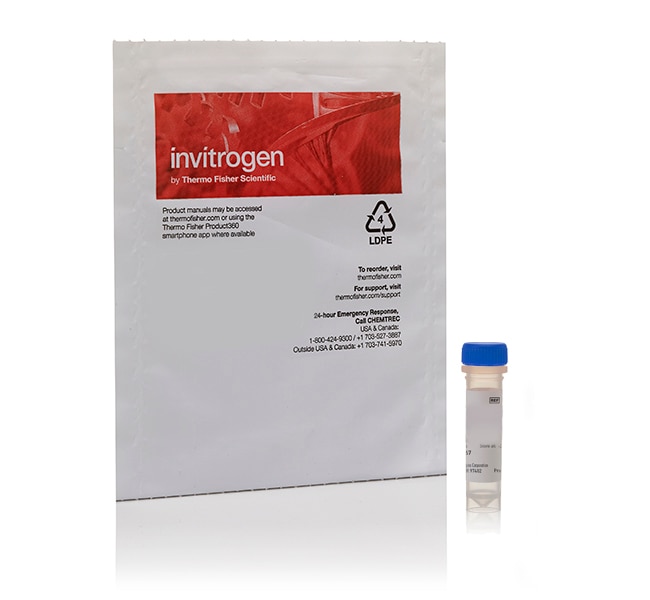
FluoZin™-3, Tetrapotassium Salt, cell impermeant
FluoZin™-3インジケータは、fluo-4に類似した構造を持つ Zn 2+選択的インジケータです。FluoZin™-3は、Zn2+結合親和性が高く、少なくとも1 μMまでは、Ca2+濃度には影響されません。また詳細を見る
| 製品番号(カタログ番号) | 数量 |
|---|---|
| F24194 | 500 μg |
製品番号(カタログ番号) F24194
価格(JPY)
69,800
Each
数量:
500 μg
FluoZin™-3インジケータは、fluo-4に類似した構造を持つ Zn 2+選択的インジケータです。FluoZin™-3は、Zn2+結合親和性が高く、少なくとも1 μMまでは、Ca2+濃度には影響されません。また、FluoZin™-3は、Zn2+の飽和レベルに応じて蛍光が50倍以上増加します。FluoZin™-3のイメージングアプリケーションが主流ですが、細胞ベースのマイクロプレートアッセイやフローサイトメトリープロトコルも開発されています。FluoZin™-3インジケータは、細胞透過型および細胞不透過の形態で提供されています。
カルシウム、カリウム、pH、および膜電位インジケータを含むイオンインジケータの詳細については、こちらを参照してください›
蛍光亜鉛インジケータ仕様:
•ラベル(Ex/EM):FluoZin™-3(約494/516 nm)
• Kd(Zn2+)(バッファー内):約15 nm
•凍結乾燥した製品を蒸留水または水性バッファーに溶解して使用できます
•製品は通常、パッチピペットからマイクロインジェクションまたは拡散を使用して細胞にロードされます
亜鉛およびその他の金属イオンの蛍光インジケーターを探します
当社は、細胞内の多価陽イオン濃度の測定、イオンチャンネルを介した金属イオン輸送の追跡、環境サンプルを測定するための蛍光インジケーターを多数提供しています。これらの製品の詳細については、『分子プローブ™ハンドブック』の「Zn2+およびその他の金属イオン用蛍光インジケータ—セクション19.7」を参照してください。
研究用途にのみご使用ください。ヒトまたは動物の治療もしくは診断目的には使用できません。
カルシウム、カリウム、pH、および膜電位インジケータを含むイオンインジケータの詳細については、こちらを参照してください›
蛍光亜鉛インジケータ仕様:
•ラベル(Ex/EM):FluoZin™-3(約494/516 nm)
• Kd(Zn2+)(バッファー内):約15 nm
•凍結乾燥した製品を蒸留水または水性バッファーに溶解して使用できます
•製品は通常、パッチピペットからマイクロインジェクションまたは拡散を使用して細胞にロードされます
亜鉛およびその他の金属イオンの蛍光インジケーターを探します
当社は、細胞内の多価陽イオン濃度の測定、イオンチャンネルを介した金属イオン輸送の追跡、環境サンプルを測定するための蛍光インジケーターを多数提供しています。これらの製品の詳細については、『分子プローブ™ハンドブック』の「Zn2+およびその他の金属イオン用蛍光インジケータ—セクション19.7」を参照してください。
研究用途にのみご使用ください。ヒトまたは動物の治療もしくは診断目的には使用できません。
研究用にのみ使用できます。診断用には使用いただけません。
仕様
検出法蛍光
染色剤タイプ亜鉛インジケータ
数量500 μg
出荷条件室温
使用対象 (装置)蛍光顕微鏡
製品ラインFluoZin
製品タイプ亜鉛インジケータ
Unit SizeEach
組成および保存条件
フリーザー(-5°C~-30°C)に保存し、遮光してください。
引用および参考文献 (27)
引用および参考文献
Abstract
Uncoupling of the base excision and nucleotide incision repair pathways reveals their respective biological roles.
Journal:Proc Natl Acad Sci U S A
PubMed ID:16473948
'The multifunctional DNA repair enzymes apurinic/apyrimidinic (AP) endonucleases cleave DNA at AP sites and 3''-blocking moieties generated by DNA glycosylases in the base excision repair pathway. Alternatively, in the nucleotide incision repair (NIR) pathway, the same AP endonucleases incise DNA 5'' of a number of oxidatively damaged bases. At present,
Fluorescence imaging study of extracellular zinc at the hippocampal mossy fiber synapse.
Journal:Neurosci Lett
PubMed ID:17485170
'Although synaptically released, vesicular Zn(2+) has been proposed to play a neuromodulatory or neuronal signaling role at the mossy fiber-CA3 synapse, Zn(2+) release remains controversial, especially when detected using fluorescent imaging. In the present study, we investigated synaptically released Zn(2+) at the mossy fiber (MF) synapse in rat hippocampal slices
Determining zinc with commonly used calcium and zinc fluorescent indicators, a question on calcium signals.
Journal:Cell Calcium
PubMed ID:16764924
'Investigations into the roles of Ca(2+) and Zn(2+) in cell biology have been facilitated by the development of sensitive fluorometric probes that have enabled the measurement of Ca(2+) or Zn(2+) in both extracellular and intracellular environments. It is critical to be aware of the specificity and relative selectivity of a
Integration of multianalyte sensing functions on a capillary-assembled microchip: simultaneous determination of ion concentrations and enzymatic activities by a "drop-and-sip" technique.
Journal:Anal Chem
PubMed ID:17263315
'A general and simple implementation of simultaneous multiparametric sensing in a single microchip is presented by using a capillary-assembled microchip (CAs-CHIP) integrated with the plural different reagent-release capillaries (RRCs), acting as various biochemical sensors. A novel "drop-and-sip" technique of fluid handling is performed with a microliter droplet of a model
Dual nanomolar and picomolar Zn(II) binding properties of metallothionein.
Journal:J Am Chem Soc
PubMed ID:17696343
'Each of the seven Zn(II) ions in the Zn(3)S(9) and Zn(4)S(11) clusters of human metallothionein is in a tetrathiolate coordination environment. Yet analysis of Zn(II) association with thionein, the apoprotein, and analysis of Zn(II) dissociation from metallothionein using the fluorescent chelating agents FluoZin-3 and RhodZin-3 reveal at least three classes