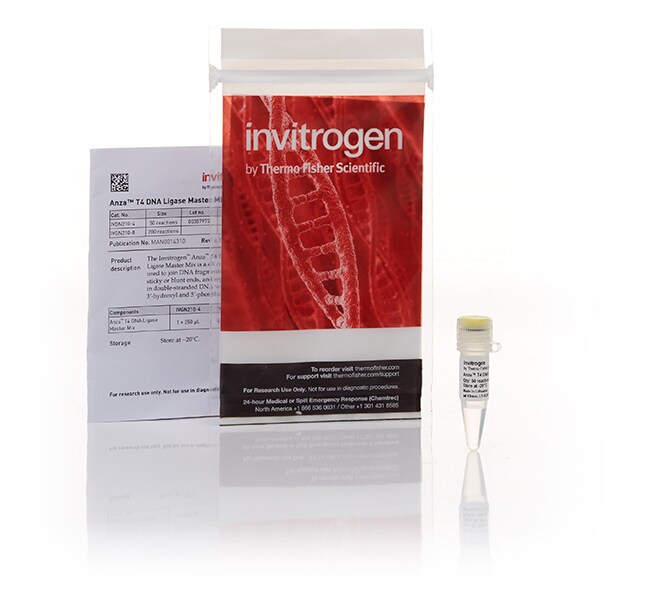
Anza™ T4 DNA Ligase Master Mix
Invitrogen™

Anza™ T4 DNA Ligase Master Mix

Invitrogen Anza™ T4 DNAリガーゼマスターミックスは、ホスホジエステル結合の形成を通じて、二本鎖DNAの隣接する5’-リン酸末端と3’-ヒドロキシル末端の結合を促進します。付着末端と平滑末端の両方を持つDNA断片の結合や、3'-ヒドロキシル末端および5’-リン酸末端を持つ二本鎖DNAのニックの修復に使用できます。Anza T4詳細を見る
製品番号(カタログ番号)数量
IVGN2108200反応
IVGN210450反応
製品番号(カタログ番号) IVGN2108
価格(JPY)
120,900
Each
お問い合わせください ›
数量:
200反応
Invitrogen Anza™ T4 DNAリガーゼマスターミックスは、ホスホジエステル結合の形成を通じて、二本鎖DNAの隣接する5’-リン酸末端と3’-ヒドロキシル末端の結合を促進します。付着末端と平滑末端の両方を持つDNA断片の結合や、3'-ヒドロキシル末端および5’-リン酸末端を持つ二本鎖DNAのニックの修復に使用できます。Anza T4 DNAリガーゼは、4倍濃縮マスターミックスとして製造されています。DNAライゲーションは、水、TE、溶出バッファー、または1倍のAnza™バッファー中で行えます。

利点:
• ライゲーションは室温、15分で完了
• 1つのリガーゼマスターミックスで、付着末端と平滑末端の両方のライゲーション反応に対応
• すぐに使用できるマスターミックスフォーマットでピペット操作を削減
• 4倍濃縮のため、濃縮することなく、より多くの希釈DNAをライゲーション反応に使用可能

Anza T4 DNAリガーゼマスターミックスは、Anza™制限酵素クローニングシステムの一部で、従来のクローニングプロセスを統合しています。その他のAnza DNA修飾酵素には、Anza T4 PNKキットAnza DNA平滑末端キットAnza DNA末端修復キットがあります。
研究用にのみ使用できます。診断用には使用いただけません。
仕様
適合バッファー溶出バッファー、1X Anzaバッファー
製品タイプT4 DNA Ligase Master Mix
数量200反応
出荷条件氷水またはドライアイスでの出荷が承認されています
濃度4X
酵素T4 DNAリガーゼ
製品ラインAnza
Unit SizeEach
組成および保存条件
1 mLのAnza T4 DNAリガーゼマスターミックス

-5℃~-30℃で保存してください。

よくあるご質問(FAQ)

What are the recommended conditions for blunt-ended ligations?

Generally, ligations are done in a 20 µL volume. Use a total of 100 to 1000 ng of DNA with an insert to vector ratio of 3:1. Add 1.0 units (Weiss) ligase to the reaction. Incubate at room temperature for 4 h or overnight at 14-16 degrees C.

Ideally, assemble several reactions with varying ratios of vector:insert (i.e. 3:1, 5:1, 10:1, 20:1, etc.) to determine the optimal ratio for ligation.

Thermo Fisher Scientific offers T4 DNA ligase at two concentrations: 1 U/µL (Cat. No. 15224-017) and 5 U/µL (Cat. No. 15224-041). When performing blunt or TA cloning ligations, the higher concentration of ligase is generally preferred since ligating a blunt or single base overhang requires more enzyme.

What are the recommended conditions for cohesive-end ligations?

Generally, ligations are done in a 20 µL volume. Use a total of 10 to 100 ng of DNA per reaction with an insert to vector ratio of 3:1. Add 0.1 units (Weiss) ligase to the reaction. Incubate at room temperature for 30-60 minutes.

Optimal ligation may occur at other ratios (e.g. 1:5, 1:10). If possible, assemble several ligation reactions of varying insert to vector ratios in order to reveal the optimal ligation conditions.

Thermo Fisher Scientific offers T4 DNA ligase at two concentrations: 1 U/µL (Cat. No. 15224-017) and 5 U/µL (Cat. No. 15224-041). When performing blunt or TA cloning ligations, the higher concentration of ligase is generally preferred since ligating a blunt or single base overhang requires more enzyme.

Which is better to use, T4 or E. coli DNA ligase?

It depends on your application. For ligation of dsDNA fragments with cohesive ends, either enzyme can be used. E. coli DNA ligase requires the presence of beta-NAD, while T4 DNA ligase requires ATP. However, only T4 DNA ligase can join blunt-ended DNA fragments - E. coli ligase is unable to join such fragments.

E. coli DNA ligase is generally used to eliminate nicks during second-strand cDNA synthesis. T4 DNA ligase should not be substituted for E. coli DNA ligase in second-strand synthesis because of its capability for blunt end ligation of the ds cDNA fragments, which could result in formation of chimeric inserts.

Why is ATP present in the reaction buffer for T4 DNA Ligase?

ATP is necessary for enzymatic function. It is involved in phosphorylating the ligase prior to the ligation reaction. Ligation efficiency is markedly reduced by removing ATP from the reaction. It is important, therefore, to handle the buffer appropriately in order to minimize degradation of ATP.

What are some of the problems associated with sticky-end cloning?

The amplified DNA needs to be purified from the PCR mixture components prior to cloning. The dNTPs carried over from the PCR are competitive inhibitors for ATP in the ligation reaction.

If during synthesis of the PCR primers their chemical integrity has been compromised by either a base substitution or modification, the enzyme recognition site may in actuality not exist. If this is the case, PCR products will be resistant to digestion with restriction enzymes. It may be necessary to use a higher concentration of the restriction enzyme and to incubate at the appropriate temperature overnight to ensure cutting.