Search


인용 및 참조 문헌 (1)
Invitrogen™
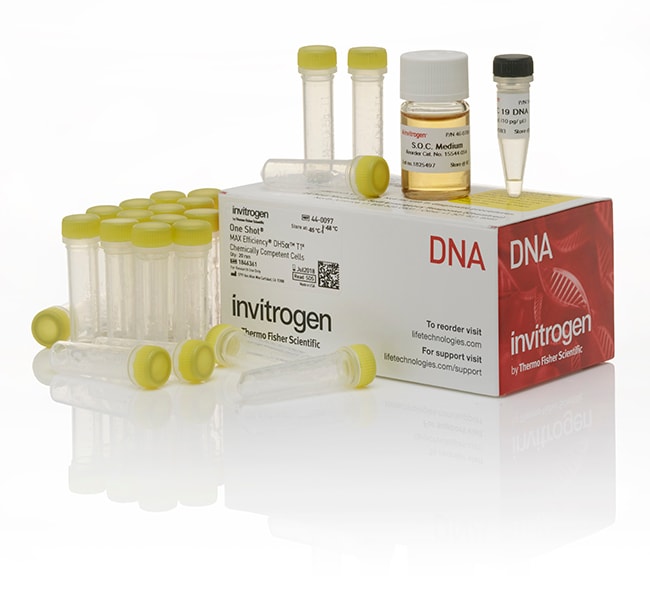
One Shot™ MAX Efficiency™ DH5α-T1R Competent Cells
One Shot MAX Efficiency DH5α-T1R Competent Cells are derived from the popular DH5α strain and carry the tonA (fhuA) mutation자세히 알아보기
| 카탈로그 번호 | 수량 |
|---|---|
| 12297016 | 21 x 50 μL |
카탈로그 번호 12297016
제품 가격(KRW)
299,000
온라인 행사
Ends: 31-Dec-2026
341,000할인액 42,000
Each
수량:
21 x 50 μL
제품 가격(KRW)
299,000
온라인 행사
Ends: 31-Dec-2026
341,000할인액 42,000
Each
One Shot MAX Efficiency DH5α-T1R Competent Cells are derived from the popular DH5α strain and carry the tonA (fhuA) mutation that confers resistance to T1 and T5 phage. They offer added security to protect valuable clones and libraries. This is especially important for genome and sequencing centers where T1 phage infection would be detrimental.
DH5α-T1R is a versatile strain that can be used in many everyday cloning applications. Prepared by a proprietary modification of the Hanahan method, these cells are suitable for the construction of gene banks or for the generation of cDNA libraries using plasmid-derived vectors. The lacZ∆M15 marker provides α-complementation of the ß-galactosidase gene from pUC or similar vectors and therefore can be used for blue/white screening of colonies on bacterial plates containing Bluo-gal or X-gal. DH5α-T1R Competent Cells are capable of being transformed efficiently with large plasmids and can also serve as a host for the M13mp cloning vectors if a lawn of DH5αF'IQ is provided to allow plaque formation.
Benefits of MAX Efficiency DH5α-T1R Competent Cells
• Transformation efficiency of >1 x 10⁹ transformants/μg with non-saturating amounts of DNA
• tonA (fhuA) mutation to confer resistance to T1 and T5 phage
• endA1 mutation that enables cleaner DNA preparations and better results in downstream applications due to the elimination of nonspecific digestion by Endonuclease I
• recA1 mutation that reduces occurrence of unwanted recombination in cloned DNA
• hsdR for efficient transformation of unmethylated DNA from PCR applications
• lacZΔM15 marker that allows blue/white color screening of recombinant clones carrying the alpha fragment of β-galactosidase
Convenient and efficient format
DH5α-T1R E. coli are supplied in the convenient, single-reaction One Shot format. Each tube contains enough cells for one transformation so there are no efficiency-zapping, freeze-thaw cycles or money wasted on unused cells.
Genotype: F- φ80lacZΔM15 Δ(lacZYA-argF)U169 recA1 endA1 hsdR17(rK-, mK+) phoA supE44 thi-1 gyrA96 relA1 tonA
Find the strain and format that fits you needs
DH strains are available in chemically competent and electrocompetent cell formats.
MAX Efficiency DH5αF´IQ Competent Cells are available in chemically competent format.
DH5α-T1R is available in Multishot format for high throughput applications.
For Research Use Only. Not for use in diagnostic procedures.
사양
항생제 내성 박테리아No
블루/화이트 스크리닝Yes (lacZΔM15)
메틸화 DNA 클로닝No
불안정 DNA 클로닝Not suitable for cloning unstable DNA
에프에피솜 포함No
고처리량 호환성Low
플라스미드 품질 개선Yes (endA1)
비메틸화 DNA 준비No
제품라인One Shot
제품 유형Chemically Competent Cells
수량21 x 50 μL
재조합 감소Yes (recA1)
배송 조건Dry Ice
T1 Phage - 저항성(tonA)Yes
형질전환 효율 수준High Efficiency (>1 x 10⁹ cfu/μg)
형식Tube
종E. coli (K12)
Unit SizeEach
구성 및 보관
• One Shot MAX Efficiency DH5α-T1R Competent Cells (21 x 50 μL)
Store Competent Cells at –80°C.
• pUC19 DNA (50 μL 10 pg/μL)
Store pUC19 DNA at –20°C.
• S.O.C. Medium (6 mL)
Store S.O.C. Medium at 4°C or room temperature.
Store Competent Cells at –80°C.
• pUC19 DNA (50 μL 10 pg/μL)
Store pUC19 DNA at –20°C.
• S.O.C. Medium (6 mL)
Store S.O.C. Medium at 4°C or room temperature.
자주 묻는 질문(FAQ)
How do you recommend that I prepare my DNA for successful electroporation of E. coli?
You offer competent cells in Subcloning Efficiency, Library Efficiency and MAX Efficiency. How do these differ?
Do any Invitrogen competent cells contain DMSO in the freezing medium?
When should DMSO, formamide, glycerol and other cosolvents be used in PCR?
인용 및 참조 문헌 (1)
인용 및 참조 문헌
Abstract
Haemophilus influenzae type b strain A2 has multiple sialyltransferases involved in lipooligosaccharide sialylation.
Journal:J Biol Chem
PubMed ID:11842084
The lipooligosaccharide (LOS) of Haemophilus influenzae contains sialylated glycoforms, and a sialyltransferase, Lic3A, has been previously identified. We report evidence for two additional sialyltransferases, SiaA, and LsgB, that affect N-acetyllactosamine containing glycoforms. Mutations in genes we have designated siaA and lsgB affected only the sialylated glycoforms containing N-acetylhexosamine. A mutation