Search
 Element Search
 Structure Search


Thermo Scientific Chemicals
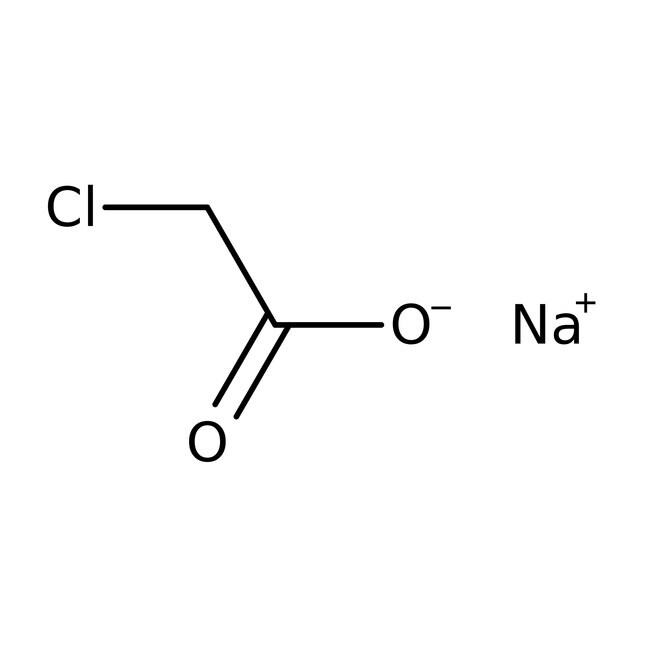
Sodium chloroacetate, 98%
CAS: 3926-62-3 | C2H2ClNaO2 | 116.476 g/mol
Have Questions?
Change view

Catalog number A12379.0E
also known as A12379-0E
Price (USD)
73.65
Online Exclusive
81.70Save 8.05 (10%)
Each
Quantity:
2500 g
Price (USD)
73.65
Online Exclusive
81.70Save 8.05 (10%)
Each
Chemical Identifiers
CAS3926-62-3
IUPAC Namesodium 2-chloroacetate
Molecular FormulaC2H2ClNaO2
InChI KeyFDRCDNZGSXJAFP-UHFFFAOYSA-M
SMILES[Na+].[O-]C(=O)CCl
View more
Specifications Specification Sheet
Specification SheetAppearance (Color)White
Water Content (Karl Fischer Titration)≤1.0%
FormCrystals or powder or crystalline powder or compacted powder or granules or flakes or lumps
Identification (FTIR)Conforms
Assay (Non-aqueous acid-base Titration)≥97.5 to ≤102.5%
Sodium chloroacetate is used to prepare dyes and active pharmaceutical ingredients. It is also used as an odor agent, surface active agent and viscosity adjustor.
This Thermo Scientific Chemicals brand product was originally part of the Alfa Aesar product portfolio. Some documentation and label information may refer to the legacy brand. The original Alfa Aesar product / item code or SKU reference has not changed as a part of the brand transition to Thermo Scientific Chemicals.
Applications
Sodium chloroacetate is used to prepare dyes and active pharmaceutical ingredients. It is also used as an odor agent, surface active agent and viscosity adjustor.
Solubility
Soluble in water, ether, chloroform, benzene and alcohol.
Notes
Incompatible with strong oxidizing agents.
Sodium chloroacetate is used to prepare dyes and active pharmaceutical ingredients. It is also used as an odor agent, surface active agent and viscosity adjustor.
Solubility
Soluble in water, ether, chloroform, benzene and alcohol.
Notes
Incompatible with strong oxidizing agents.
RUO – Research Use Only
General References:
- A convenient method for the conversion of arylamines to the corresponding N,N-diacetic acids is by lithiation followed by reaction with sodium chloroacetate. For discussion and limitations, see: Synthesis, 548 (1989).
- Ding, F.; Qian, X.; Zhang, Q.; Wu, H.; Liu, Y.; Xiao, L.; Deng, H.; Du, Y.; Shi, X. Electrochemically induced reversible formation of carboxymethyl chitin hydrogel and tunable protein release. New J. Chem. 2015, 39 (2), 1253-1259.
- Zhang, A.; Cheng, L.; Hong, S.; Yang, C.; Lin, Y. Preparation of anti-fouling silicone elastomers by covalent immobilization of carboxybetaine. RSC Adv. 2015, 5 (107), 88456-88463.