Search
 Element Search
 Structure Search


Thermo Scientific Chemicals
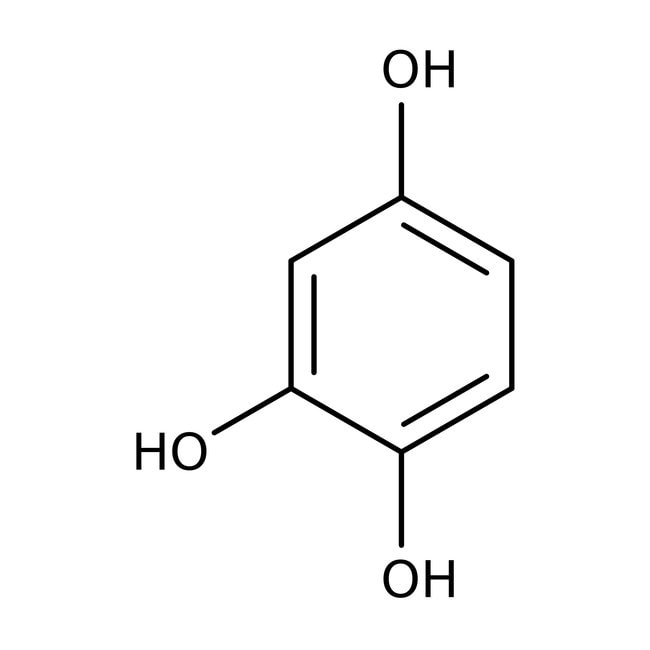
1,2,4-Trihydroxybenzene, 97%
CAS: 533-73-3 | C6H6O3 | 126.111 g/mol
Have Questions?
Change view


Catalog number A13069.06
also known as A13069-06
Price (USD)
135.65
Online Exclusive
151.00Save 15.35 (10%)
Each
Quantity:
5 g
Price (USD)
135.65
Online Exclusive
151.00Save 15.35 (10%)
Each
Chemical Identifiers
CAS533-73-3
IUPAC Namebenzene-1,2,4-triol
Molecular FormulaC6H6O3
InChI KeyGGNQRNBDZQJCCN-UHFFFAOYSA-N
SMILESOC1=CC=C(O)C(O)=C1
View more
Specifications Specification Sheet
Specification SheetAppearance (Color)White to grey or pale pink to pale brown to brown
FormPowder
Assay (GC)≥96.0%
Infrared spectrumConforms
Melting point133-141°C
1,2,4-Trihydroxybenzene is an important raw material and intermediate used in organic Synthesis, pharmaceuticals, agrochemicals and dyestuff.It is used as a metabolite of benzene.
This Thermo Scientific Chemicals brand product was originally part of the Alfa Aesar product portfolio. Some documentation and label information may refer to the legacy brand. The original Alfa Aesar product / item code or SKU reference has not changed as a part of the brand transition to Thermo Scientific Chemicals.
Applications
1,2,4-Trihydroxybenzene is an important raw material and intermediate used in organic Synthesis, pharmaceuticals, agrochemicals and dyestuff.It is used as a metabolite of benzene.
Solubility
Soluble in water.
Notes
Store in cool place. Keep container tightly closed in a dry and well-ventilated place. Stable under recommended storage conditions. Keep away from acid chlorides, acid anhydrides, bases, oxidizing agents. Air & Light Sensitive.
1,2,4-Trihydroxybenzene is an important raw material and intermediate used in organic Synthesis, pharmaceuticals, agrochemicals and dyestuff.It is used as a metabolite of benzene.
Solubility
Soluble in water.
Notes
Store in cool place. Keep container tightly closed in a dry and well-ventilated place. Stable under recommended storage conditions. Keep away from acid chlorides, acid anhydrides, bases, oxidizing agents. Air & Light Sensitive.
RUO – Research Use Only
General References:
- S Rieble.; DK Joshi.; MH Gold. Purification and characterization of a 1, 2, 4-trihydroxybenzene 1, 2-dioxygenase from the basidiomycete Phanerochaete chrysosporium. Journal of bacteriology. 1994, 176 (16), 4838-4844.
- W Reichenbecher.; B Schink. Desulfovibrio inopinatus, sp. nov., a new sulfate-reducing bacterium that degrades hydroxyhydroquinone (1, 2, 4-trihydroxybenzene). Archives of microbiology. 1997, 168 (4), 338-344.