Search
 Elementsuche
 Struktursuche



Thermo Scientific Chemicals
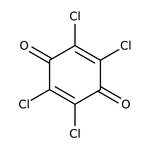
P-Chloranil, 97 %, Thermo Scientific Chemicals
CAS: 118-75-2 | C6Cl4O2 | 245.86 g/mol
Have Questions?
Ansicht ändern



Katalognummer A13495.22
auch als A13495-22 bezeichnet
Preis (EUR)
77,60
Each
Menge:
100 g
Preis (EUR)
77,60
Each
Chemikalien-Kennzeichnungen
CAS118-75-2
Specifications Datenblatt
FormCrystals or powder or crystalline powder
Identification (FTIR)Conforms
Appearance (Color)Yellow to yellow-green
Assay (HPLC)≥96.0%
p-Chloranil is used as a dye intermediate, oxidizing agent, vulcanizing agent and dehydrogenation reagent. It is also used to make chloranil electrodes for pH measurements. Further, it serves as a hydrogen acceptor and used for the aromatization reactions such as conversion of cyclohexadienes to the benzene derivatives. It is used to test the secondary amine. In addition to this, it is employed as a precursor to prepare diaziquone, which is used as a cancer chemotherapeutic agent.
This Thermo Scientific Chemicals brand product was originally part of the Alfa Aesar product portfolio. Some documentation and label information may refer to the legacy brand. The original Alfa Aesar product / item code or SKU reference has not changed as a part of the brand transition to Thermo Scientific Chemicals.
Anwendungen
P-Chloranil wird als Farbstoffzwischenprodukt, Oxidationsmittel, Vulkanisationsmittel und Dehydrierungsreagenz verwendet. Wird auch zur Herstellung von Chloranil-Elektroden für pH-Messungen verwendet. Dient außerdem als Wasserstoffakzeptor und wird für die Aromatisierungsreaktionen wie die Umwandlung von Cyclohexadienen in die Benzolderivate verwendet. Wird zum Testen des Sekundäramins verwendet. Wird darüber hinaus als Vorläufer bei der Herstellung von Diaziquon eingesetzt, das als Chemotherapeutikum in der Krebsbehandlung verwendet wird.
Löslichkeit
Löslich in Ether und Aceton. Schwer löslich in Chloroform, Dimethylformamid, lösendem Naphtha, Benzol, Kohlenstoffdisulfid und Kohlenstofftetrachlorid. Unlöslich in Wasser, kaltem Petrolether, Methanol, Dibutylphthalat und kaltem Alkohol.
Hinweise
Nicht kompatibel mit starken Oxidationsmitteln und starken Basen.
RUO – Research Use Only
Allgemeine Referenzen:
- High-Potential-Chinone dehydrieren viele hydroaromatische Systeme durch Hydrid-Abstraktion.
- Reviews: Adv. Org. Chem., 2, 329 (1960); Chem. Rev., 67, 153 (1967); 78, 317 (1978).
- Bildet Komplexe mit vielen nicht aromatischen Elektronenspendern, z. B. Carbonylverbindungen, Estern, Amiden, Lactonen, Lactamen und Alkyliodiden: J. Org. Chem., 53, 2163 (1988).
- Liu, B.; Li, X.; Stępień, M.; Chmielewski, P. J. Towards Norcorrin: Hydrogenation Chemistry and the Heterodimerization of Nickel(II) Norcorrole. Chem. Eur. J. 2015, 21 (21), 7790-7797.
- Paddy, V.; van Tonder, J. J.; Steenkamp, V. In vitro Antioxidant Activity and Polyphenolic Content of a Polyherbal Tea and Its Constituents. European J. Med. Plants 2015, 7 (4), 215-226.