Search
 Elementsuche
 Struktursuche


Thermo Scientific Chemicals
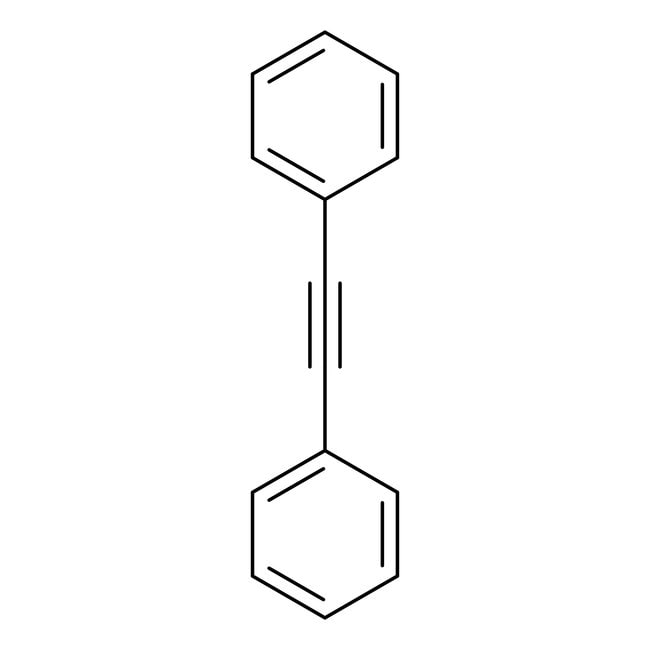
Diphenylacetylen, 99 %, Thermo Scientific Chemicals
CAS: 501-65-5 | C14H10 | 178.234 g/mol
Have Questions?
Ansicht ändern


Katalognummer A13979.06
auch als A13979-06 bezeichnet
Preis (EUR)
33,30
Each
Menge:
5 g
Preis (EUR)
33,30
Each
Chemikalien-Kennzeichnungen
CAS501-65-5
IUPAC Name(2-phenylethynyl)benzene
Molecular FormulaC14H10
InChI KeyJRXXLCKWQFKACW-UHFFFAOYSA-N
SMILESC1=CC=C(C=C1)C#CC1=CC=CC=C1
Mehr anzeigen
Specifications Datenblatt
Appearance (Color)White to cream
Assay (GC)≥98.5%
FormCrystals or powder or crystalline powder
Identification (FTIR)Conforms
Melting Point (clear melt)57.0-63.0?C
Diphenylacetylene is often used as a building block in organic and organometallic chemistry. It acts as dienophile and under goes Diels-Alder reaction with tetraphenylcyclopentadienone to prepare hexaphenylbenzene. It acts as a precursor in the preparation of 3-alkoxycyclopropene by reacting with benzal chloride in the presence of potassium t-butoxide.
This Thermo Scientific Chemicals brand product was originally part of the Alfa Aesar product portfolio. Some documentation and label information may refer to the legacy brand. The original Alfa Aesar product / item code or SKU reference has not changed as a part of the brand transition to Thermo Scientific Chemicals.
Anwendungen
Diphenylacetylen wird häufig als Baustein in der organischen und organometallischen Chemie verwendet. Es fungiert als dienophil und durchläuft eine Diels-Alder-Reaktion mit Tetraphenylcyclopentadienon zur Vorbereitung von Hexaphenylbenzol. Es dient als Vorstufe bei der Herstellung von 3-Alkoxycyclopropen, indem es in Gegenwart von Kalium-t-Butoxid mit Benzalchlorid reagiert.
Löslichkeit
Mischbar mit Ether und heißem Alkohol. Nicht mit Wasser mischbar.
Hinweise
Nicht kompatibel mit starken Oxidationsmitteln.
RUO – Research Use Only
Allgemeine Referenzen:
- Ein Beispiel für die Verwendung als Diels-Alder-Dienophil finden Sie unter: Org. Synth. Coll., 5, 604 (1973).
- Informationen zum Transfer von Methylengruppen aus Dimsyl-Natrium zur Produktion von 2,3-Diphenylbutadien finden Sie in: Org. Synth. Coll., 6, 531 (1988).
- Kann mit Jod-DMSO zu Benzil oxidiert werden: Synthesis, 131 (1991).
- Shi, Y.; Li, G.; Zhao, B.; Chen, Y.; Chao, P.; Zhang, H.; Wang, X.; Wang, T. Synthesis and optical properties of cationic cyclopentadienyl iron complexes with diphenylacetylene chromophores. Inorg. Chim. Acta 2015, 427, 259-265.
- Le, K. V.; Aya, S.; Ogino, S.; Okano, K.; Araoka, F.; Takezoe, H. Large Twist Elastic Constant in Diphenylacetylene-Core-Based Liquid Crystals. Mol Cryst Liq Cryst 2015, 614 (1), 124-127.