Search


Citations & References (13)
Invitrogen™
ProcartaPlex™ Human Immune Monitoring Panel, 65plex
The ProcartaPlex Human Immune Monitoring Panel 65plex enables the study of immune function by analyzing 65 protein targets in aRead more
| Catalog Number | Quantity |
|---|---|
| EPX650-10065-901 | 96 Tests |
Catalog number EPX650-10065-901
Price (USD)
11,340.00
Each
Quantity:
96 Tests
Price (USD)
11,340.00
Each
The ProcartaPlex Human Immune Monitoring Panel 65plex enables the study of immune function by analyzing 65 protein targets in a single well using Luminex xMAP technology. Analyze 65 cytokine, chemokine, and growth factor targets simultaneously for efficient immune response profiling, biomarker discovery, and validation. The panel is provided in a ready-to-use format with individual vials of capture and detection reagents formulated at 1X concentration, requiring less pipetting and experimental setup. This kit is is not compatible with the MAGPIX instrument. MAGPIX users should use the Human Immune Monitoring Panel for MAGPIX 65plex(Cat. No. EPX650-16500-901) that consists of two separate kits: a 43-plex and a 22-plex kit specifically designed to be used on the MAGPIX instrument that is capable of detecting up to 50 targets simultaneously.
ProcartaPlex preconfigured panels are extensively tested for analyte combinability, interference, and cross-reactivity to provide the highest level of validation and precision. All ProcartaPlex panels are supplied with the necessary reagents to perform the assay.
ProcartaPlex multiplex panels are available in multiple formats across six species (human, mouse, rat, nonhuman primate, porcine, and canine).
Target [bead region]:
Cytokines: G-CSF (CSF-3) [42], GM-CSF [44], IFN alpha [48], IFN gamma [43], IL-1 alpha [62], IL-1 beta [18], IL-2 [19], IL-3 [73], IL-4 [20], IL-5 [21], IL-6 [25], IL-7 [26], IL-8 (CXCL8) [27], IL-9 [52], IL-10 [28], IL-12p70 [34], IL-13 [35], IL-15 [65], IL-16 [70], IL-17A (CTLA-8) [36], IL-18 [66], IL-20 [81], IL-21 [72], IL-22 [76], IL-23 [63], IL-27 [14], IL-31 [37], LIF [15], M-CSF [67], MIF [53], TNF alpha [45], TNF beta [54], TSLP [80]
Chemokines: BLC (CXCL13) [29], ENA-78 (CXCL5) [82], Eotaxin (CCL11) [33], Eotaxin-2 (CCL24) [37], Eotaxin-3 (CCL26) [77], Fractalkine (CX3CL1) [59], Gro-alpha (CXCL1) [61], IP-10 (CXCL10) [22], I-TAC (CXCL11) [57], MCP-1 (CCL2) [51], MCP-2 (CCL8) [8], MCP-3 (CCL7) [68], MDC (CCL22) [87], MIG (CXCL9) [69], MIP-1 alpha (CCL3) [12], MIP-1 beta (CCL4) [47], MIP-3 alpha (CCL20) [56], SDF-1 alpha (CXCL12) [13]
Growth factors/regulators: FGF-2 [75], HGF [46], MMP-1 [64], NGF beta [55], SCF [39], VEGF-A [78]
Soluble receptors: APRIL [88], BAFF [86], CD30 [84], CD40L (CD154) [74], IL-2R (CD25) [22], TNF-RII [85], TRAIL (CD253) [58], TWEAK [97]
About ProcartaPlex assays for the Luminex platform
ProcartaPlex immunoassays are based on the principles of a sandwich ELISA, using two highly specific antibodies binding to different epitopes of one protein to quantitate all protein targets simultaneously using a Luminex instrument. ProcartaPlex multiplex assays require as little as 25 μL of plasma or serum, or 50 μL of cell culture supernatant, and just four hours to obtain analyzed results.
Features include:
• Reproducible, reliable results—validated as a panel to the highest industry standard, including protein target combinability and cross-reactivity testing
• More results per sample—measure multiple protein targets simultaneously in a single 25–50 μL sample
• Well-established Luminex technology highly referenced multiplexing platform for protein detection and quantitation
ProcartaPlex assays utilize Luminex xMAP (multianalyte profiling) technology for the simultaneous detection and quantitation of up to 80 protein targets in a single 25–50 μL sample—from plasma, serum, cell culture supernatants, and other bodily fluids.
QuantiGene RNA testing—one machine, two applications
Gain deeper insight with complementary and highly correlative gene expression and protein assays. With the largest multiplex panel for measurement of protein and RNA, you can now profile more biomarkers with less sample. The Immune Response 80-Plex Human QuantiGene Plex Panel enables efficient immune response profiling and biomarker discovery. Learn more >
For Research Use Only. Not for use in diagnostic procedures.
Specifications
Assay RangeSee Certificate of Analysis
Assay SensitivitySee Certificate of Analysis
Detection MethodFluorescence
For Use With (Equipment)Luminex™ Instruments
FormatMultiplex Kit
Product LineProcartaPlex
Sample TypeSerum, Plasma, Cell Culture Supernatants
Sample VolumeSerum, Plasma: 25 μL; CCS: 50 μL
Shipping ConditionWet Ice
CombinabilityNon-Combinable
Product TypeMultiplex Panel
Quantity96 Tests
Research AreaImmunology
SpeciesHuman
Unit SizeEach
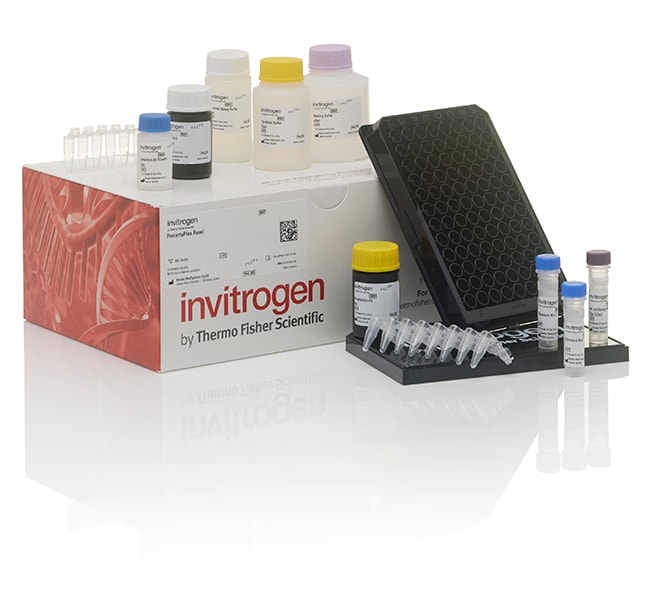
Contents & Storage
• 2 vials Human Standard Mix M (lyophilized)
• 1 vial Capture Bead Mix (1X)
• 1 vial Biotinylated Detection Antibody Mix (1X)
• 2 vials Human Control-High
• 2 vials Human Control-Low
• 1 Bottle Reading Buffer (1X)
• 1 Bottle Wash Buffer (10X)
• 1 Bottle Streptavidin-PE (1X)
• 1 Bottle Universal Assay Buffer (1X)
• 8-tube strip
• Adhesive film
• Flat-bottom 96-well plate, black
Store at 2°C to 8°C
Frequently asked questions (FAQs)
What is the size of the Luminex beads you currently use?
I am interested in performing Luminex assays using BioSource kits, and I have a Luminex xMAP system. Besides the kits and system, what other reagents and equipment will I need?
Do the Luminex beads require special care in handling?
Why would the Luminex acquisition software display "Sample Empty" messages during analysis?
What are the Luminex beads made of?
Citations & References (13)
Citations & References
Abstract
No Distinct Cytokine, Chemokine, and Growth Factor Blood Profile Associated With Monkeypox Virus Clade IIb Infected Patients.
Journal:Journal of medical virology
PubMed ID:40156483
Previous studies indicated Clade I monkeypox virus infection to be associated with marked elevation of proinflammatory cytokines. This remains unexplored for Clade IIâassociated disease, which has different clinical manifestations and prognosis. We used a 65âplex cytokine, chemokine, and growth factor (CCG) panel to analyze serum samples of 100 male acute
Immune monitoring of trabectedin therapy in refractory soft tissue sarcoma patients - the IMMUNYON study.
Journal:Frontiers in immunology
PubMed ID:40007535
Soft tissue sarcomas (STS) encompass over 50 histologic subtypes, representing more than 1% of solid tumors. Standard treatments include surgical resection and therapies such as anthracyclines or trabectedin for advanced cases, though challenges persist due to the tumor microenvironmentâs complexity and limited immune profiling data. This study evaluates Trabectedin therapy
Immune profiling of human vestibular schwannoma secretions identifies TNF-α and TWEAK as cytokines with synergistic potential to impair hearing
Journal:Journal of Neuroinflammation
PubMed ID:39923035
Vestibular schwannoma (VS) is an intracranial tumor arising from the Schwann cells of the vestibular nerve and is an important cause of sensorineural hearing loss (SNHL) in humans. The mechanisms underlying this SNHL are incompletely understood and currently, there are no drugs FDA approved specifically for VS. This knowledge gap
Assessing serum cytokine profiles in inflammatory breast cancer patients using Luminex® technology.
Journal:Cytokine
PubMed ID:37918053
Inflammatory breast cancer (IBC), accounts for the majority of deaths associated with breast tumors. Because this form is aggressive from its appearance and has a strong metastatic potential. The majority of patients are not diagnosed until late stages, highlighting the need for the development of novel diagnostic biomarkers. Immune mediators
Multiplexing protein and gene level measurements on a single Luminex platform.
Journal:Methods
PubMed ID:30742996
'The ability to simultaneously measure multiple secreted proteins and the corresponding gene expression levels from a single sample is valuable for comprehensive analysis. Bottlenecks to traditional immunoassays and gene expression assays include large sample consumption, time consuming experimental procedures, and complex data analysis.'