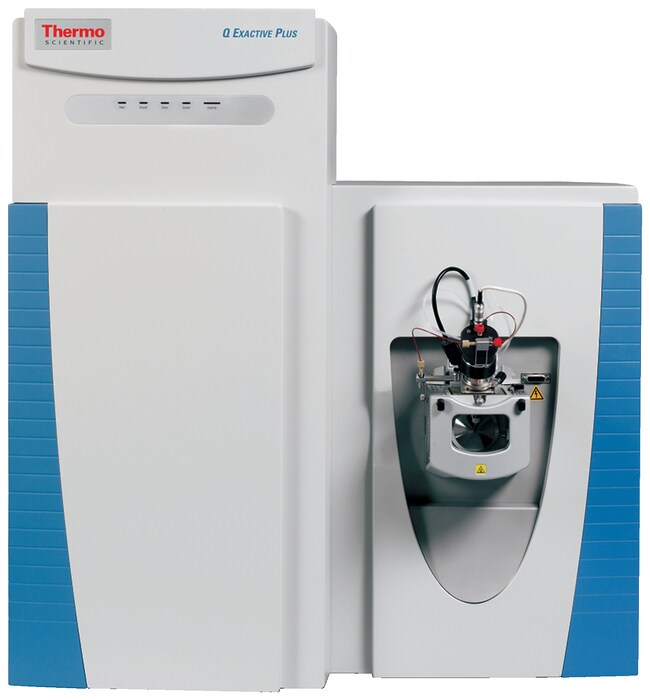
Q Exactive™ Plus Hybrid Quadrupol-Orbitrap™ Massenspektrometer
Thermo Scientific™

Q Exactive™ Plus Hybrid Quadrupol-Orbitrap™ Massenspektrometer

Charakterisieren, quantifizieren und bestätigen Sie zuverlässig und routinemäßig in einer einzigen Analyse und mit einem einzelnen Massenspektrometer.

Have Questions?
KatalognummerScan-RatenMassenbereich
IQLAAEGAAPFALGMBDKBis zu 12 Hz50 bis 6000 m/z
Katalognummer IQLAAEGAAPFALGMBDK
Preis (EUR)
-
Angebot anfordern
Scan-Raten:
Bis zu 12 Hz
Massenbereich:
50 bis 6000 m/z

Erheben Sie Quanfirmation™ auf die nächste Stufe. Mit dem Thermo Scientific™ Q Exactive™ Hybrid Quadrupol-Orbitrap™ Massenspektrometer wurde das revolutionäre Konzept der Quanfirmation eingeführt. Das Q Exactive™ Plus Hybrid Quadrupol-Orbitrap™ Massenspektrometer hebt die Quanfirmation auf die nächste Stufe mit verbessertem Leistungsverhalten und neuen Möglichkeiten zur Erweiterung von Anwendungen, von zuverlässigen DMPK Qual./Quan.-Screening-Untersuchungen bis hin zur Charakterisierung von intakten monoklonalen Antikörpern.

Herausragende Quantifizierung

  • Die fortschrittliche Quadrupol-Technologie (Advanced quadrupole technology, AQT) verbessert die Vorläuferselektion und Transmission für eine genauere Quantifizierung niedrig abundanter Analyten in komplexen Matrices
  • Die komplexe datenunabhängige Aufnahme (DIA) und die Parallelüberwachung von Reaktionen (PRM) liefern eine reproduzierbare Quantifizierung mit vollständiger qualitativer Sicherheit
  • Eine hochentwickelte aktive Strahlführung (AABG) reduziert das Rauschen und verlängert die Wartungsintervalle

Verbesserte Analyse von intakten Proteinen

  • Optionaler Modus für intakte Proteine bietet ein hervorragendes Auffangen von großen Molekülen für die verbesserte Analyse von intakten Proteinen und Proteinkomplexen
  • Die optional erhältliche verbesserte Auflösung sorgt für maximale ID-Sicherheit in der Top-Down-Proteomik und Lipidomik

Ergebnisse mit hoher Sicherheit

  • Mittels HR/AM und Vollscan können alle Probendaten über die gesamte Zeit erfasst werden, was eine retrospektive Datenanalyse ermöglicht und eine Probenwiederholung überflüssig macht.
  • Das Auflösungsvermögen von bis zu 140.000 FWHM eliminiert bei der Analyse von Proben in komplexen Matrices isobare Interferenzen und erhöht die Zuverlässigkeit der Ergebnisse
  • Eine Massengenauigkeit von unter 1 ppm im Voll- und AIF-Scanmodus (All-Ion Fragmentation) gewährleistet die zuverlässige Identifizierung der Verbindungen
  • Schnelles Scannen bei 12 Hz und spektrales Multiplexing machen das System mit UHPLC-Anwendungen kompatibel
  • Der schnelle Polaritätswechsel sorgt für maximale Informationsgewinnung
  • AIF und mehrere Dissoziationsverfahren — In-Source-CID und HCD — helfen bei der Identifizierung von Verbindungen
  • Ein Massenbereich von bis zu 6000 m/z verbessert den Nachweis von einfach geladenen kleinen Molekülen und Biomolekülen
  • Ein dynamischer Bereich im Intrascan über mehr als vier Größenordnungen und die Empfindlichkeit im Femtogrammbereich ermöglichen die Detektion von Konzentrationen im Spurenbereich und von Verbindungen mit hoher Abundanz in einem Scan

Nur für Forschungszwecke. Darf nicht für diagnostische Verfahren eingesetzt werden.

Specifications
Dynamischer Bereich> 5000:1
MassengenauigkeitIntern: < 1 ppm RMS
Extern: < 3 ppm RMS
PolaritätswechselEin vollständiger Zyklus in < 1 s (jeweils ein vollständiger Scan im positiven und negativen Modus bei einer Auflösung von 35.000)
Scan-RatenBis zu 12 Hz
EmpfindlichkeitVollständige MS: 500 fg Buspiron, Signal-Rausch-Verhältnis an der Säule 100:1
SIM: 30 fg Buspiron, Signal-Rausch-Verhältnis an der Säule 100:1
Massenbereich50 bis 6000 m/z
Max. ResolutionBis zu 240.000 bei m/z 200
TypQuadrupol-Orbitrap LC-MS
Unit SizeEach

Häufig gestellte Fragen (FAQ)

Why is the turbomolecular pump not operating when using Orbitrap Exactive or Q Exactive mass spectrometry instruments?

A turbomolecular pump may be switched off because of one of the following reasons:

- Turbomolecular pump is blocked
- Failure of fans in turbomolecular pump
Each of the above reasons might lead to an overheating of the pump. When overheated, a turbomolecular pump switches off automatically to prevent its destruction. This overheating protection prevents the outbreak of a fire and minimizes the risk of destructing the pump.

If the Exactive Series mass spectrometer does not work as expected, use the Tune software for error diagnosis:
- The instrument status window displays real-time status information for the instrument components. All parameters are arranged in a tree view. In addition to showing numerical values of parameters (for example, pump speeds or component temperatures), the instrument status window uses icons to indicate the statuses of system components.
- The messages window displays real-time information about the statuses of the instrument, the control service, or other programs. It might display additional information.

In case of an overheated turbomolecular pump, shut down the mass spectrometer as described on page 6-8 of the manual (https://assets.thermofisher.com/TFS-Assets/CMD/manuals/man-bre0012255-exactive-series-manbre0012255-en.pdf). To prevent permanent damage to components of the Exactive Series mass spectrometer, Thermo Fisher Scientific recommends that you call a Thermo Fisher Scientific field service engineer.

Find additional tips, troubleshooting help, and resources within our Mass Spectrometry Support Center.

Why is the temperature of UHV chamber higher than expected when using Orbitrap Exactive or Q Exactive mass spectrometry instruments?

The UHV chamber heating control may have failed. During general operation of the mass spectrometer, the temperature of the UHV chamber is not regulated. Only during a system bakeout, electric power is supplied to the heating elements of the UHV chamber. The heating always operates at maximum power. Thus, failure of the heating control does not lead to a dangerous overheating of the mass spectrometer. If the Exactive Series mass spectrometer does not work as expected, use the Tune software for error diagnosis:

- The messages window displays real-time information about the statuses of the instrument, the control service, or other programs. If the heating was terminated, the window displays a corresponding error message.

In case of a failure of the UHV chamber heating control, shut down the mass spectrometer as described on page 6-8 of the manual (https://assets.thermofisher.com/TFS-Assets/CMD/manuals/man-bre0012255-exactive-series-manbre0012255-en.pdf). To prevent permanent damage to components of the Exactive Series mass spectrometer, Thermo Fisher Scientific recommends that you call a Thermo Fisher Scientific field service engineer.

Find additional tips, troubleshooting help, and resources within our Mass Spectrometry Support Center.

When using Orbitrap Exactive or Q Exactive mass spectrometry instruments, why does the tune software show bad vacuum?

Here are possible causes and solutions:
-System was vented because of a main power failure: A main power failure has the same consequence as switching off with the main power circuit breaker switch. If the power is available again, the system is started up automatically: the pumps are switched on and the vacuum is created. If the system has been vented during the mains failure, it is necessary to bake out the system to obtain the operating vacuum. See “Baking Out the System” on page 8-12 of the manual. If the log file of the data system shows a reboot of the system and the pressure reading in the Tune software shows a bad vacuum, this indicates that the system was vented. In case of frequent but short power failures, we recommend that you install an uninterruptible power supply (UPS). If main power failures occur frequently while the system is not attended (for example, in the night), we recommend that you install a power fail detector. - Vacuum leak: Refer to pages 7-5 and 8-12 in the Operator's Manual (https://assets.thermofisher.com/TFS-Assets/CMD/manuals/man-bre0012255-exactive-series-manbre0012255-en.pdf).

Find additional tips, troubleshooting help, and resources within our Mass Spectrometry Support Center.

Why does the metal needle insert in the heated ESI probe frequently clog when using Orbitrap Exactive or Q Exactive mass spectrometry instruments?

Clogging of the H-ESI spray needle is generally caused by the presence of non-volatile components in the injected samples. If the non-volatile components of the samples are not removed during sample preparation, they will be injected onto the column where they will gradually bleed off over time into the detector. They may also be directly introduced by the use of non-volatile buffers in the mobile phase. Non volatile buffers should be avoided in LC-MS analysis because the spray needle will clog frequently and in addition the MS optics will quickly become contaminated.

Clogging issues may be worsened when using a divert valve or bypass valve. This is because when the valve switches to waste the LC flow to the needle is stopped, causing the residual liquid in the hot needle to quickly evaporate. This in turn causes the non-volatile components to deposit on the inner wall of the tubing which will eventually clog it.

When using a divert or bypass valve, the issue may be fully resolved by adding another HPLC pump to supply make-up flow through the needle when the column eluent is bypassed. The second pump is connected to the divert valve or bypass valve so that when the eluent is diverted to waste, clean solvent flows through the needle to help keep it clean. Alternatively, sample preparation procedures should be modified to reduce the amount of non-volatile components in each sample injection.

Find additional tips, troubleshooting help, and resources within our Mass Spectrometry Support Center.

What is High Energy Collision Dissociation (HCD) as it relates to Orbitrap Exactive or Q Exactive mass spectrometry instruments?

The HCD Cell consists of a straight multipole (octapole) device mounted within a metal tube. The metal tube is in turn connected to the C-Trap in direct line of sight.

The voltage offset between the C-Trap and the HCD Cell is used to accelerate the precursor ions into the gas filled cell. Inside the HCD cell, ions collide with the neutral gas causing rotation, stretching and ultimately cleaving bonds to create fragment ions and neutral species, which are subsequently removed by the vacuum system.

The generated fragment or product ions are then pushed back toward the C-Trap and focused before being pushed toward the Orbitrap analyzer.

Find additional tips, troubleshooting help, and resources within our Mass Spectrometry Support Center.