Product References
Purification of Fibroblasts From the Spiral Ganglion.
Frontiers in neurology
Anacker A,Esser KH,Lenarz T,Paasche G
Published figure using Connexin 26 monoclonal antibody (Product # 13-8100) in Immunocytochemistry
Sat Jul 16 00:00:00 EDT 2022
Dysregulation of Connexin Expression Plays a Pivotal Role in Psoriasis.
International journal of molecular sciences
O'Shaughnessy EM,Duffy W,Garcia-Vega L,Hussey K,Burden AD,Zamiri M,Martin PE
Published figure using Connexin 26 monoclonal antibody (Product # 13-8100) in Immunohistochemistry
Fri Jun 04 00:00:00 EDT 2021
Dynamic Spatiotemporal Expression Changes in Connexins of the Developing Primate's Cochlea.
Genes
Hosoya M,Fujioka M,Murayama AY,Ogawa K,Okano H,Ozawa H
13-8100 was used in Immunohistochemistry to examine expression patterns of connexin 26 and connexin 30 in the developing cochlea of a common marmoset as a way to investigate genetic deafness in humans.
Fri Jul 16 00:00:00 EDT 2021
Dynamic Spatiotemporal Expression Changes in Connexins of the Developing Primate's Cochlea.
Genes
Hosoya M,Fujioka M,Murayama AY,Ogawa K,Okano H,Ozawa H
13-8100 was used in Immunohistochemistry to examine expression patterns of connexin 26 and connexin 30 in the developing cochlea of a common marmoset as a way to investigate genetic deafness in humans.
Fri Jul 16 00:00:00 EDT 2021
Allele-Specific Small Interfering RNA Corrects Aberrant Cellular Phenotype in Keratitis-Ichthyosis-Deafness Syndrome Keratinocytes.
The Journal of investigative dermatology
Lee MY,Wang HZ,White TW,Brooks T,Pittman A,Halai H,Petrova A,Xu D,Hart SL,Kinsler VA,Di WL
13-8100 was used in Western Blotting to provide an important proof-of-concept and model system for the potential use of allele-specific small interfering RNA in treating KID syndrome and other dominant genetic conditions.
Fri May 01 00:00:00 EDT 2020
GJB2 Mutations Linked to Hearing Loss Exhibit Differential Trafficking and Functional Defects as Revealed in Cochlear-Relevant Cells.
Frontiers in cell and developmental biology
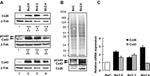
Beach R,Abitbol JM,Allman BL,Esseltine JL,Shao Q,Laird DW
Published figure using Connexin 26 monoclonal antibody (Product # 13-8100) in Western Blot
Mon Sep 28 00:00:00 EDT 2020
GJB2 Mutations Linked to Hearing Loss Exhibit Differential Trafficking and Functional Defects as Revealed in Cochlear-Relevant Cells.
Frontiers in cell and developmental biology
Beach R,Abitbol JM,Allman BL,Esseltine JL,Shao Q,Laird DW
Published figure using Connexin 26 monoclonal antibody (Product # 13-8100) in Western Blot
Mon Sep 28 00:00:00 EDT 2020
GJB2 Mutations Linked to Hearing Loss Exhibit Differential Trafficking and Functional Defects as Revealed in Cochlear-Relevant Cells.
Frontiers in cell and developmental biology
Beach R,Abitbol JM,Allman BL,Esseltine JL,Shao Q,Laird DW
Published figure using Connexin 26 monoclonal antibody (Product # 13-8100) in Western Blot
Mon Sep 28 00:00:00 EDT 2020
GJB2 Mutations Linked to Hearing Loss Exhibit Differential Trafficking and Functional Defects as Revealed in Cochlear-Relevant Cells.
Frontiers in cell and developmental biology
Beach R,Abitbol JM,Allman BL,Esseltine JL,Shao Q,Laird DW
Published figure using Connexin 26 monoclonal antibody (Product # 13-8100) in Western Blot
Mon Sep 28 00:00:00 EDT 2020
A heterozygous mutation in GJB2 (Cx26F142L) associated with deafness and recurrent skin rashes results in connexin assembly deficiencies.
Experimental dermatology
Albuloushi A,Lovgren ML,Steel A,Yeoh Y,Waters A,Zamiri M,Martin PE
Published figure using Connexin 26 monoclonal antibody (Product # 13-8100) in Immunocytochemistry
Thu Oct 01 00:00:00 EDT 2020
Detecting CO2-Sensitive Hemichannels in Neurons in Acute Brain Slices.
STAR protocols
Hill E,Dale N,Wall MJ
13-8100 was used in Immunohistochemistry to outline a method to change the concentration of CO2 without changing pH, using isohydric solutions and then utilizing this to detect opening and closing of functional hemichannels using whole-cell patch clamp recording and dye loading.
Fri Dec 18 00:00:00 EST 2020
Detecting CO2-Sensitive Hemichannels in Neurons in Acute Brain Slices.
STAR protocols
Hill E,Dale N,Wall MJ
13-8100 was used in Immunohistochemistry to outline a method to change the concentration of CO2 without changing pH, using isohydric solutions and then utilizing this to detect opening and closing of functional hemichannels using whole-cell patch clamp recording and dye loading.
Fri Dec 18 00:00:00 EST 2020
Moderate Changes in CO2 Modulate the Firing of Neurons in the VTA and Substantia Nigra.
iScience
Hill E,Dale N,Wall MJ
Published figure using Connexin 26 monoclonal antibody (Product # 13-8100) in Immunocytochemistry
Fri Jul 24 00:00:00 EDT 2020
Connexin 43 maintains tissue polarity and regulates mitotic spindle orientation in the breast epithelium.
Journal of cell science
Bazzoun D,Adissu HA,Wang L,Urazaev A,Tenvooren I,Fostok SF,Chittiboyina S,Sturgis J,Hodges K,Chandramouly G,Vidi PA,Talhouk RS,Lelièvre SA
13-8100 was used in Western Blotting to demonstrate the involvement of connexin 43 (Cx43, also known as GJA1) and related gap junction in epithelial homeostasis.
Thu May 16 00:00:00 EDT 2019
Early Hearing Loss upon Disruption of Slc4a10 in C57BL/6 Mice.
Journal of the Association for Research in Otolaryngology : JARO
Huebner AK,Maier H,Maul A,Nietzsche S,Herrmann T,Praetorius J,Hübner CA
13-8100 was used in Immunohistochemistry to study the timeline of Slc4a10/Nbcn2 expression during sensory transduction in the inner ear using a mouse model.
Sat Jun 01 00:00:00 EDT 2019
Characterisation of medullary astrocytic populations in respiratory nuclei and alterations in sudden unexpected death in epilepsy.
Epilepsy research
Patodia S,Paradiso B,Ellis M,Somani A,Sisodiya SM,Devinsky O,Thom M
Published figure using Connexin 26 monoclonal antibody (Product # 13-8100) in Immunohistochemistry
Fri Nov 01 00:00:00 EDT 2019
Connexin 43 plays an important role in the transformation of cholangiocytes with Clonochis sinensis excretory-secretory protein and N-nitrosodimethylamine.
PLoS neglected tropical diseases
Kim EM,Bae YM,Choi MH,Hong ST
13-8100 was used in Western Blotting to investigate cell proliferation and gap junction protein expression after stimulation with the hepatotoxin N-nitrosodimethylamine and/or excretory-secretory products of C. sinensis, which induce inflammation.
Mon Apr 01 00:00:00 EDT 2019
Connexin 43 plays an important role in the transformation of cholangiocytes with Clonochis sinensis excretory-secretory protein and N-nitrosodimethylamine.
PLoS neglected tropical diseases
Kim EM,Bae YM,Choi MH,Hong ST
13-8100 was used in Western Blotting to investigate cell proliferation and gap junction protein expression after stimulation with the hepatotoxin N-nitrosodimethylamine and/or excretory-secretory products of C. sinensis, which induce inflammation.
Mon Apr 01 00:00:00 EDT 2019
Intrinsic Oncogenic Function of Intracellular Connexin26 Protein in Head and Neck Squamous Cell Carcinoma Cells.
International journal of molecular sciences
Iikawa N,Yamamoto Y,Kawasaki Y,Nishijima-Matsunobu A,Suzuki M,Yamada T,Omori Y
13-8100 was used in Immunocytochemistry-immunoflourescence to define the dual roles of connexin in head and neck squamous cell carcinoma.
Mon Jul 23 00:00:00 EDT 2018
Essential Roles of L-Type Amino Acid Transporter 1 in Syncytiotrophoblast Development by Presenting Fusogenic 4F2hc.
Molecular and cellular biology
Ohgaki R,Ohmori T,Hara S,Nakagomi S,Kanai-Azuma M,Kaneda-Nakashima K,Okuda S,Nagamori S,Kanai Y
Published figure using Connexin 26 monoclonal antibody (Product # 13-8100) in Immunofluorescence
Thu Jun 01 00:00:00 EDT 2017
Immunofluorescence reveals unusual patterns of labelling for connexin43 localized to calbindin-D28K-positive interstitial cells in the pineal gland.
The European journal of neuroscience
Tsao DD,Wang SG,Lynn BD,Nagy JI
Published figure using Connexin 26 monoclonal antibody (Product # 13-8100) in Immunofluorescence
Thu Jun 01 00:00:00 EDT 2017
Disease-linked connexin26 S17F promotes volar skin abnormalities and mild wound healing defects in mice.
Cell death & disease
Press E,Alaga KC,Barr K,Shao Q,Bosen F,Willecke K,Laird DW
13-8100 was used in Western Blotting to suggest that the Cx26S17F mutant disturbs keratinocyte differentiation and epidermal remodeling following wound closure.
Thu Jun 01 00:00:00 EDT 2017
Overlapping expression of anion exchangers in the cochlea of a non-human primate suggests functional compensation.
Neuroscience research
Hosoya M,Fujioka M,Kobayashi R,Okano H,Ogawa K
13-8100 was used in immunohistochemistry - frozen section to research functional compensation by overlapping expression of anion exchangers in the cochlea of a non-human primate
Thu Sep 01 00:00:00 EDT 2016
Expression of connexin 26 and connexin 43 is reduced in Hirschsprung's disease.
The Journal of surgical research
Coyle D,Doyle B,Murphy JM,O'Donnell AM,Gillick J,Puri P
138100 was used in immunohistochemistry and western blot to assess the expression patterns of connexin 26, 36, and 43 in the colon of children with Hirschsprung's disease
Tue Nov 01 00:00:00 EDT 2016
Altered CO2 sensitivity of connexin26 mutant hemichannels in vitro.
Physiological reports
de Wolf E,van de Wiel J,Cook J,Dale N
138100 was used in immunocytochemistry to study how connexin26 mutations affect carbon dioxide sensitivity
Tue Nov 01 00:00:00 EDT 2016
CO2-evoked release of PGE2 modulates sighs and inspiration as demonstrated in brainstem organotypic culture.
eLife
Forsberg D,Horn Z,Tserga E,Smedler E,Silberberg G,Shvarev Y,Kaila K,Uhlén P,Herlenius E
138100 was used in immunohistochemistry to investigate how prostaglandin E2 regulates breathing in young mice
Tue Jul 05 00:00:00 EDT 2016
Distinct Expression Patterns Of Causative Genes Responsible For Hereditary Progressive Hearing Loss In Non-Human Primate Cochlea.
Scientific reports
Hosoya M,Fujioka M,Ogawa K,Okano H
13-8100 was used in immunohistochemistry to compare the expression of deafness genes in mice and the common marmoset
Fri Feb 26 00:00:00 EST 2016
Tanshinone IIA enhances bystander cell killing of cancer cells expressing Drosophila melanogaster deoxyribonucleoside kinase in nuclei and mitochondria.
Oncology reports
Jiang H,Zhao L,Dong X,He A,Zheng C,Johansson M,Karlsson A,Zheng X
13-8100 was used in western blot to characterize the suicide gene drosophila melanogaster multi-substrate deoxyribonucleoside kinase
Tue Sep 01 00:00:00 EDT 2015
Cx26 knockout predisposes the mammary gland to primary mammary tumors in a DMBA-induced mouse model of breast cancer.
Oncotarget
Stewart MK,Bechberger JF,Welch I,Naus CC,Laird DW
13-8100 was used in immunohistochemistry to discuss Cx26 knockout in DMBA-induced mouse models and breast cancer
Tue Nov 10 00:00:00 EST 2015
OTX2 regulates the expression of TAp63 leading to macular and cochlear neuroepithelium development.
Aging
Palombo R,Porta G,Bruno E,Provero P,Serra V,Neduri K,Viziano A,Alessandrini M,Micarelli A,Ottaviani F,Melino G,Terrinoni A
13-8100 was used in immunohistochemistry to examine the role of OTX2 in TAp63 regulation
Sun Nov 01 00:00:00 EDT 2015
Reduced connexin 43 in eutopic endometrium and cultured endometrial stromal cells from subjects with endometriosis.
Molecular human reproduction
Yu J,Boicea A,Barrett KL,James CO,Bagchi IC,Bagchi MK,Nezhat C,Sidell N,Taylor RN
13-8100 was used in immunohistochemistry - paraffin section and western blot to investigate the expression of connexin 43 in eutopic endometrium and cultured endometrial stromal cells
Sat Mar 01 00:00:00 EST 2014
Reduced connexin 43 in eutopic endometrium and cultured endometrial stromal cells from subjects with endometriosis.
Molecular human reproduction
Yu J,Boicea A,Barrett KL,James CO,Bagchi IC,Bagchi MK,Nezhat C,Sidell N,Taylor RN
13-8100 was used in immunohistochemistry - paraffin section and western blot to investigate the expression of connexin 43 in eutopic endometrium and cultured endometrial stromal cells
Sat Mar 01 00:00:00 EST 2014
Expression of gap junction proteins connexins 26, 30, and 43 in Dupuytren's disease.
Acta orthopaedica
Holzer LA,Cör A,Holzer G
13-8100 was used in immunohistochemistry - frozen section to investigate the expression of gap junction proteins in Dupuytren disease
Sat Feb 01 00:00:00 EST 2014
Expression of gap junction proteins connexins 26, 30, and 43 in Dupuytren's disease.
Acta orthopaedica
Holzer LA,Cör A,Holzer G
13-8100 was used in immunohistochemistry - frozen section to investigate the expression of gap junction proteins in Dupuytren disease
Sat Feb 01 00:00:00 EST 2014
The Clouston syndrome mutation connexin30 A88V leads to hyperproliferation of sebaceous glands and hearing impairments in mice.
FEBS letters
Bosen F,Schütz M,Beinhauer A,Strenzke N,Franz T,Willecke K
Published figure using Connexin 26 monoclonal antibody (Product # 13-8100) in Immunocytochemistry
Fri May 02 00:00:00 EDT 2014
The Clouston syndrome mutation connexin30 A88V leads to hyperproliferation of sebaceous glands and hearing impairments in mice.
FEBS letters
Bosen F,Schütz M,Beinhauer A,Strenzke N,Franz T,Willecke K
Published figure using Connexin 26 monoclonal antibody (Product # 13-8100) in Immunocytochemistry
Fri May 02 00:00:00 EDT 2014
Reduced expression of Connexin26 and its DNA promoter hypermethylation in the inner ear of mimetic aging rats induced by d-galactose.
Biochemical and biophysical research communications
Wu X,Wang Y,Sun Y,Chen S,Zhang S,Shen L,Huang X,Lin X,Kong W
13-8100 was used in immunohistochemistry to examine the relationship between Cx26 and presbycusis
Fri Sep 26 00:00:00 EDT 2014
Genetic ablation of the fatty acid-binding protein FABP5 suppresses HER2-induced mammary tumorigenesis.
Cancer research
Levi L,Lobo G,Doud MK,von Lintig J,Seachrist D,Tochtrop GP,Noy N
Thu Aug 01 00:00:00 EDT 2013
Role of p63 and the Notch pathway in cochlea development and sensorineural deafness.
Proceedings of the National Academy of Sciences of the United States of America
Terrinoni A,Serra V,Bruno E,Strasser A,Valente E,Flores ER,van Bokhoven H,Lu X,Knight RA,Melino G
Published figure using Connexin 26 monoclonal antibody (Product # 13-8100) in Immunofluorescence
Tue Apr 30 00:00:00 EDT 2013
Role of p63 and the Notch pathway in cochlea development and sensorineural deafness.
Proceedings of the National Academy of Sciences of the United States of America
Terrinoni A,Serra V,Bruno E,Strasser A,Valente E,Flores ER,van Bokhoven H,Lu X,Knight RA,Melino G
Published figure using Connexin 26 monoclonal antibody (Product # 13-8100) in Immunofluorescence
Tue Apr 30 00:00:00 EDT 2013
Phosphorylation on Ser-279 and Ser-282 of connexin43 regulates endocytosis and gap junction assembly in pancreatic cancer cells.
Molecular biology of the cell
Johnson KE,Mitra S,Katoch P,Kelsey LS,Johnson KR,Mehta PP
13-8100 was used in immunocytochemistry to study the assembly of Cx43 at the cell surface
Fri Mar 01 00:00:00 EST 2013
Tanshinone IIA increases the bystander effect of herpes simplex virus thymidine kinase/ganciclovir gene therapy via enhanced gap junctional intercellular communication.
PloS one
Xiao J,Zhang G,Qiu P,Liu X,Wu Y,Du B,Li J,Zhou J,Li J,Tan Y
Published figure using Connexin 26 monoclonal antibody (Product # 13-8100) in Western Blot
Mon Feb 03 00:00:00 EST 2014
Connexin32 can restore hearing in connexin26 deficient mice.
European journal of cell biology
Degen J,Schütz M,Dicke N,Strenzke N,Jokwitz M,Moser T,Willecke K
13-8100 was used in immunocytochemistry to study connexin 26 and connexin 32 isoforms in the cochlea.
Sat Oct 01 00:00:00 EDT 2011
The connexin26 S17F mouse mutant represents a model for the human hereditary keratitis-ichthyosis-deafness syndrome.
Human molecular genetics
Schütz M,Auth T,Gehrt A,Bosen F,Körber I,Strenzke N,Moser T,Willecke K
13-8100 was used in immunohistochemistry to study the Cx26S17F mutation in mice
Sat Jan 01 00:00:00 EST 2011
Different domains are critical for oligomerization compatibility of different connexins.
The Biochemical journal
Martínez AD,Maripillán J,Acuña R,Minogue PJ,Berthoud VM,Beyer EC
13-8100 was used in Immunofluorescence to suggest that amino acids in the third transmembrane domain are critical for oligomerization with Cx43 and Cx45.
Sun May 15 00:00:00 EDT 2011
Connexin 26 expression correlates with less aggressive phenotype of intestinal type-gastric carcinomas.
International journal of molecular medicine
Liu X,Furuya T,Li D,Xu J,Cao X,Li Q,Xu J,Xu Z,Sasaki K,Liu X
13-8100 was used in immunohistochemistry - paraffin section and western blot to investigate the role of connexin 26 in gastric cancer
Sat May 01 00:00:00 EDT 2010
The human deafness-associated connexin 30 T5M mutation causes mild hearing loss and reduces biochemical coupling among cochlear non-sensory cells in knock-in mice.
Human molecular genetics
Schütz M,Scimemi P,Majumder P,De Siati RD,Crispino G,Rodriguez L,Bortolozzi M,Santarelli R,Seydel A,Sonntag S,Ingham N,Steel KP,Willecke K,Mammano F
Published figure using Connexin 26 monoclonal antibody (Product # 13-8100) in Western Blot
Wed Dec 15 00:00:00 EST 2010
The human deafness-associated connexin 30 T5M mutation causes mild hearing loss and reduces biochemical coupling among cochlear non-sensory cells in knock-in mice.
Human molecular genetics
Schütz M,Scimemi P,Majumder P,De Siati RD,Crispino G,Rodriguez L,Bortolozzi M,Santarelli R,Seydel A,Sonntag S,Ingham N,Steel KP,Willecke K,Mammano F
Published figure using Connexin 26 monoclonal antibody (Product # 13-8100) in Western Blot
Wed Dec 15 00:00:00 EST 2010
Consortin, a trans-Golgi network cargo receptor for the plasma membrane targeting and recycling of connexins.
Human molecular genetics
del Castillo FJ,Cohen-Salmon M,Charollais A,Caille D,Lampe PD,Chavrier P,Meda P,Petit C
13-8100 was used in immunocytochemistry to investigate the contribution of consortin on connexin trafficking
Fri Jan 15 00:00:00 EST 2010
Pannexin1 and Pannexin2 channels show quaternary similarities to connexons and different oligomerization numbers from each other.
The Journal of biological chemistry
Ambrosi C,Gassmann O,Pranskevich JN,Boassa D,Smock A,Wang J,Dahl G,Steinem C,Sosinsky GE
13-8100 was used in western blot to investigate Pannexin1 or Pannexin2 complexes
Fri Aug 06 00:00:00 EDT 2010
Clinical significance of the expression of connexin26 in colorectal cancer.
Journal of experimental & clinical cancer research : CR
Nomura S,Maeda K,Noda E,Inoue T,Fukunaga S,Nagahara H,Hirakawa K
Mon Jun 21 00:00:00 EDT 2010
Cx36 makes channels coupling human pancreatic beta-cells, and correlates with insulin expression.
Human molecular genetics
Serre-Beinier V,Bosco D,Zulianello L,Charollais A,Caille D,Charpantier E,Gauthier BR,Diaferia GR,Giepmans BN,Lupi R,Marchetti P,Deng S,Buhler L,Berney T,Cirulli V,Meda P
Published figure using Connexin 26 monoclonal antibody (Product # 13-8100) in Western Blot
Sun Feb 01 00:00:00 EST 2009
Connexin30 null and conditional connexin26 null mice display distinct pattern and time course of cellular degeneration in the cochlea.
The Journal of comparative neurology
Sun Y,Tang W,Chang Q,Wang Y,Kong W,Lin X
Published figure using Connexin 26 monoclonal antibody (Product # 13-8100) in Immunohistochemistry (Frozen)
Tue Oct 20 00:00:00 EDT 2009
Connexin30 null and conditional connexin26 null mice display distinct pattern and time course of cellular degeneration in the cochlea.
The Journal of comparative neurology
Sun Y,Tang W,Chang Q,Wang Y,Kong W,Lin X
Published figure using Connexin 26 monoclonal antibody (Product # 13-8100) in Immunohistochemistry (Frozen)
Tue Oct 20 00:00:00 EDT 2009
Aberrant expression of connexin 26 is associated with lung metastasis of colorectal cancer.
Clinical cancer research : an official journal of the American Association for Cancer Research
Ezumi K,Yamamoto H,Murata K,Higashiyama M,Damdinsuren B,Nakamura Y,Kyo N,Okami J,Ngan CY,Takemasa I,Ikeda M,Sekimoto M,Matsuura N,Nojima H,Monden M
Fri Feb 01 00:00:00 EST 2008
A murine living skin equivalent amenable to live-cell imaging: analysis of the roles of connexins in the epidermis.
The Journal of investigative dermatology
Kandyba EE,Hodgins MB,Martin PE
Tue Apr 01 00:00:00 EDT 2008
Connexin hemichannel composition determines the FGF-1-induced membrane permeability and free [Ca2+]i responses.
Molecular biology of the cell
Schalper KA,Palacios-Prado N,Retamal MA,Shoji KF,Martínez AD,Sáez JC
13-8100 was used in western blot to examine the contributions of connexins on FGF-1-induced cellular responses
Fri Aug 01 00:00:00 EDT 2008
Neuronal connexin expression in the cochlear nucleus of big brown bats.
Brain research
Horowitz SS,Stamper SA,Simmons JA
Tue Mar 04 00:00:00 EST 2008
Role of gap junctions in spontaneous activity of the rat bladder.
American journal of physiology. Renal physiology
Ikeda Y,Fry C,Hayashi F,Stolz D,Griffiths D,Kanai A
Mon Oct 01 00:00:00 EDT 2007
Impaired gap junction formation and intercellular calcium signaling in urinary bladder cancer cells can be improved by Gö6976.
Cell communication & adhesion
Leinonen P,Aaltonen V,Koskela S,Lehenkari P,Korkiamäki T,Peltonen J
138100 was used in immunocytochemistry and western blot to examine calcium wave propagation and connexin 26, 32 and 43 expression in normal and malignant urothelial cells
Mon Oct 01 00:00:00 EDT 2007
Contacts and cooperation between cells depend on the hormone ouabain.
Proceedings of the National Academy of Sciences of the United States of America
Larre I,Ponce A,Fiorentino R,Shoshani L,Contreras RG,Cereijido M
13-8100 was used in immunocytochemistry to study ouabain-sensitive and -resistant MDCK cells
Tue Jul 18 00:00:00 EDT 2006
N-terminal residues in Cx43 and Cx40 determine physiological properties of gap junction channels, but do not influence heteromeric assembly with each other or with Cx26.
Journal of cell science
Gemel J,Lin X,Veenstra RD,Beyer EC
Published figure using Connexin 26 monoclonal antibody (Product # 13-8100) in Immunofluorescence
Thu Jun 01 00:00:00 EDT 2006
N-terminal residues in Cx43 and Cx40 determine physiological properties of gap junction channels, but do not influence heteromeric assembly with each other or with Cx26.
Journal of cell science
Gemel J,Lin X,Veenstra RD,Beyer EC
Published figure using Connexin 26 monoclonal antibody (Product # 13-8100) in Immunofluorescence
Thu Jun 01 00:00:00 EDT 2006
Differential induction of connexins 26 and 30 in skin tumors and their adjacent epidermis.
The journal of histochemistry and cytochemistry : official journal of the Histochemistry Society
Haass NK,Wladykowski E,Kief S,Moll I,Brandner JM
13-8100 was used in immunohistochemistry - paraffin section to report that connexin 26 and connexin 30 induced in keratinocyte-derived epithelial skin tumors
Wed Feb 01 00:00:00 EST 2006
In differentiating prefusion myoblasts connexin43 gap junction coupling is upregulated before myoblast alignment then reduced in post-mitotic cells.
Histochemistry and cell biology
Gorbe A,Becker DL,Dux L,Krenacs L,Krenacs T
13-8100 was used in immunocytochemistry to examine the temporal regulation of connexin expression in allogenic primary myoblast cultures
Thu Jun 01 00:00:00 EDT 2006
Restoration of functional gap junctions through internal ribosome entry site-dependent synthesis of endogenous connexins in density-inhibited cancer cells.
Molecular and cellular biology
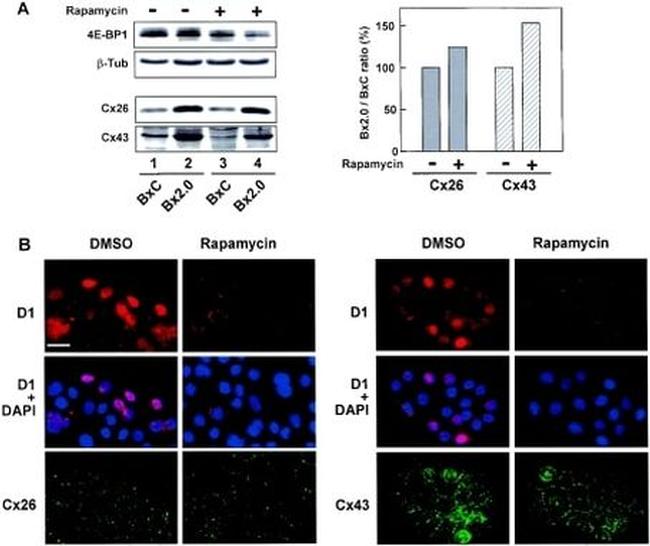
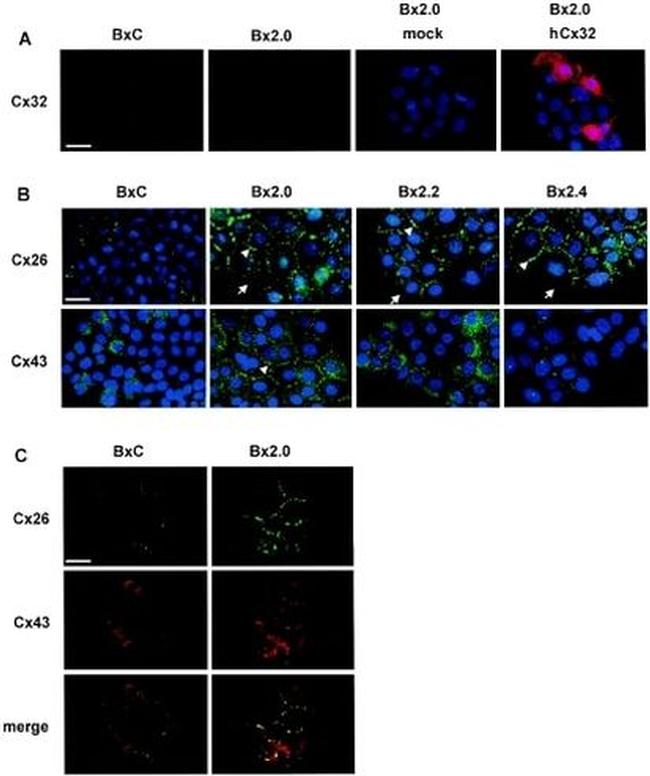
Lahlou H,Fanjul M,Pradayrol L,Susini C,Pyronnet S
Sun May 01 00:00:00 EDT 2005
Restoration of functional gap junctions through internal ribosome entry site-dependent synthesis of endogenous connexins in density-inhibited cancer cells.
Molecular and cellular biology
Lahlou H,Fanjul M,Pradayrol L,Susini C,Pyronnet S
Sun May 01 00:00:00 EDT 2005
Restoration of functional gap junctions through internal ribosome entry site-dependent synthesis of endogenous connexins in density-inhibited cancer cells.
Molecular and cellular biology
Lahlou H,Fanjul M,Pradayrol L,Susini C,Pyronnet S
Sun May 01 00:00:00 EDT 2005
Connexin43 with a cytoplasmic loop deletion inhibits the function of several connexins.
Biochemical and biophysical research communications
Wang M,Martínez AD,Berthoud VM,Seul KH,Gemel J,Valiunas V,Kumari S,Brink PR,Beyer EC
13-8100 was used in immunocytochemistry to determine role of amino acids within the cytoplasmic loop of connexins
Fri Aug 12 00:00:00 EDT 2005
Transient upregulation of connexin43 gap junctions and synchronized cell cycle control precede myoblast fusion in regenerating skeletal muscle in vivo.
Histochemistry and cell biology
Gorbe A,Becker DL,Dux L,Stelkovics E,Krenacs L,Bagdi E,Krenacs T
13-8100 was used in immunohistochemistry - frozen section to determine the spatio-temporal expression of gap junction connexins and correlate their expression with the progression of cell cycle control in regenerating soleus muscle of Wistar rats
Wed Jun 01 00:00:00 EDT 2005
Overexpression of estrogen receptor-alpha gene suppresses gap junctional intercellular communication in endometrial carcinoma cells.
Oncogene
Saito T,Tanaka R,Wataba K,Kudo R,Yamasaki H
13-8100 was used in immunocytochemistry and western blot to investigate the influence of estrogen and its receptor in connexin expression and gap junctional intercellular communication in endometrial carcinoma cells
Thu Feb 05 00:00:00 EST 2004
Connexin43 and connexin26 form gap junctions, but not heteromeric channels in co-expressing cells.
Journal of cell science
Gemel J,Valiunas V,Brink PR,Beyer EC
Sat May 15 00:00:00 EDT 2004
Connexin43 and connexin26 form gap junctions, but not heteromeric channels in co-expressing cells.
Journal of cell science
Gemel J,Valiunas V,Brink PR,Beyer EC
Sat May 15 00:00:00 EDT 2004
Functional domain mapping and selective trans-dominant effects exhibited by Cx26 disease-causing mutations.
The Journal of biological chemistry
Thomas T,Telford D,Laird DW
Fri Apr 30 00:00:00 EDT 2004
Functional domain mapping and selective trans-dominant effects exhibited by Cx26 disease-causing mutations.
The Journal of biological chemistry
Thomas T,Telford D,Laird DW
Fri Apr 30 00:00:00 EDT 2004
The relationship between connexins, gap junctions, tissue architecture and tumour invasion, as studied in a novel in vitro model of HPV-16-associated cervical cancer progression.
Oncogene
Aasen T,Hodgins MB,Edward M,Graham SV
Thu Sep 11 00:00:00 EDT 2003
Sequential changes of connexin32 and connexin26 in ischemia-reperfusion of the liver in rats.
Hepatology research : the official journal of the Japan Society of Hepatology
Nakashima Y,Kohno H,EL-Assal ON,Dhar DK,Ono T,Yamanoi A,Nagasue N
13-8100 was used in immunohistochemistry - frozen section to examine connexin32 and connexin26 expression during ischemia-reperfusion injury
Mon Sep 01 00:00:00 EDT 2003
Suppression of gap junctional intercellular communication via 5' CpG island methylation in promoter region of E-cadherin gene in endometrial cancer cells.
Carcinogenesis
Nishimura M,Saito T,Yamasaki H,Kudo R
13-8100 was used in immunocytochemistry to study connexins and gap junction proteins in endometrial carcinoma cells.
Wed Oct 01 00:00:00 EDT 2003
Connexin immunoreactivity in glial cells of the rat retina.
The Journal of comparative neurology
Zahs KR,Kofuji P,Meier C,Dermietzel R
13-8100 was used in immunohistochemistry to study connexins in retinal glial cells.
Mon Jan 20 00:00:00 EST 2003
Role of gap junctions in fluid secretion of lacrimal glands.
American journal of physiology. Cell physiology
Walcott B,Moore LC,Birzgalis A,Claros N,Valiunas V,Ott T,Willecke K,Brink PR
Fri Mar 01 00:00:00 EST 2002
Role of gap junctions in fluid secretion of lacrimal glands.
American journal of physiology. Cell physiology
Walcott B,Moore LC,Birzgalis A,Claros N,Valiunas V,Ott T,Willecke K,Brink PR
Fri Mar 01 00:00:00 EST 2002
Role of gap junctions in fluid secretion of lacrimal glands.
American journal of physiology. Cell physiology
Walcott B,Moore LC,Birzgalis A,Claros N,Valiunas V,Ott T,Willecke K,Brink PR
Fri Mar 01 00:00:00 EST 2002
Cell-specific expression of connexins and evidence of restricted gap junctional coupling between glial cells and between neurons.
The Journal of neuroscience : the official journal of the Society for Neuroscience
Rash JE,Yasumura T,Dudek FE,Nagy JI
Thu Mar 15 00:00:00 EST 2001
Cell-specific expression of connexins and evidence of restricted gap junctional coupling between glial cells and between neurons.
The Journal of neuroscience : the official journal of the Society for Neuroscience
Rash JE,Yasumura T,Dudek FE,Nagy JI
Thu Mar 15 00:00:00 EST 2001
Connexin 43 hemi channels mediate Ca2+-regulated transmembrane NAD+ fluxes in intact cells.
FASEB journal : official publication of the Federation of American Societies for Experimental Biology
Bruzzone S,Guida L,Zocchi E,Franco L
13-8100 was used in Western Blotting to address the molecular characterization of the NAD+ transporter and identify it as connexin 43.
Mon Jan 01 00:00:00 EST 2001
trans-dominant inhibition of connexin-43 by mutant connexin-26: implications for dominant connexin disorders affecting epidermal differentiation.
Journal of cell science
Rouan F,White TW,Brown N,Taylor AM,Lucke TW,Paul DL,Munro CS,Uitto J,Hodgins MB,Richard G
13-8100 was used in immunohistochemistry to investigate the effects of mutations to connexin-26 on hearing impairment.
Fri Jun 01 00:00:00 EDT 2001
Connexin 26 and basic fibroblast growth factor are expressed primarily in the subpial and subependymal layers in adult brain parenchyma: roles in stem cell proliferation and morphological plasticity?
The Journal of comparative neurology
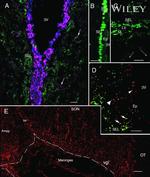
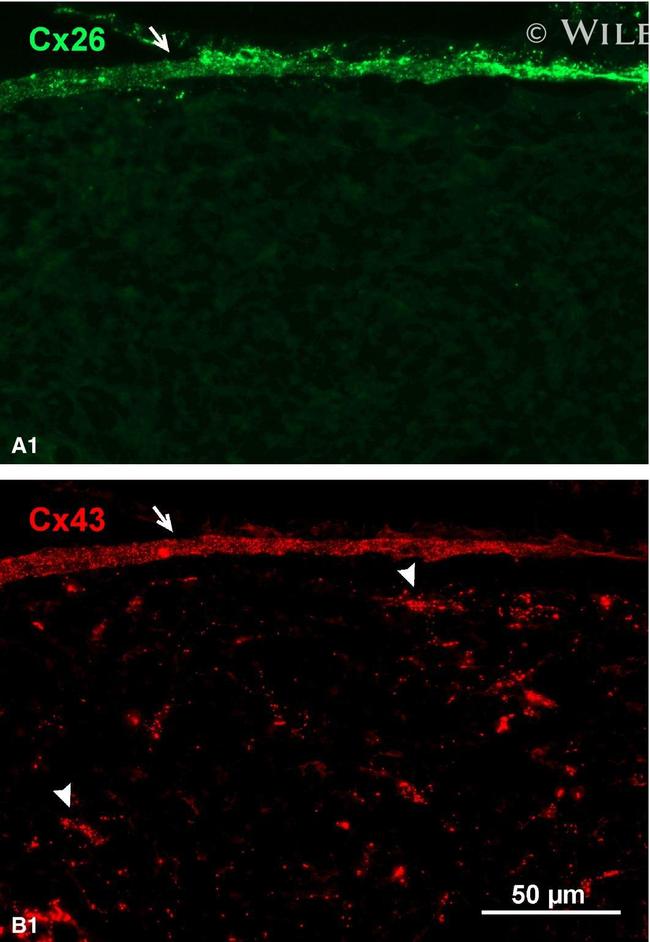
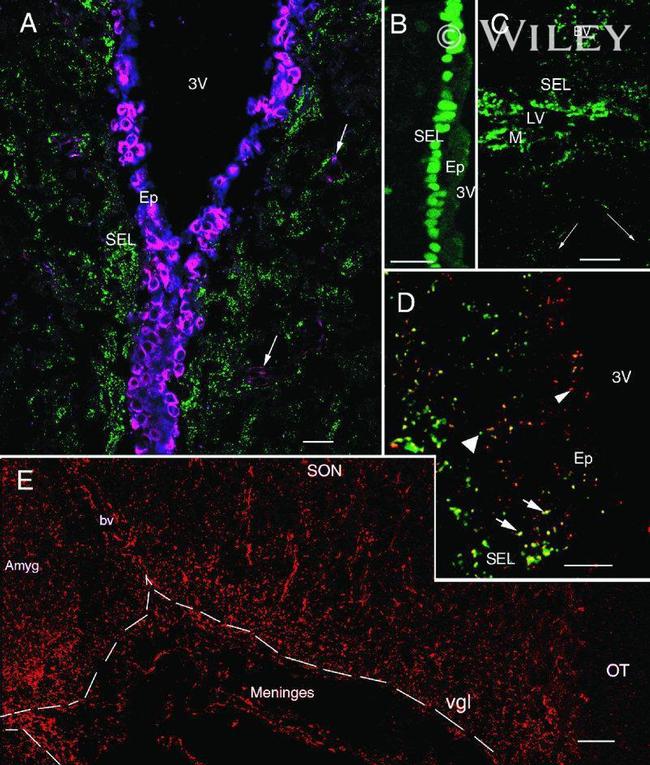
Mercier F,Hatton GI
Published figure using Connexin 26 monoclonal antibody (Product # 13-8100) in Immunohistochemistry
Mon Feb 26 00:00:00 EST 2001
Localization of connexin26 and connexin32 in putative CO(2)-chemosensitive brainstem regions in rat.
Respiration physiology
Solomon IC,Halat TJ,El-Maghrabi MR,O'Neal MH
Sat Dec 01 00:00:00 EST 2001
A role for heterologous gap junctions between melanoma and endothelial cells in metastasis.
The Journal of clinical investigation
Ito A,Katoh F,Kataoka TR,Okada M,Tsubota N,Asada H,Yoshikawa K,Maeda S,Kitamura Y,Yamasaki H,Nojima H
13-8100 was used in immunohistochemistry - paraffin section and western blot to study the role of Cx26 in intravasation and extravasation of tumor cells.
Mon May 01 00:00:00 EDT 2000
A role for heterologous gap junctions between melanoma and endothelial cells in metastasis.
The Journal of clinical investigation
Ito A,Katoh F,Kataoka TR,Okada M,Tsubota N,Asada H,Yoshikawa K,Maeda S,Kitamura Y,Yamasaki H,Nojima H
13-8100 was used in immunohistochemistry - paraffin section and western blot to study the role of Cx26 in intravasation and extravasation of tumor cells.
Mon May 01 00:00:00 EDT 2000
Biochemical and functional characterization of intercellular adhesion and gap junctions in fibroblasts.
American journal of physiology. Cell physiology
Ko K,Arora P,Lee W,McCulloch C
13-8100 was used in western blot to study intercellular adherens junctions and gap junctions in human gingival fibroblasts.
Sat Jul 01 00:00:00 EDT 2000
Transport function and hepatocellular localization of mrp6 in rat liver.
Molecular pharmacology
Madon J,Hagenbuch B,Landmann L,Meier PJ,Stieger B
13-8100 was used in immunohistochemistry (frozen) to study the transport function and subcellular localization of mrp6.
Wed Mar 01 00:00:00 EST 2000