Search


Citations & References (27)
Gibco™
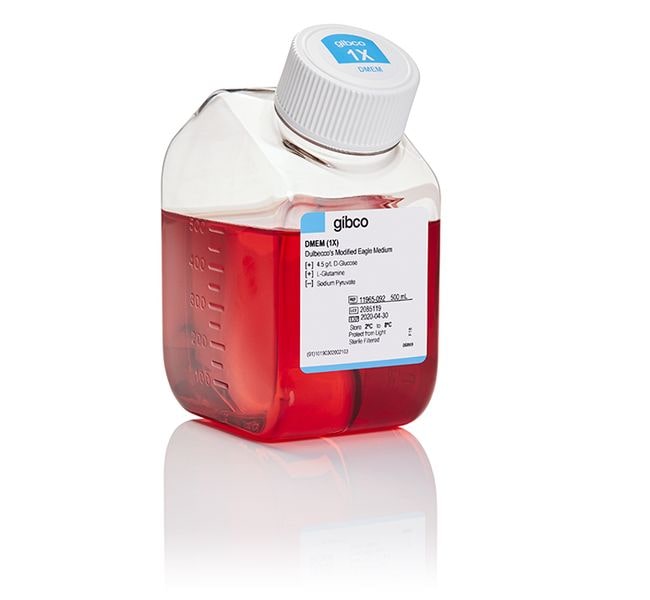
DMEM, high glucose
DMEM (Dulbecco's Modified Eagle Medium) is a widely used basal medium for supporting the growth of many different mammalian cells.
Have Questions?
Change view

| Catalog Number | Quantity |
|---|---|
| 11965118 | 10 x 500 mL |
| 11965092 | 1 x 500 mL |
| 11965084 | 1 x 1000 mL |
| 11965126 | 6 x 1000 mL |
| 11965167 | 1 x 5 L |
| 11965175 | 1 x 10 L |
Catalog number 11965118
Price (USD)
301.65
Online exclusive
331.00Save 29.35
Each
Quantity:
10 x 500 mL
Price (USD)
301.65
Online exclusive
331.00Save 29.35
Each
DMEM (Dulbecco's Modified Eagle Medium) is a widely used basal medium for supporting the growth of many different mammalian cells. Cells successfully cultured in DMEM include primary fibroblasts, neurons, glial cells, HUVECs, and smooth muscle cells, as well as cell lines such as HeLa, 293, Cos-7, and PC-12. Life Technologies offers a variety of DMEM modifications for a range of cell culture applications. Find the right formulation using the media selector tool.
This DMEM is modified as follows:
With: High Glucose, L-glutamine, Phenol Red
Without: Sodium Pyruvate, HEPES
The complete formulation is available.
Using DMEM
DMEM is unique from other media as it contains 4 times the concentration of amino acids and vitamins than the original Eagle's Minimal Essential Medium. DMEM was originally formulated with low glucose (1 g/L) and sodium pyruvate, but is often used with higher glucose levels, with or without sodium pyruvate. DMEM contains no proteins, lipids, or growth factors. Therefore, DMEM requires supplementation, commonly with 10% Fetal Bovine Serum (FBS). DMEM uses a sodium bicarbonate buffer system (3.7 g/L), and therefore requires a 5–10% CO2 environment to maintain physiological pH.
For Research Use or Further Manufacturing. Not for diagnostic use or direct administration into humans or animals.
Specifications
Cell LineHeLa, 293, Cos-7, and PC-12
Cell TypeMammalian Cells
Concentration1X
Culture EnvironmentCO2
For Use With (Application)Mammalian Cell Culture
FormatBottles
Glucose Concentration4500 mg/L
Manufacturing QualitycGMP-compliant under the ISO 13485 standard
Product LineGibco
Product TypeDMEM (Dulbecco's Modified Eagle Medium)
Quantity10 x 500 mL
Shelf Life12 Months From Date of Manufacture
Shipping ConditionAmbient
ClassificationAnimal Origin-free
Culture TypeMammalian Cell Culture
FormLiquid
Serum LevelStandard Serum Supplementation
SterilitySterile-filtered
Sterilization MethodSterile-filtered
With AdditivesHigh Glucose, Glutamine, Phenol Red
Without AdditivesNo HEPES, No Sodium Pyruvate
Unit SizeEach
Contents & Storage
Storage conditions: 2°C to 8°C (protect from light)
Shipping conditions: Ambient
Shelf life: 12 months from date of manufacture
Shipping conditions: Ambient
Shelf life: 12 months from date of manufacture
Frequently asked questions (FAQs)
My cells will not grow in DMEM, what other type of culture media can be used with the Photoreactive Amino Acids?
What is the osmolality of DMEM, high glucose (Cat. No. 11965xxx)?
What is the manganese concentration in DMEM? Do you offer manganese-free DMEM?
How long can I keep my media after supplementing with serum?
My medium was shipped at room temperature but it is supposed to be stored refrigerated. Is it okay?
Citations & References (27)
Citations & References
Abstract
Identification of a novel redox-sensitive gene, Id3, which mediates angiotensin II-induced cell growth.
Journal:Circulation
PubMed ID:12021231
BACKGROUND: Reactive oxygen species, such as superoxide (O(2)(-)), are involved in the abnormal growth of various cell types. Angiotensin II (Ang II) is one of the most potent inducers of oxidative stress in the vasculature. The molecular events involved in Ang II-induced proliferation of vascular smooth muscle cells (VSMCs) are
Human cytomegalovirus-encoded interleukin-10 homolog inhibits maturation of dendritic cells and alters their functionality.
Journal:J Virol
PubMed ID:15280480
Interleukin-10 (IL-10) suppresses the maturation and cytokine production of dendritic cells (DCs), key regulators of adaptive immunity, and prevents the activation and polarization of naïve T cells towards protective gamma interferon-producing effectors. We hypothesized that human cytomegalovirus (HCMV) utilizes its viral IL-10 homolog (cmvIL-10) to attenuate DC functionality, thereby subverting
Protocol to generate human liver spheroids to study liver fibrosis induced by metabolic stress.
Journal:STAR protocols
PubMed ID:38833372
Currently, there is no effective treatment for obesity and alcohol-associated liver diseases, partially due to the lack of translational human models. Here, we present a protocol to generate 3D human liver spheroids that contain all the liver cell types and mimic âlivers in a dish.â We describe strategies to induce
Shedding of the Interleukin-6 (IL-6) Receptor (gp80) Determines the Ability of IL-6 to Induce gp130 Phosphorylation in Human Osteoblasts.
Journal:J Biol Chem
PubMed ID:11884403
'Human osteoblasts produce interleukin-6 (IL-6) and respond to IL-6 in the presence of soluble IL-6 receptor (sIL-6R), but the cell surface expression of IL-6R and the mechanism of sIL-6R production are largely unknown. Three different human osteoblast-like cell lines (MG-63, HOS, and SaOS-2) and bone marrow-derived primary human osteoblasts expressed
Active nuclear import and export pathways regulate E2F-5 subcellular localization.
Journal:J Biol Chem
PubMed ID:12089160
'Epidermal keratinocyte differentiation is accompanied by differential regulation of E2F genes, including up-regulation of E2F-5 and its concomitant association with the retinoblastoma family protein p130. This complex appears to play a role in irreversible withdrawal from the cell cycle in differentiating keratinocytes. We now report that keratinocyte differentiation is also