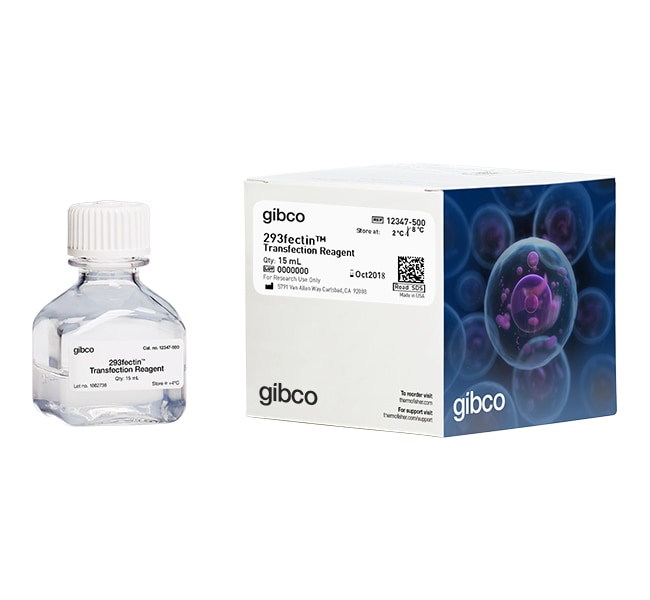
Firmeneigene Formulierung basierend auf kationischen Lipiden für die Transfektion von DNA in eukaryotische Zellen
Have Questions?
Ansicht ändern
Katalognummer
Menge
12347500
auch als 12347-500 bezeichnet
15 ml
12347019
1 ml
12347750
auch als 12347-750 bezeichnet
10 x 15 ml
3 Optionen
Katalognummer 12347500
auch als 12347-500 bezeichnet
Preis (EUR)
12.115,65
Exklusiv online
12.620,00
Ersparnis 504,35 (4%)
Each
Menge:
15 ml
Preis (EUR)
12.115,65
Exklusiv online
12.620,00
Ersparnis 504,35 (4%)
Each
293fectin™ Transfektionsreagenz ist eine proprietäre, kationische und lipid-basierte Formulierung für die Transfektion von DNA in eukaryotischen Zellen. Dieses Reagenz ist optimiert für die Transfektion von 293-HEK-Suspensionszellen (humanen embryonalen Nierenzellen) (z. B. FreeStyle™ 293-F-Zellen, Best.- Nr. R790-07) in definiertem, serumfreien FreeStyle™ 293 Expression Medium (Best.- Nr. 12338-018) und ist vorgesehen für die Verwendung mit dem FreeStyle™ 293 Expression System (Best.- Nr. K9000-01). 293fectin™ Transfektionsreagenz bietet die folgenden Vorteile:
• Weist eine hochwirksame Transfektion in 293-Suspensionszellen auf und ist auch geeignet für die Transfektion von adhärenten 293-Zellen • Suspension FreeStyle™ 293-F-Zellen können in FreeStyle™ 293-Expressionsmedium transfiziert werden; das Medium muss nicht gewechselt werden • 293fectin™ Reagenzkomplexe werden den Zellen direkt im Kulturmedium hinzugefügt • Es ist nicht erforderlich, Komplexe zu entfernen oder zu ändern oder nach der Transfektion Medium hinzuzufügen
Nur für Forschungszwecke. Nicht zur Verwendung bei diagnostischen Verfahren.
Specifications
Zur Verwendung mit (Anwendung)Transfektion
Hochdurchsatz-KompatibilitätNicht mit hohen Durchsatz kompatibel (manuell)
Produktlinie293fectin
ProdukttypTransfektionsreagenz
Menge15 ml
Serum-kompatibelJa
ZelltypEtablierte Zelllinien
FormatRörchen
ProbentypPlasmid-DNA
Transfection TechniqueLipid-basierte Transfektion
Unit SizeEach
Inhalt und Lagerung
Jede Einheit enthält ein Fläschchen mit Reagenzien. Bei +4 °C lagern. 293fectin™ ist bei ordnungsgemäßer Lagerung garantiert 6 Monate lang haltbar.
Häufig gestellte Fragen (FAQ)
What is the advantage of FreeStyle Max Reagent over 293fectin Transfection Reagent?
Both FreeStyle Max Reagent and 293fectin Transfection Reagent provide similar levels of high transfection efficiency; however, FreeStyle Max Reagent has lower cytotoxicity and hence results in higher protein yields. Additionally, FreeStyle Max Reagent is animal-origin free.
What is the difference between reverse transfection and forward transfection? What should I use?
In forward transfection, cells are seeded to appropriate confluence or cell density in wells or dishes, and the lipid-DNA complexes are added the next day. In reverse transfection, the transfection complexes are prepared inside the wells, after which cells and medium are added. Reverse transfection is faster to perform than forward transfection, and is the method of choice for high-throughput transfection. For non-high-throughput transfections, generally forward transfections have better efficiency for most cell types.
Is there a place where I can find references from other researchers who have used your transfection reagents?
Visit the product page for each reagent type and you will see a list of references at the bottom of the page. A table that lists specific cell line references is also accessible. We also recommend www.highwire.org as a search engine to find a large selection of up-to-date research articles using our transfection products. Simply include the name of the transfection reagent and your cell line/application of interest in your search criteria.
Can I use antibiotics in the medium during transfection?
Antibiotics can be used in the medium for culturing of cell lines. However, we do not recommend using antibiotics in the transfection medium unless previously tested in the cell type and payload being transfected. This is because presence of antibiotics during transfection may adversely affect transfection efficiency (i.e., positively charged antibiotics binding to the DNA being transfected) and overall health of cells being transfected.
For stable transfection, we recommend waiting wait 24-48 hrs after transfection before adding selected antibiotics.