Search


Citations & References (26)
Invitrogen™
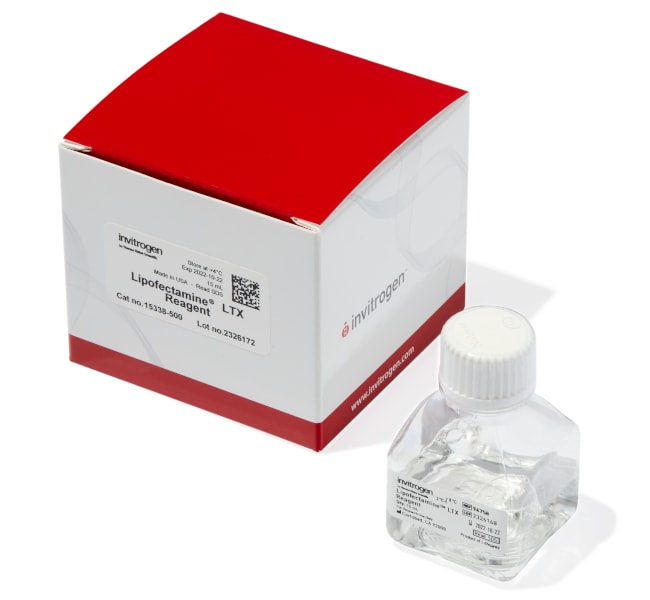
Lipofectamine™ LTX Reagent
Lipofectamine™ LTX Reagent is a plasmid transfection reagent that offers the right balance of potency and gentleness for your cells,Read more
| Catalog Number | Quantity |
|---|---|
| 15338500 | 15 mL |
Catalog number 15338500
Price (USD)
12,383.65
Online exclusive
12,900.00Save 516.35
Each
Quantity:
15 mL
Price (USD)
12,383.65
Online exclusive
12,900.00Save 516.35
Each
Lipofectamine™ LTX Reagent is a plasmid transfection reagent that offers the right balance of potency and gentleness for your cells, resulting in the highest possible transfection efficiencies and viabilities. Lipofectamine™ LTX Reagent is a new, advanced solution for gene expression in both common and challenging cell types. No other plasmid DNA-specific transfection reagent can match the efficiency, convenience, and gentleness of Lipofectamine™ LTX Reagent for transfection of primary, challenging, and sensitive cell lines. Lipofectamine™ LTX Reagent is synthesized from 100% animal origin-free components, making it easy to validate the absence of zoonotic diseases, such as BSE or viruses, in research experiments or cell lines. A certificate of origin may be obtained by contacting Technical Support.
Lipofectamine™ LTX Reagent offers:
• Superior delivery – transfect a broad range of cell types, including primary challenging and sensitive cells, with high efficiency
• Superior performance – combine high transfection efficiency with maximal (>90%) cell viability
• Optimized protocols – rapid, simple protocols provided for most cell lines
• A highly effective reagent to generate stable cell lines
Transfect Primary Cells Efficiently
Primary cells are often difficult to transfect. Lipofectamine™ LTX Reagent, when combined with PLUS™ Reagent, provides the highest level of transfection in primary cells of any lipid- or polymer-based reagent. Many primary cell types have been successfully transfected with Lipofectamine™ LTX including primary neural progenitor cells.
Superior Delivery into Challenging Cells
When it comes to achieving high levels of protein expression in RAW267.3 macrophages, Lipofectamine™ LTX Reagent outperforms competing transfection reagents (see Figure 4). Achieving high-level transgene expression in cells that are traditionally refractory to transfection allows you to obtain results that were previously unattainable.
Broad Compatibility with Cell Lines
In addition to being excellent for transfecting primary and challenging cells, Lipofectamine™ LTX Reagent provides you with the most versatile approach to transfecting established cells lines, including those that are sensitive to other transfection reagents. Use our Transfection Selection Tool to help you select the best transfection conditions for the cells with which you work.
Stable Transfection
Lipofectamine™ LTX strikes the right balance between potency and gentleness, giving you the highest possible percentage of successfully transfected cells. This makes Lipofectamine™ LTX the quickest and easiest reagent for establishing stable transfectants from challenging or refractory cell types.
Simple, Rapid, Serum-compatible Protocol
Lipofectamine™ LTX Reagent offers a streamlined protocol – no need to remove transfection complexes or change/add medium following transfection. A simple, optimization protocol helps you get the best results quickly so you'll spend less hands-on time, and get faster results.
Lipofectamine™ LTX and PLUS™ Reagent is available in the following sizes:
• 0.1 ml with 40 μl PLUS™ Reagent
• 0.3 ml with 0.25 ml PLUS™ Reagent
• 1.0 ml with 0.85 ml PLUS™ Reagent
• 15 ml (purchase PLUS™ Reagent separately)
Lipofectamine™ LTX Reagent offers:
• Superior delivery – transfect a broad range of cell types, including primary challenging and sensitive cells, with high efficiency
• Superior performance – combine high transfection efficiency with maximal (>90%) cell viability
• Optimized protocols – rapid, simple protocols provided for most cell lines
• A highly effective reagent to generate stable cell lines
Transfect Primary Cells Efficiently
Primary cells are often difficult to transfect. Lipofectamine™ LTX Reagent, when combined with PLUS™ Reagent, provides the highest level of transfection in primary cells of any lipid- or polymer-based reagent. Many primary cell types have been successfully transfected with Lipofectamine™ LTX including primary neural progenitor cells.
Superior Delivery into Challenging Cells
When it comes to achieving high levels of protein expression in RAW267.3 macrophages, Lipofectamine™ LTX Reagent outperforms competing transfection reagents (see Figure 4). Achieving high-level transgene expression in cells that are traditionally refractory to transfection allows you to obtain results that were previously unattainable.
Broad Compatibility with Cell Lines
In addition to being excellent for transfecting primary and challenging cells, Lipofectamine™ LTX Reagent provides you with the most versatile approach to transfecting established cells lines, including those that are sensitive to other transfection reagents. Use our Transfection Selection Tool to help you select the best transfection conditions for the cells with which you work.
Stable Transfection
Lipofectamine™ LTX strikes the right balance between potency and gentleness, giving you the highest possible percentage of successfully transfected cells. This makes Lipofectamine™ LTX the quickest and easiest reagent for establishing stable transfectants from challenging or refractory cell types.
Simple, Rapid, Serum-compatible Protocol
Lipofectamine™ LTX Reagent offers a streamlined protocol – no need to remove transfection complexes or change/add medium following transfection. A simple, optimization protocol helps you get the best results quickly so you'll spend less hands-on time, and get faster results.
Lipofectamine™ LTX and PLUS™ Reagent is available in the following sizes:
• 0.1 ml with 40 μl PLUS™ Reagent
• 0.3 ml with 0.25 ml PLUS™ Reagent
• 1.0 ml with 0.85 ml PLUS™ Reagent
• 15 ml (purchase PLUS™ Reagent separately)
For Research Use Only. Not for use in diagnostic procedures.
Specifications
ClassificationAnimal Origin-Free
For Use With (Application)Transfection
High-throughput CompatibilityHigh-throughput Compatible
Product LineLipofectamine
Product TypeLTX Reagent
Quantity15 mL
Serum CompatibleYes
Shipping ConditionWet Ice
Cell TypeEstablished Cell Lines, Stem Cells, Primary Cells, Hard-to-Transfect Cells
Format6-well Plate, 12-well Plate, 24-well Plate, 48-well Plate, 96-well Plate, Flasks
Sample TypePlasmid DNA, RNAi Plasmids (shRNA, miR)
Transfection TechniqueLipid-based Transfection
Unit SizeEach
Contents & Storage
Each unit contains one vial of Lipofectamine™ LTX Reagent (15 mL). Store at 2–8°C.
Frequently asked questions (FAQs)
I accidentally left my lipid reagent at room temperature. Can I still use it?
Can I use Lipofectamine LTX in RNAi experiments?
Can I use Lipofectamine LTX for transfection of suspension cells, other hard-to-transfect cells, and primary cells?
Can I use Lipofectamine LTX for transfecting plasmid DNA into primary cells?
Can I use Lipofectamine LTX for delivery of plasmid DNA and siRNA?
Citations & References (26)
Citations & References
Abstract
Interaction between sterol regulatory element-binding proteins and liver receptor homolog-1 reciprocally suppresses their transcriptional activities.
Journal:The Journal of biological chemistry
PubMed ID:17283069
Cytohesins are cytoplasmic ErbB receptor activators.
Journal:Cell
PubMed ID:20946980
'Signaling by ErbB receptors requires the activation of their cytoplasmic kinase domains, which is initiated by ligand binding to the receptor ectodomains. Cytoplasmic factors contributing to the activation are unknown. Here we identify members of the cytohesin protein family as such factors. Cytohesin inhibition decreased ErbB receptor autophosphorylation and signaling,
Cytoskeletal anchoring of GLAST determines susceptibility to brain damage: an identified role for GFAP.
Journal:J Biol Chem
PubMed ID:17684014
'Glial fibrillary acidic protein (GFAP) is an enigmatic protein; it currently has no unambiguously defined role. It is expressed in the cytoskeleton of astrocytes in the mammalian brain. We have used co-immunoprecipitation to identify in vivo binding partners for GFAP in the rat and pig brain. We demonstrate interactions between
Oxidative stress modulates complement factor H expression in retinal pigmented epithelial cells by acetylation of FOXO3.
Journal:J Biol Chem
PubMed ID:17558024
'Age-related macular degeneration (AMD), the leading cause of severe vision loss in the elderly, is a complex disease that results from genetic modifications that increase susceptibility to environmental exposures. Smoking, a major source of oxidative stress, increases the incidence and severity of AMD, and antioxidants slow progression, suggesting that oxidative
Identification of residues important for agonist recognition and activation in GPR40.
Journal:J Biol Chem
PubMed ID:17699519
'GPR40 was formerly an orphan G protein-coupled receptor whose endogenous ligands have recently been identified as free fatty acids (FFAs). The receptor, now named FFA receptor 1, has been implicated in the pathophysiology of type 2 diabetes and is a drug target because of its role in FFA-mediated enhancement of