Search


Citations & References (5)
Gibco™
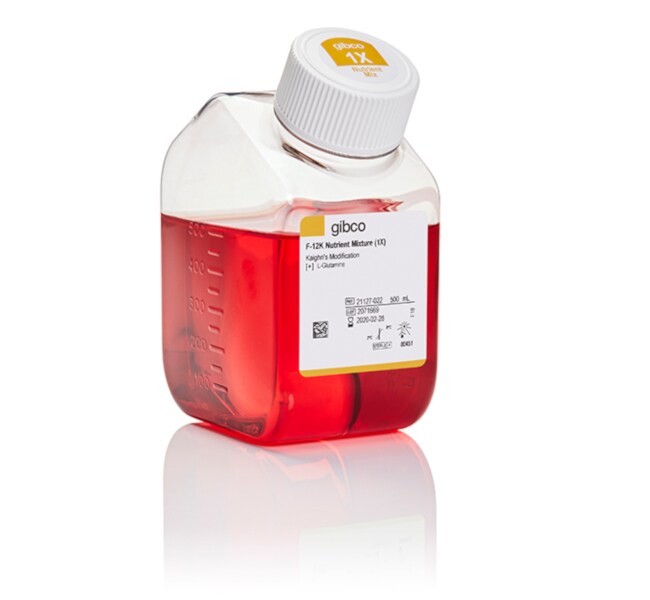
Ham's F-12K (Kaighn's) Medium
Ham's F-12K (Kaighn's) Medium is a modification of Ham's F-12 Nutrient Mixture. Ham's F-12K (Kaighn's) Medium was developed for primaryRead more
Have Questions?
Change view

| Catalog Number | Quantity |
|---|---|
| 21127022 | 500 mL |
| 21127030 | 10 x 500 mL |
Catalog number 21127022
Price (MXN)
986.32
Each
Quantity:
500 mL
Price (MXN)
986.32
Each
Ham's F-12K (Kaighn's) Medium is a modification of Ham's F-12 Nutrient Mixture. Ham's F-12K (Kaighn's) Medium was developed for primary human hepatocytes, as well as for some rat and chicken liver cells in a reduced serum environment.
This F-12K (Kaighn's) Medium is manufactured as follows:
With: L-glutamine, Phenol Red
Without: HEPES
The complete formulation is available.
Using Ham's F-12K
Ham's F-12K (Kaighn's) Medium contains many components not found in traditional basal media, such as putrescine, thymidine, hypoxanthine, zinc, and higher levels of all amino acids and sodium pyruvate. These additions allow the medium to be supplemented with very low levels of serum or defined components, for some cell types. Ham's F-12K (Kaighn's) Medium contains no proteins or growth factors, and is therefore often supplemented with growth factors and Fetal Bovine Serum (FBS). The FBS concentration must be optimized for each cell line. Ham's F-12K (Kaighn's) Medium uses a sodium bicarbonate buffer system (2.5 g/L), and therefore requires a 5–10% CO2 environment to maintain physiological pH.
For Research Use Only. Not for use in diagnostic procedures.
Specifications
Cell TypeHuman Hepatocytes
Concentration1 X
Manufacturing QualitycGMP-compliant under the ISO 13485 standard
Product LineGibco
Product TypeHam's F-12K (Kaighn's) Medium
Quantity500 mL
Shelf Life12 Months From Date of Manufacture
Shipping ConditionRoom Temperature
ClassificationAnimal Origin-free
FormLiquid
SterilitySterile-filtered
Sterilization MethodSterile-filtered
With AdditivesLow Glucose, Glutamine, Phenol Red, Sodium Pyruvate
Without AdditivesNo HEPES
Unit SizeEach
Contents & Storage
Storage conditions: 2-8°C. Protect from light
Shipping conditions: Ambient
Shipping conditions: Ambient
Frequently asked questions (FAQs)
How long can I keep my media after supplementing with serum?
My medium was shipped at room temperature but it is supposed to be stored refrigerated. Is it okay?
How can I remove mycoplasma contamination from my cell culture medium?
I see a decrease in growth of my culture. What should I do?
My cells are not adhering to the culture vessel. What should I do?
Citations & References (5)
Citations & References
Abstract
Human MutY homolog, a DNA glycosylase involved in base excision repair, physically and functionally interacts with mismatch repair proteins human MutS homolog 2/human MutS homolog 6.
Journal:J Biol Chem
PubMed ID:11801590
Adenines mismatched with guanines or 7,8-dihydro-8-oxo-deoxyguanines that arise through DNA replication errors can be repaired by either base excision repair or mismatch repair. The human MutY homolog (hMYH), a DNA glycosylase, removes adenines from these mismatches. Human MutS homologs, hMSH2/hMSH6 (hMutSalpha), bind to the mismatches and initiate the repair on
Stimulation of neuronal neurite outgrowth using functionalized carbon nanotubes.
Journal:Nanotechnology
PubMed ID:20173239
Low concentrations (0.11-1.7 microg ml(-1)) of functionalized carbon nanotubes (CNTs), which are multi-walled CNTs modified by amino groups, when added with nerve growth factor (NGF), promoted outgrowth of neuronal neurites in dorsal root ganglion (DRG) neurons and rat pheochromocytoma cell line PC12h cells in culture media. The quantity of active
Dystrophin deficiency markedly increases enterovirus-induced cardiomyopathy: a genetic predisposition to viral heart disease.
Journal:Nat Med
PubMed ID:12118246
Both enteroviral infection of the heart and mutations in the dystrophin gene can cause cardiomyopathy. Little is known, however, about the interaction between genetic and acquired forms of cardiomyopathy. We previously demonstrated that the enteroviral protease 2A cleaves dystrophin; therefore, we hypothesized that dystrophin deficiency would predispose to enterovirus-induced cardiomyopathy.
The Slp homology domain of synaptotagmin-like proteins 1-4 and Slac2 functions as a novel Rab27A binding domain.
Journal:J Biol Chem
PubMed ID:11773082
rab27A, which encodes a small GTP-binding protein, was recently identified as a gene in which mutations caused human hemophagocytic syndrome (Griscelli syndrome) and ashen mice, which exhibit defects in melanosome transport as well as in regulated granule exocytosis in cytotoxic T lymphocytes. However, little is known about the molecular mechanism
Role for 18:1 lysophosphatidic acid as an autocrine mediator in prostate cancer cells.
Journal:J Biol Chem
PubMed ID:12084719
Lysophosphatidic acid (LPA) is a lipid mediator that may play an important role in growth and survival of carcinomas. In this study, LPA production and response were characterized in two human prostate cancer (CaP) cell lines: PC-3 and Du145. Bombesin, a neuroendocrine peptide that is mitogenic for CaP cells, stimulated