What is a spectral calibration?
A spectral calibration is an algorithm applied to raw data, which converts it into the component 4 or 5 dye data stored in the sample files. A spectral is created for a specific dye set (combination of dyes), array type (4 or 16 capillaries), and array length (36cm or 50cm). It is used to correct for the natural overlap of the fluorescent dyes.
Find additional tips, troubleshooting help, and resources within our Capillary Electrophoresis Instruments Support Center.
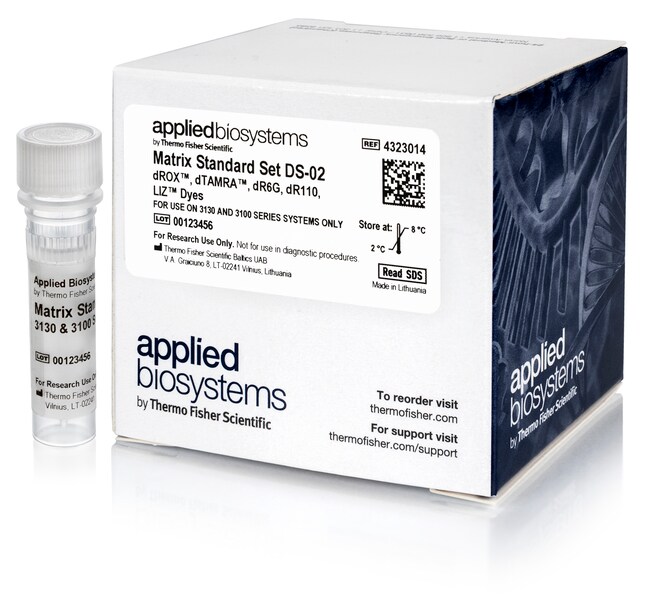
Which fragment analysis matrix standards can I use for my Applied Biosystems 3130 Series instrument?
DS-02 (Dye Set E5), DS-30 (Dye Set D), DS-31 (Dye Set D), DS-32 (Dye Set F), and DS-33 (Dye Set G5) are all supported on the Applied Biosystems 3130 Series systems. Please refer to the Applied Biosystems 3130/3130xl Genetic Analyzers Getting Started Guide (http://tools.thermofisher.com/content/sfs/manuals/cms_041468.pdf) for more information.
Find additional tips, troubleshooting help, and resources within our Capillary Electrophoresis Applications Support Center.
I am using only one dye for fragment analysis but I see peaks in other colors below my peak of interest. Why is this?
If the peaks in other colors are directly below the peak of interest, the issue could be that the fluorescent dye being used is not part of the selected dye set, the spectral calibration needs to be performed, or the peaks are offscale. Confirm that the dye set selected on the instrument is compatible with the dye being used, run a new spectral calibration if the correct dye set has been selected and, if the signal intensity is too high, decrease sample concentration during PCR or when preparing samples for electrophoresis.
Find additional tips, troubleshooting help, and resources within our Capillary Electrophoresis Applications Support Center.
How many SNPs can be multiplexed with the SNaPshot Multiplex Kit?
The SNaPshot Multiplex Kit is designed to interrogate up to ten single nucleotide polymorphisms (SNPs) at known locations on one to ten DNA templates in a single tube.
Find additional tips, troubleshooting help, and resources within our Capillary Electrophoresis Applications Support Center.
How do I design my primers for the SNaPshot Multiplex Kit?
Follow these recommendations for designing and evaluating primers:
- Primers included in a single reaction need to differ significantly in lengths in order to avoid overlap between the final SNaPshot products. A difference of 4-6 nucleotides between primer lengths is recommended as a starting point (5-7 nucleotides if running on POP-7 Polymer).
- The length of a primer can be modified by the addition of non-homologous polynucleotides at the 5′ end. Since the recommended annealing temperature for a SNaPshot control primer is 50 degrees C, the melting temperature for the complementary region between any primer and its corresponding template should be at least 50 degrees C.
- Poly (dT), poly (dA), poly (dC), and poly (dGACT) are 5′ non-homologous tails which are predicted to have minimal secondary structures. They have all been used successfully. Generally the signal patterns are not affected by the kinds of tails that are used. The 5′ poly (dT) tails however may interfere with the addition of 3′ ddA.
- The mobility of an oligonucleotide in capillary electrophoresis is determined by its size, nucleotide composition, and dye. Thus the effect of nucleotide composition on mobility can be significant when the primer is short. We strongly recommend that you test primers shorter than 36 nucleotides before being multiplexed to ensure that the final products are spatially resolved when analyzed on the instrument.
- Check primers for possible extendable hairpin structures within each primer and for extendable dimer formation between primers.
- HPLC purification of primers is recommended for oligonucleotides longer than 30 nucleotides. Heterogeneous primer mixtures containing mixed molecular weight oligonucleotides may yield undesired products that will confuse analysis.
For additional suggestions please refer to Appendix A of the SNaPshot Multiplex Kit manual (https://tools.thermofisher.com/content/sfs/manuals/cms_041203.pdf).
Find additional tips, troubleshooting help, and resources within our Capillary Electrophoresis Applications Support Center.