Search
 Element Search
 Structure Search


Thermo Scientific Chemicals
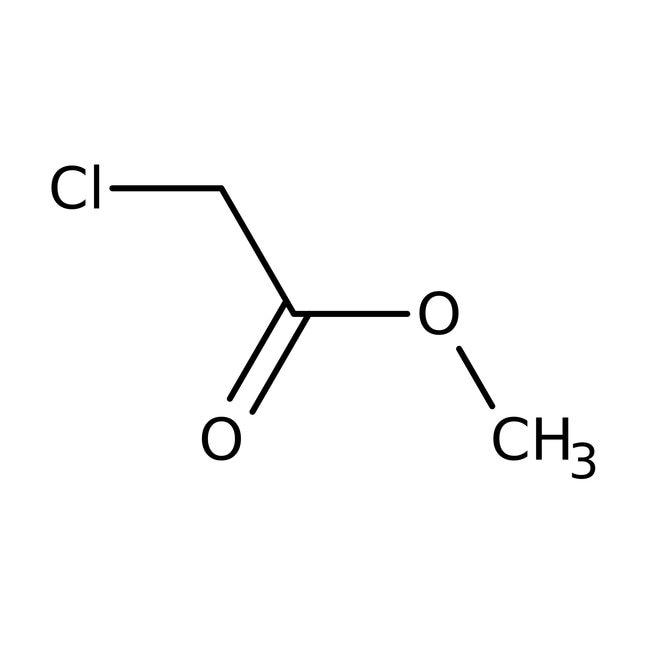
Methyl chloroacetate, 99+%
CAS: 96-34-4 | C3H5ClO2 | 108.521 g/mol
Have Questions?
Change view

Catalog number A10325.30
also known as A10325-30
Price (USD)
25.40
Each
Quantity:
250 g
Price (USD)
25.40
Each
Chemical Identifiers
CAS96-34-4
IUPAC Namemethyl 2-chloroacetate
Molecular FormulaC3H5ClO2
InChI KeyQABLOFMHHSOFRJ-UHFFFAOYSA-N
SMILESCOC(=O)CCl
View more
Specifications Specification Sheet
Specification SheetAppearance (Color)Clear colorless
Assay (GC)≥99.0%
FormLiquid
Refractive Index1.4205-1.4225 @ 20?C
Methyl chloroacetate is used as a solvent and chemical intermediate. It acts as a precursor in the preparation of (carboxymethyl) trimethylammonium chloride esters. Further, it is used in the preparation of octakis-(carbethoxymethoxy)calix[8]arene. It is employed as an extraction solvent during the separation of neutral compounds. In addition to this, it is used in the synthesis of dimethyl carbonate.
This Thermo Scientific Chemicals brand product was originally part of the Alfa Aesar product portfolio. Some documentation and label information may refer to the legacy brand. The original Alfa Aesar product / item code or SKU reference has not changed as a part of the brand transition to Thermo Scientific Chemicals.
Applications
Methyl chloroacetate is used as a solvent and chemical intermediate. It acts as a precursor in the preparation of (carboxymethyl) trimethylammonium chloride esters. Further, it is used in the preparation of octakis-(carbethoxymethoxy)calix[8]arene. It is employed as an extraction solvent during the separation of neutral compounds. In addition to this, it is used in the synthesis of dimethyl carbonate.
Solubility
Miscible with organic solvents, alcohol, ether, acetone and benzene. Slightly miscible with water.
Notes
Incompatible with strong oxidizing agents and strong bases.
Methyl chloroacetate is used as a solvent and chemical intermediate. It acts as a precursor in the preparation of (carboxymethyl) trimethylammonium chloride esters. Further, it is used in the preparation of octakis-(carbethoxymethoxy)calix[8]arene. It is employed as an extraction solvent during the separation of neutral compounds. In addition to this, it is used in the synthesis of dimethyl carbonate.
Solubility
Miscible with organic solvents, alcohol, ether, acetone and benzene. Slightly miscible with water.
Notes
Incompatible with strong oxidizing agents and strong bases.
RUO – Research Use Only
General References:
- Hu, K.; Zhao, D.; Wu, G.; Ma, J. Polyesters derived from bio-based eugenol and 10-undecenoic acid: synthesis, characterization, and structure-property relationships. RSC Adv. 2015, 5 (105), 85996-86005.
- Wang, X. F.; Hai, X.; Shu, Y.; Chen, X. W.; Wang, J. H. A novel cross-linked co-polymeric ionic liquid as a potential adsorbent for highly efficient adsorption of curcuminoids. Anal. Methods 2015, 7 (22), 9529-9534.