Search
 Element Search
 Structure Search


Thermo Scientific Chemicals
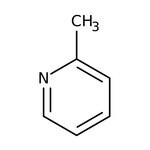
2-Picoline, 98+%
CAS: 109-06-8 | C6H7N | 93.129 g/mol
Have Questions?
Change view


Catalog number A10847.0F
also known as A10847-0F
Price (USD)
121.65
Special offer
Online exclusive
Ends: 28-Dec-2026
143.00Save 21.35
Each
Quantity:
2500 mL
Price (USD)
121.65
Special offer
Online exclusive
Ends: 28-Dec-2026
143.00Save 21.35
Each
Chemical Identifiers
CAS109-06-8
IUPAC Name2-methylpyridine
Molecular FormulaC6H7N
InChI KeyBSKHPKMHTQYZBB-UHFFFAOYSA-N
SMILESCC1=CC=CC=N1
View more
Specifications Specification Sheet
Specification SheetFormLiquid
Appearance (Color)Clear, colorless to yellow
Assay from Supplier's CofA≥98.0%
2-Picoline is used as an intermediate in agrochemicals and pharmaceuticals. It serves as a solvent as well as to prepare dyes and resins. It finds application as a constituent in cigarette smoke, bone oil, coal tar and coke oven emissions. Further, it acts as a precursor of 2-vinylpyridine, picolinic acid and nitrapyrin. It is also employed to study the electron and proton transfer reactions of lumiflavin. In addition, it is used in the synthetic pathway for the preparation of dearomatized, allylated and carbon-hydrogen bond activated pyridine derivatives.
This Thermo Scientific Chemicals brand product was originally part of the Alfa Aesar product portfolio. Some documentation and label information may refer to the legacy brand. The original Alfa Aesar product / item code or SKU reference has not changed as a part of the brand transition to Thermo Scientific Chemicals.
Applications
2-Picoline is used as an intermediate in agrochemicals and pharmaceuticals. It serves as a solvent as well as to prepare dyes and resins. It finds application as a constituent in cigarette smoke, bone oil, coal tar and coke oven emissions. Further, it acts as a precursor of 2-vinylpyridine, picolinic acid and nitrapyrin. It is also employed to study the electron and proton transfer reactions of lumiflavin. In addition, it is used in the synthetic pathway for the preparation of dearomatized, allylated and carbon-hydrogen bond activated pyridine derivatives.
Solubility
Miscible with water.
Notes
Hygroscopic. Incompatible with strong oxidizing agents, sulfuric acid, acids, metals, iron(II) sulfate and hydrogen peroxide.
2-Picoline is used as an intermediate in agrochemicals and pharmaceuticals. It serves as a solvent as well as to prepare dyes and resins. It finds application as a constituent in cigarette smoke, bone oil, coal tar and coke oven emissions. Further, it acts as a precursor of 2-vinylpyridine, picolinic acid and nitrapyrin. It is also employed to study the electron and proton transfer reactions of lumiflavin. In addition, it is used in the synthetic pathway for the preparation of dearomatized, allylated and carbon-hydrogen bond activated pyridine derivatives.
Solubility
Miscible with water.
Notes
Hygroscopic. Incompatible with strong oxidizing agents, sulfuric acid, acids, metals, iron(II) sulfate and hydrogen peroxide.
RUO – Research Use Only
General References:
- Dhau, J. S.; Singh, A. A study on the BF3-directed lithiation of 2-picoline and 2,3-lutidine. J. Organomet. Chem. 2014, 749, 109-114.
- Li, B.; Wei, H.; Li, H.; Pereshivko, O. P.; Peshkov, V. A. Direct addition of 2-methylazines to aryl glyoxals for the synthesis of alpha-hydroxy ketones. Tetrahedron Lett. 2015, 56 (37), 5231-5234.