Search
 Element Search
 Structure Search


Thermo Scientific Chemicals
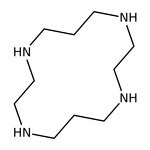
1,4,8,11-Tetraazacyclotetradecane, 98+%
CAS: 295-37-4 | C10H24N4 | 200.33 g/mol
Have Questions?
Change view

Catalog number A11516.14
also known as A11516-14
Price (USD)
895.65
Special offer
Online exclusive
Ends: 30-Jun-2026
1,054.00Save 158.35 (15%)
Each
Quantity:
25 g
Price (USD)
895.65
Special offer
Online exclusive
Ends: 30-Jun-2026
1,054.00Save 158.35 (15%)
Each
Chemical Identifiers
CAS295-37-4
IUPAC Name1,4,8,11-tetraazacyclotetradecane
Molecular FormulaC10H24N4
InChI KeyMDAXKAUIABOHTD-UHFFFAOYSA-N
SMILESC1CNCCNCCCNCCNC1
View more
Specifications Specification Sheet
Specification SheetFormFibrous crystalline solid or crystals or needles or powder
Identification (FTIR)Conforms
Melting Point (clear melt)183-192?C
Appearance (Color)White to pale cream
Water Content (Karl Fischer Titration)<2.0%
View more
1,4,8,11-Tetraazacyclotetradecane is used in the synthesis of molecules with electroactive cavities. It acts as a nitrogen crown ether analogue and as an antioxidant in rubber. It is also used in the preparation of plerixafor derivatives.
This Thermo Scientific Chemicals brand product was originally part of the Alfa Aesar product portfolio. Some documentation and label information may refer to the legacy brand. The original Alfa Aesar product / item code or SKU reference has not changed as a part of the brand transition to Thermo Scientific Chemicals.
Applications
1,4,8,11-Tetraazacyclotetradecane is used in the synthesis of molecules with electroactive cavities. It acts as a nitrogen crown ether analogue and as an antioxidant in rubber. It is also used in the preparation of plerixafor derivatives.
Solubility
Soluble in water.
Notes
Hygroscopic. Incompatible with oxidizing agents.
1,4,8,11-Tetraazacyclotetradecane is used in the synthesis of molecules with electroactive cavities. It acts as a nitrogen crown ether analogue and as an antioxidant in rubber. It is also used in the preparation of plerixafor derivatives.
Solubility
Soluble in water.
Notes
Hygroscopic. Incompatible with oxidizing agents.
RUO – Research Use Only
General References:
- Nitrogen analogue of the crown ethers (see Appendix 2), forming stable complexes with metal ions: Inorg. Chem., 4,1102, 1109 (1965); Can. J. Chem., 48, 1481 (1970). For examples of use as a versatile ligand in coordination chemistry, see: Acc. Chem. Res., 11, 392 (1978); J. Chem. Soc., Chem. Commun., 1322 (1986); 1075 (1987); 156 (1988); Inorg. Chem., 26, 908 (1987); J. Am. Chem. Soc., 110, 3679 (1988).
- Complex with iron(II) triflate is an effective epoxidation catalyst: J. Am. Chem. Soc., 113, 7052 (1991).
- The Ni(II) complex catalyzes the novel electrochemical reaction of epoxides with carbon dioxide to give good yields of cyclic carbonates: J. Chem. Soc., Chem. Commun., 43 (1995). A similar system catalyzes the electrochemical intramolecular reductive cyclization of a series of o-halogenated aryl alkenes: Tetrahedron Lett., 36, 4429 (1995):
- For use in synthesis of molecules with electroactive cavities, see (Ferrocenyl methyl) trimethyl ammonium iodide, 39399.
- Misra, A. C.; Luker, K. E.; Durmaz, H.; Luker, G. D.; Lahann, J. CXCR4-Targeted Nanocarriers for Triple Negative Breast Cancers. Biomacromolecules 2015, 16 (8), 2412-2417.