Search
 Element Search
 Structure Search


Thermo Scientific Chemicals
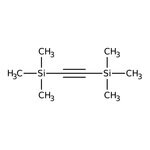
Bis(trimethylsilyl)acetylene, 99%
CAS: 14630-40-1 | C8H18Si2 | 170.402 g/mol
Have Questions?
Change view


Catalog number A11960.30
also known as A11960-30
Price (USD)
807.65
Online Exclusive
897.00Save 89.35 (10%)
Each
Quantity:
250 g
Price (USD)
807.65
Online Exclusive
897.00Save 89.35 (10%)
Each
Chemical Identifiers
CAS14630-40-1
IUPAC Nametrimethyl[2-(trimethylsilyl)ethynyl]silane
Molecular FormulaC8H18Si2
InChI KeyZDWYFWIBTZJGOR-UHFFFAOYSA-N
SMILESC[Si](C)(C)C#C[Si](C)(C)C
View more
Specifications Specification Sheet
Specification SheetAppearance (Color)Colorless to white
FormCrystals or powder or crystalline powder or clear liquid as melt
Assay (GC)≥98.5%
Identification (FTIR)Conforms
Refractive Index1.4260-1.4290 @ 20?C
BTMSA is used as starting reagent in the synthesis of functionalized 4-R-1,2-bis(trimethylsilyl)benzenes. It is also used in the synthesis of (+)-brasilenyne2 and (β-diketanato)Ag(BTMSA). Bis(trimethylsilyl)acetylene is a ligand that binds to a central metal ion (e.g. Titanium) to create a coordination complex. One of its complexes, Permethyltitanocene-bis(trimethylsilyl)acetylene, is a catalyst for the head-to-tail dimerization of 1-alkynes (e.g. 3-Penten-1-yne [P227430]).
This Thermo Scientific Chemicals brand product was originally part of the Alfa Aesar product portfolio. Some documentation and label information may refer to the legacy brand. The original Alfa Aesar product / item code or SKU reference has not changed as a part of the brand transition to Thermo Scientific Chemicals.
Applications
BTMSA is used as starting reagent in the synthesis of functionalized 4-R-1,2-bis(trimethylsilyl)benzenes. It is also used in the synthesis of (+)-brasilenyne2 and (β-diketanato)Ag(BTMSA). Bis(trimethylsilyl)acetylene is a ligand that binds to a central metal ion (e.g. Titanium) to create a coordination complex. One of its complexes, Permethyltitanocene-bis(trimethylsilyl)acetylene, is a catalyst for the head-to-tail dimerization of 1-alkynes (e.g. 3-Penten-1-yne [P227430]).
Solubility
Not miscible or difficult to mix in water. Soluble in Chloroform and Methanol.
Notes
Store away from oxidizing agents. Do not store together with acids.
BTMSA is used as starting reagent in the synthesis of functionalized 4-R-1,2-bis(trimethylsilyl)benzenes. It is also used in the synthesis of (+)-brasilenyne2 and (β-diketanato)Ag(BTMSA). Bis(trimethylsilyl)acetylene is a ligand that binds to a central metal ion (e.g. Titanium) to create a coordination complex. One of its complexes, Permethyltitanocene-bis(trimethylsilyl)acetylene, is a catalyst for the head-to-tail dimerization of 1-alkynes (e.g. 3-Penten-1-yne [P227430]).
Solubility
Not miscible or difficult to mix in water. Soluble in Chloroform and Methanol.
Notes
Store away from oxidizing agents. Do not store together with acids.
RUO – Research Use Only
General References:
- Christian Reus.; Liu NW.; Bolte M.; Lerner HW.; Wagner M. Synthesis of bromo-, boryl-, and stannyl-functionalized 1,2-bis(trimethylsilyl)benzenes via Diels-Alder or C-H activation reactions.J. Org. Chem.,2012,77(7), 3518-3523.
- Denmark SE.; Yang SM. Intramolecular silicon-assisted cross-coupling: total synthesis of (+)-brasilenyne.J Am Chem Soc.,2002,124(51), 15196-15197.
- Akinobu Horita.; Hayato Tsurugi.; Tetsuya Satoh.; Masahiro Miura. IRhodium-catalyzed anti selective cross-addition of bis(trimethylsilyl)acetylene to diarylacetylenes via carbon-silicon bond cleavage.Org Lett.,2008,10(9), 1751-1754.
- Reacts with electrophiles via Si-stabilized carbocations ions and subsequent desilylation; see Appendix 4. Thus, Lewis acid promoted reaction with acid chlorides gives alkynyl ketones, leading to a synthesis of ɑß-enals: J. Org. Chem., 38, 2254 (1973); 57, 3203 (1992):
- Addition to chiral acetals in the presence of TiCl4 leads to ɑ-hydroxy alkynes in high yield and ee: J. Am . Chem. Soc., 105, 2904 (1983); J. Chem. Soc., Perkin 1, 3301 (1991). Sulfonyl chlorides give alkynyl sulfones: Org. Synth. Coll., 8, 281 (1993), and references therein.
- Precursor of lithium TMS acetylide: J. Chem. Soc., Chem. Commun., 840 (1979), and dilithioacetylide: Tetrahedron Lett., 34, 839 (1993).