Search
 Element Search
 Structure Search


Thermo Scientific Chemicals
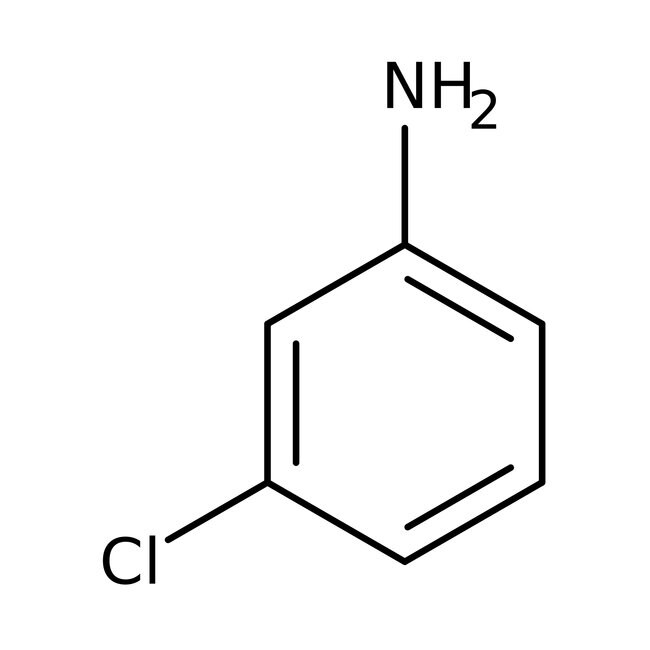
3-Chloroaniline, 99%
CAS: 108-42-9 | C6H6ClN | 127.57 g/mol
Have Questions?
Change view

Catalog number A12019.22
also known as A12019-22
Price (USD)
33.65
Special offer
Online exclusive
Ends: 30-Jun-2026
39.80Save 6.15 (15%)
Each
Quantity:
100 g
Price (USD)
33.65
Special offer
Online exclusive
Ends: 30-Jun-2026
39.80Save 6.15 (15%)
Each
Chemical Identifiers
CAS108-42-9
IUPAC Name3-chloroaniline
Molecular FormulaC6H6ClN
InChI KeyPNPCRKVUWYDDST-UHFFFAOYSA-N
SMILESNC1=CC=CC(Cl)=C1
View more
Specifications Specification Sheet
Specification SheetFormLiquid
Assay (GC)≥98.5%
Refractive Index1.5925-1.5955 @ 20?C
Appearance (Color)Clear colorless to yellow to brown
3-Chloroaniline was the only aniline compound to increase plasmaALT/GPT activity at 48 h. It is employed in the bioaugmentation of activated sludge.
This Thermo Scientific Chemicals brand product was originally part of the Alfa Aesar product portfolio. Some documentation and label information may refer to the legacy brand. The original Alfa Aesar product / item code or SKU reference has not changed as a part of the brand transition to Thermo Scientific Chemicals.
Applications
3-Chloroaniline was the only aniline compound to increase plasmaALT/GPT activity at 48 h. It is employed in the bioaugmentation of activated sludge.
Solubility
Soluble in water. [6.8 g/L (20°C)].
Notes
Store in cool place. Keep away from oxidizing agents. Incompatible with bases.
3-Chloroaniline was the only aniline compound to increase plasmaALT/GPT activity at 48 h. It is employed in the bioaugmentation of activated sludge.
Solubility
Soluble in water. [6.8 g/L (20°C)].
Notes
Store in cool place. Keep away from oxidizing agents. Incompatible with bases.
RUO – Research Use Only
General References:
- Nico Boon.; Johan Goris.; Paul De Vos.; Willy Verstraete.; Eva M. Top. Bioaugmentation of Activated Sludge by an Indigenous 3-Chloroaniline-Degrading Comamonas testosteroni Strain, I2gfp. Appl. Environ. Microbiol. 2000, 66 (7),2906-2913.
- Nico Boon.; Johan Goris.; Paul De Vos.; Willy Verstraete.; Eva M. Top. Genetic Diversity among 3-Chloroaniline- and Aniline-Degrading Strains of theComamonadaceae. Appl. Environ. Microbiol. 2001, 67 (3),1107-1115.