Search
 Element Search
 Structure Search


Thermo Scientific Chemicals
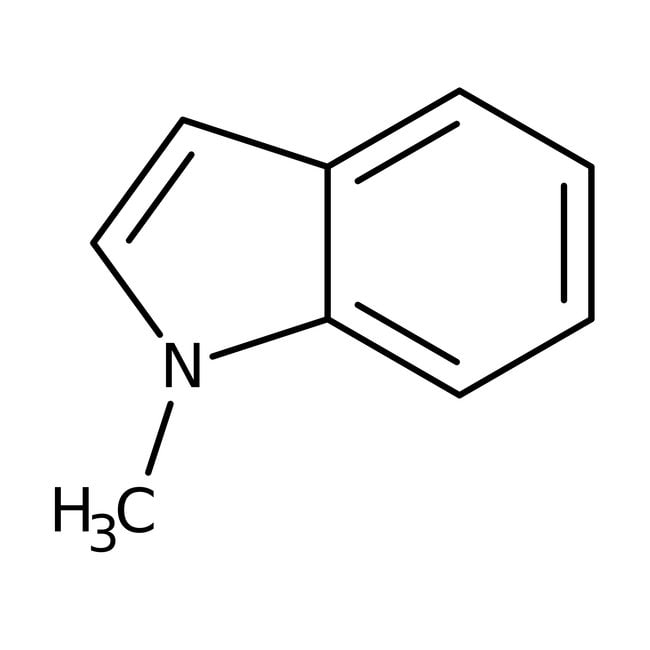
1-Methylindole, 98%
CAS: 603-76-9 | C9H9N | 131.178 g/mol
Have Questions?
Change view


Catalog number A12605.09
also known as A12605-09
Price (USD)
45.90
Each
Quantity:
10 g
Price (USD)
45.90
Each
Chemical Identifiers
CAS603-76-9
IUPAC Name1-methyl-1H-indole
Molecular FormulaC9H9N
InChI KeyBLRHMMGNCXNXJL-UHFFFAOYSA-N
SMILESCN1C=CC2=CC=CC=C12
View more
Specifications Specification Sheet
Specification SheetAppearance (Color)Clear colorless to yellow to orange
Assay (GC)≥97.5%
Identification (FTIR)Conforms
Refractive Index1.6035-1.6085 @ 20?C
FormLiquid
View more
1-Methylindole is useful for the determination of association constant for the electron-donor-acceptor complexes with 1-(2,4,6-trinitrophenyl) propan-2-one. It acts as a reactant for the preparation of polycyclic derivatives of indoles, bisindole derivatives and pharmaceutically active 2-oxo-1-pyrrolidine analogues. It is also used as a reactant for the preparation of Positron Emission Tomography (PET) imaging agents of protein kinase C (PKC) and glycogen synthase kinase-3 (GSK-3).
This Thermo Scientific Chemicals brand product was originally part of the Alfa Aesar product portfolio. Some documentation and label information may refer to the legacy brand. The original Alfa Aesar product / item code or SKU reference has not changed as a part of the brand transition to Thermo Scientific Chemicals.
Applications
1-Methylindole is useful for the determination of association constant for the electron-donor-acceptor complexes with 1-(2,4,6-trinitrophenyl) propan-2-one. It acts as a reactant for the preparation of polycyclic derivatives of indoles, bisindole derivatives and pharmaceutically active 2-oxo-1-pyrrolidine analogues. It is also used as a reactant for the preparation of Positron Emission Tomography (PET) imaging agents of protein kinase C (PKC) and glycogen synthase kinase-3 (GSK-3).
Solubility
Immiscible with water.
Notes
Light sensitive. Store in a cool place. Incompatible with strong oxidizing agents.
1-Methylindole is useful for the determination of association constant for the electron-donor-acceptor complexes with 1-(2,4,6-trinitrophenyl) propan-2-one. It acts as a reactant for the preparation of polycyclic derivatives of indoles, bisindole derivatives and pharmaceutically active 2-oxo-1-pyrrolidine analogues. It is also used as a reactant for the preparation of Positron Emission Tomography (PET) imaging agents of protein kinase C (PKC) and glycogen synthase kinase-3 (GSK-3).
Solubility
Immiscible with water.
Notes
Light sensitive. Store in a cool place. Incompatible with strong oxidizing agents.
RUO – Research Use Only
General References:
- Lithiation, followed by treatment with tri-n-butyltin chloride gives the indol-2-yltributylstannane, a versatile precursor of 2-substituted indole derivatives; e.g. Stille coupling with alkyl halides gives 2-alkyl derivatives: J. Org. Chem., 59, 4250 (1994):
- Dulin, C. C.; Murphy, K. L.; Nolin, K. A. Calcium-catalyzed Friedel-Crafts addition of 1-methylindole to activated cyclopropanes. Tetrahedron Lett. 2014, 55 (38), 5280-5282.
- Nematollahi, D.; Hedayatfar, V. Diversity in electrochemical oxidation of dihydroxybenzenes in the presence of 1-methylindole. J. Chem. Sci. 2011, 123 (5), 709-717.