Search
 Element Search
 Structure Search


Thermo Scientific Chemicals
Barium hydroxide octahydrate, 97%
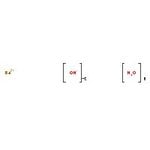
Alfa Aesar Barium hydroxide octahydrate, 97%, Quantity: 500g, CAS: 12230-71-6, Melting Point: 78 deg.C, Molecular Formula: BaH18O10, Molecular Weight: 315.461, Percent Purity: 97% | CAS: 12230-71-6 | BaH18O10 | 315.46 g/mol
Have Questions?
Change view

Catalog number A12714.0E
also known as A12714-0E
Price (USD)
172.65
Online Exclusive
192.00Save 19.35 (10%)
Each
Quantity:
2500 g
Price (USD)
172.65
Online Exclusive
192.00Save 19.35 (10%)
Each
Chemical Identifiers
CAS12230-71-6
IUPAC Namebarium(2+) octahydrate dihydroxide
Molecular FormulaBaH18O10
InChI KeyZUDYPQRUOYEARG-UHFFFAOYSA-L
SMILESO.O.O.O.O.O.O.O.[OH-].[OH-].[Ba++]
View more
Specifications Specification Sheet
Specification SheetAppearance (Color)White
Carbonate<4.0% as BaCO3
FormCrystals or powder or crystalline powder
Assay (Aqueous acid-base Titration)≥96.0% to ≤104.0%
Loss on Drying42.5-48.5% (200?C/constant weight)
Barium hydroxide octahydrate has been used in the centromeric heterochromatin banding technnique and to synthesize BaTiO3. The form Barium hydroxide was reported to catalyze the rate of β elimination of phosphoserine residues. It is also used as a general purpose additive for lubricants and greases, sugar fabrication, manufacturing soaps, fat saponification and chemical synthesis of other barium compounds.
This Thermo Scientific Chemicals brand product was originally part of the Alfa Aesar product portfolio. Some documentation and label information may refer to the legacy brand. The original Alfa Aesar product / item code or SKU reference has not changed as a part of the brand transition to Thermo Scientific Chemicals.
Applications
Barium hydroxide octahydrate has been used in the centromeric heterochromatin banding technnique and to synthesize BaTiO3. The form Barium hydroxide was reported to catalyze the rate of β elimination of phosphoserine residues. It is also used as a general purpose additive for lubricants and greases, sugar fabrication, manufacturing soaps, fat saponification and chemical synthesis of other barium compounds.
Solubility
Soluble in water (72 mg/ml at 20°C), methanol, ethanol (slightly), and water (56 mg/ml at 15°C). Insoluble in acetone (practically)
Notes
Air Sensitive. Store in cool dry place in tightly closed container. With good ventilation. Store away from air and oxidizing agent.
Barium hydroxide octahydrate has been used in the centromeric heterochromatin banding technnique and to synthesize BaTiO3. The form Barium hydroxide was reported to catalyze the rate of β elimination of phosphoserine residues. It is also used as a general purpose additive for lubricants and greases, sugar fabrication, manufacturing soaps, fat saponification and chemical synthesis of other barium compounds.
Solubility
Soluble in water (72 mg/ml at 20°C), methanol, ethanol (slightly), and water (56 mg/ml at 15°C). Insoluble in acetone (practically)
Notes
Air Sensitive. Store in cool dry place in tightly closed container. With good ventilation. Store away from air and oxidizing agent.
RUO – Research Use Only
General References:
- Jay A. Young. Barium Hydroxide Octahydrate. J. Chem. Educ. 2006, 83(4), 539.
- ngmar Persson; Magnus Sandström; Haruhiko Yokoyama. Structure of the Solvated Strontium and Barium Ions in Aqueous, Dimethyl Sulfoxide and Pyridine Solution, and Crystal Structure of Strontium and Barium Hydroxide Octahydrate. Zeitschrift für Naturforschung A. 1995, 50(1), 21-37.
- Preferred base for the Horner-Wadsworth-Emmons reaction with sensitive aldehydes, such as in formation of complex (E)-enones in natural product synthesis: Synlett, 774 (1993).
- Suzuki coupling of 4-iodopyridines with arylboronic acids is promoted by this base which has advantages for sterically hindered substrates: J. Organomet. Chem., 517, 25 (1996).
- For a brief feature on uses of the reagent, see: Synlett, 1739 (2002).