Search
 Element Search
 Structure Search

Thermo Scientific Chemicals
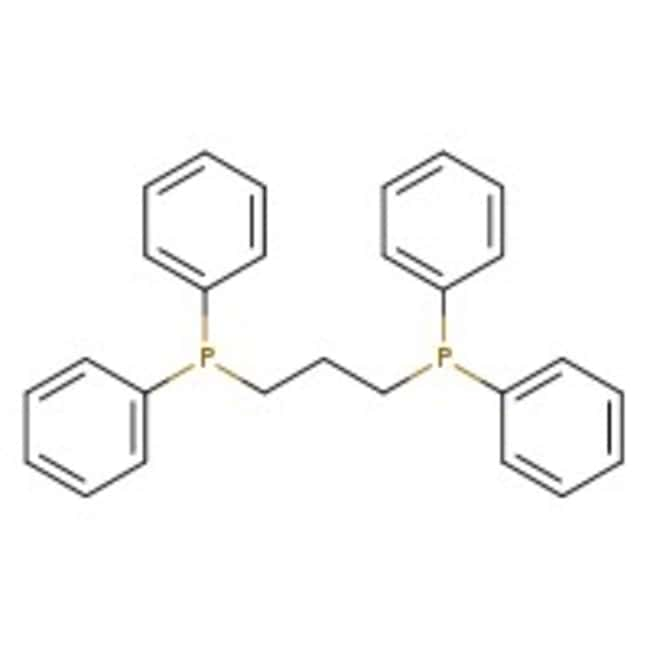
1,3-Bis(diphenylphosphino)propane, 97%
CAS: 6737-42-4 | C27H26P2 | 412.45 g/mol
Have Questions?
Change view


Catalog number A12931.06
also known as A12931-06
Price (USD)
69.65
Online Exclusive
76.70Save 7.05 (9%)
Each
Quantity:
5 g
Price (USD)
69.65
Online Exclusive
76.70Save 7.05 (9%)
Each
Chemical Identifiers
CAS6737-42-4
IUPAC Name[3-(diphenylphosphanyl)propyl]diphenylphosphane
Molecular FormulaC27H26P2
InChI KeyLVEYOSJUKRVCCF-UHFFFAOYSA-N
SMILESC(CP(C1=CC=CC=C1)C1=CC=CC=C1)CP(C1=CC=CC=C1)C1=CC=CC=C1
View more
Specifications Specification Sheet
Specification SheetFormPowder
Appearance (Color)White to very pale yellow
Purity (DSC)>96.0%
Phosphorus-31 NMRConforms to structure
1,3-Bis(diphenylphosphino)propane is used as a bidentate ligand in coordination chemistry and form complex dichloro(1,3-bis(diphenylphosphino)propane)nickel by reacting with nickel(II) chloride. This complex is used as a catalyst for Kumada coupling reaction. It also acts as a ligand for palladium(II) catalysts which is useful for the co-polymerization of carbon monoxide and ethylene to get polyketones. Further, it is employed in palladium-catalyzed arylation under Heck reaction and Suzuki reaction. In addition to this, it serves as a catalyst for Negishi coupling and Sonogashira coupling reactions.
This Thermo Scientific Chemicals brand product was originally part of the Alfa Aesar product portfolio. Some documentation and label information may refer to the legacy brand. The original Alfa Aesar product / item code or SKU reference has not changed as a part of the brand transition to Thermo Scientific Chemicals.
Applications
1,3-Bis(diphenylphosphino)propane is used as a bidentate ligand in coordination chemistry and form complex dichloro(1,3-bis(diphenylphosphino)propane)nickel by reacting with nickel(II) chloride. This complex is used as a catalyst for Kumada coupling reaction. It also acts as a ligand for palladium(II) catalysts which is useful for the co-polymerization of carbon monoxide and ethylene to get polyketones. Further, it is employed in palladium-catalyzed arylation under Heck reaction and Suzuki reaction. In addition to this, it serves as a catalyst for Negishi coupling and Sonogashira coupling reactions.
Solubility
Insoluble in water.
Notes
Air sensitive. Incompatible with strong oxidizing agents.
1,3-Bis(diphenylphosphino)propane is used as a bidentate ligand in coordination chemistry and form complex dichloro(1,3-bis(diphenylphosphino)propane)nickel by reacting with nickel(II) chloride. This complex is used as a catalyst for Kumada coupling reaction. It also acts as a ligand for palladium(II) catalysts which is useful for the co-polymerization of carbon monoxide and ethylene to get polyketones. Further, it is employed in palladium-catalyzed arylation under Heck reaction and Suzuki reaction. In addition to this, it serves as a catalyst for Negishi coupling and Sonogashira coupling reactions.
Solubility
Insoluble in water.
Notes
Air sensitive. Incompatible with strong oxidizing agents.
RUO – Research Use Only
General References:
- Chelating phosphorus ligand which forms a 1:1 complex with NiCl2, which is an efficient catalyst for the coupling of Grignard reagents with aryl, vinylic or heterocyclic halides: Bull. Chem. Soc. Jpn., 49, 1958 (1976); Tetrahedron, 38, 3347 (1982); Synthesis, 386 (1988).
- Successful Suzuki coupling of arylboronic acids with aryl chlorides bearing electron-withdrawing groups was achieved in the presence of Palladium(II) acetate, 10516, and dppp: Tetrahedron Lett., 38, 5575 (1997).
- Qi, X.; Jiang, L. B.; Li, H. P.; Wu, X. F. A A Convenient Palladium-Catalyzed Carbonylative Suzuki Coupling of Aryl Halides with Formic Acid as the Carbon Monoxide Source. Chem. Eur. J. 2015, 21 (49), 17650-17656.
- Tsubomura, T.; Kimura, K.; Nishikawa, M.; Tsukuda, T. Structures and photophysical properties of copper(I) complexes bearing diphenylphenanthroline and bis(diphenylphosphino)alkane: the effect of phenyl groups on the phenanthroline ligand. Dalton Trans. 2015, 44 (16), 7554-7562.