Search
 Element Search
 Structure Search


Thermo Scientific Chemicals
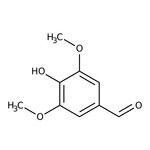
Syringaldehyde, 98+%
CAS: 134-96-3 | C9H10O4 | 182.18 g/mol
Have Questions?
Change view


Catalog number A12933.14
also known as A12933-14
Price (USD)
66.10
Each
Quantity:
25 g
Price (USD)
66.10
Each
Chemical Identifiers
CAS134-96-3
IUPAC Name4-hydroxy-3,5-dimethoxybenzaldehyde
Molecular FormulaC9H10O4
InChI KeyKCDXJAYRVLXPFO-UHFFFAOYSA-N
SMILESCOC1=CC(C=O)=CC(OC)=C1O
View more
Specifications Specification Sheet
Specification SheetAppearance (Color)White to pale cream to pale brown or pale pink
FormCrystals or powder or crystalline powder
Assay (GC)≥98.0%
Identification (FTIR)Conforms
Melting Point (clear melt)109.0-115.0?C
Syringaldehyde has bioactive properties and is, therefore, used in pharmaceuticals, food, cosmetics, textiles, pulp and paper industries.
This Thermo Scientific Chemicals brand product was originally part of the Alfa Aesar product portfolio. Some documentation and label information may refer to the legacy brand. The original Alfa Aesar product / item code or SKU reference has not changed as a part of the brand transition to Thermo Scientific Chemicals.
Applications
Syringaldehyde has bioactive properties and is, therefore, used in pharmaceuticals, food, cosmetics, textiles, pulp and paper industries.
Solubility
Very sparingly soluble in water.
Notes
Keep container tightly closed in a dry and well-ventilated place. Store at room temperature. It is sensitive to air. Incompatible with strong oxidizing agents, and bases.
Syringaldehyde has bioactive properties and is, therefore, used in pharmaceuticals, food, cosmetics, textiles, pulp and paper industries.
Solubility
Very sparingly soluble in water.
Notes
Keep container tightly closed in a dry and well-ventilated place. Store at room temperature. It is sensitive to air. Incompatible with strong oxidizing agents, and bases.
RUO – Research Use Only
General References:
- Mohamad Nasir.; Mohamad Ibrahim. A CONCISE REVIEW OF THE NATURAL EXISTANCE, SYNTHESIS, PROPERTIES, AND APPLICATIONS OF SYRINGALDEHYDE. BioResources. 1983, 7 (3), 4377-4399.
- Veena Jain.; Nisha Garg.; Himmat S. Nainawatee. Influence of Rhizosphere Application of Syringaldehyde on Rhizobia — Mungbean (Vigna radiata) Symbiosis. Biochemie und Physiologie der Pflanzen. 1991, 187 (4), 331-336.