Search
 Element Search
 Structure Search

Thermo Scientific Chemicals
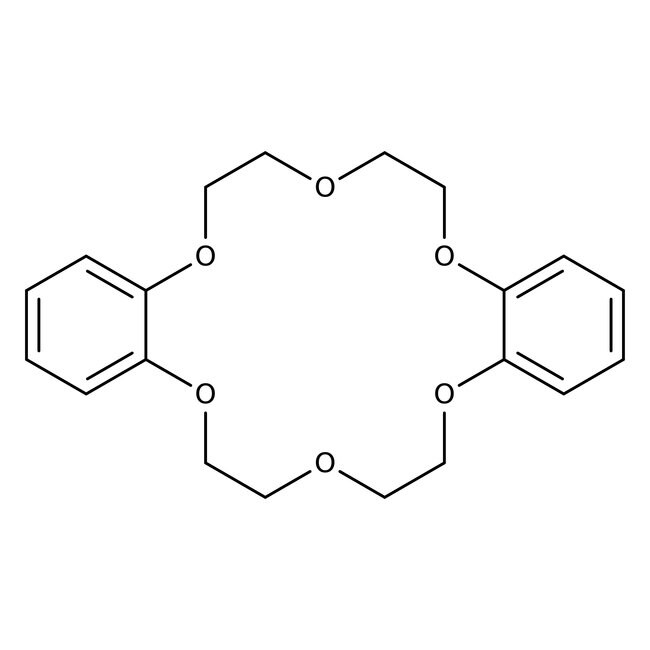
Dibenzo-18-crown-6, 98+%
CAS: 14187-32-7 | C20H24O6 | 360.406 g/mol
Have Questions?
Change view


Catalog number A13133.14
also known as A13133-14
Price (USD)
78.65
Special offer
Online exclusive
Ends: 30-Jun-2026
92.70Save 14.05 (15%)
Each
Quantity:
25 g
Price (USD)
78.65
Special offer
Online exclusive
Ends: 30-Jun-2026
92.70Save 14.05 (15%)
Each
Chemical Identifiers
CAS14187-32-7
IUPAC Name2,5,8,15,18,21-hexaoxatricyclo[20.4.0.0⁹,¹⁴]hexacosa-1(26),9,11,13,22,24-hexaene
Molecular FormulaC20H24O6
InChI KeyYSSSPARMOAYJTE-UHFFFAOYSA-N
SMILESC1COC2=CC=CC=C2OCCOCCOC2=CC=CC=C2OCCO1
View more
Specifications Specification Sheet
Specification SheetAppearance (Color)White to pale cream to cream to green
Identification (FTIR)Conforms
Assay (HPLC)≥98.0%
Assay (GC)≥98.0%
Melting Point (clear melt)158.0-165.0?C
View more
Dibenzo-18-crown-6, is used as an important raw material and intermediate used in organic Synthesis, pharmaceuticals, agrochemicals and dyestuff. It is an important organic intermediate.
This Thermo Scientific Chemicals brand product was originally part of the Alfa Aesar product portfolio. Some documentation and label information may refer to the legacy brand. The original Alfa Aesar product / item code or SKU reference has not changed as a part of the brand transition to Thermo Scientific Chemicals.
Applications
Dibenzo-18-crown-6, is used as an important raw material and intermediate used in organic Synthesis, pharmaceuticals, agrochemicals and dyestuff. It is an important organic intermediate.
Solubility
Sparingly soluble in water.
Notes
Store in cool place. Keep container tightly closed in a dry and well-ventilated place. Stable under recommended storage conditions. Incompatible to strong oxidizing agents, strong acids.
Dibenzo-18-crown-6, is used as an important raw material and intermediate used in organic Synthesis, pharmaceuticals, agrochemicals and dyestuff. It is an important organic intermediate.
Solubility
Sparingly soluble in water.
Notes
Store in cool place. Keep container tightly closed in a dry and well-ventilated place. Stable under recommended storage conditions. Incompatible to strong oxidizing agents, strong acids.
RUO – Research Use Only
General References:
- PD Beattie.; A Delay.; HH Girault. Investigation of the kinetics of assisted potassium ion transfer by dibenzo-18-crown-6 at the micro-ITIES by means of steady-state voltammetry. Journal of Electroanalytical Chemistry . 1995, 380 (1-2), 167-175.
- IM Kolthoff.; MK Chantooni. Transfer activity coefficients in various solvents of several univalent cations complexed withdibenzo-18-crown-6. Jr - Analytical Chemistry. 1980, 380 (1-2), 167-175.
- Comparison of the rates of displacement of F- in 1-fluoro-2- or 4-nitrobenzene with KOMe and KO-t-Bu in the presence of this crown ether gave a result (t-BuO- >> MeO-) opposite to the pattern observed in its absence: J. Chem. Soc., Perkin 2, 55 (1973).
- Promotes the generation of bromochlorocarbene from Chlorodibromomethane, A16938: Syntheis, 783 (1977); Tetrahedron, 33, 363 (1977), and of dibromocarbene from Bromoform, A11904: Org. Synth., 75, 98 (1997).
- In combination with Benzyltriethylammonium chloride, A13268, promotes the oxidative decarboxylation of arylacetic acids with NaIO4 to give high yields of the aryl aldehydes: Indian J. Chem. B, 35B, 151 (1996). Under the same conditions, phenacyl bromides are converted to benzoic acids.
- Catalyst for the formation of phenacyl esters from phenacyl bromides and K salts of carboxylic acids in acetonitrile: Synth. Commun., 26, 1747 (1996).
- Catalyst for the halogenative cleavage of epoxides with Br2 or I2, giving halohydrins in high yields: J. Org. Chem., 63, 1455 (1998).
- See also 18-Crown-6, A11249 and Appendix 2.