Search
 Element Search
 Structure Search


Thermo Scientific Chemicals
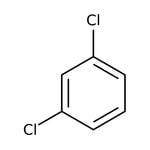
1,3-Dichlorobenzene, 98%
CAS: 541-73-1 | C6H4Cl2 | 146.998 g/mol
Have Questions?
Change view


Catalog number A13688.30
also known as A13688-30
Price (USD)
56.65
Special offer
Online exclusive
Ends: 30-Jun-2026
66.00Save 9.35 (14%)
Each
Quantity:
250 g
Price (USD)
56.65
Special offer
Online exclusive
Ends: 30-Jun-2026
66.00Save 9.35 (14%)
Each
Chemical Identifiers
CAS541-73-1
IUPAC Name1,3-dichlorobenzene
Molecular FormulaC6H4Cl2
InChI KeyZPQOPVIELGIULI-UHFFFAOYSA-N
SMILESClC1=CC(Cl)=CC=C1
View more
Specifications Specification Sheet
Specification SheetAssay (GC)≥97.5%
Appearance (Color)Clear colorless to pale yellow
FormLiquid
Refractive Index1.5435-1.5475 @ 20°C
Identification (FTIR)Conforms
1,3-Dichlorobenzene is used in medicine, and dyes. And it is also used to study the effect of solvent vapor pressure on the vertical nanowire of C60 molecules1. 1,3-Dichlorobenzene, a chlorinated aromatic hydrocarbon, can be detected in environmental samples using an advanced Fourier transform infrared spectroscopy-attenuated total reflectance (FTIR-ATR) sensor.
This Thermo Scientific Chemicals brand product was originally part of the Alfa Aesar product portfolio. Some documentation and label information may refer to the legacy brand. The original Alfa Aesar product / item code or SKU reference has not changed as a part of the brand transition to Thermo Scientific Chemicals.
Applications
1,3-Dichlorobenzene is used in medicine, and dyes. And it is also used to study the effect of solvent vapor pressure on the vertical nanowire of C60 molecules1. 1,3-Dichlorobenzene, a chlorinated aromatic hydrocarbon, can be detected in environmental samples using an advanced Fourier transform infrared spectroscopy-attenuated total reflectance (FTIR-ATR) sensor.
Solubility
Difficult to mix.
Notes
Store in cool, dry conditions in well sealed containers. Keep container tightly closed.
1,3-Dichlorobenzene is used in medicine, and dyes. And it is also used to study the effect of solvent vapor pressure on the vertical nanowire of C60 molecules1. 1,3-Dichlorobenzene, a chlorinated aromatic hydrocarbon, can be detected in environmental samples using an advanced Fourier transform infrared spectroscopy-attenuated total reflectance (FTIR-ATR) sensor.
Solubility
Difficult to mix.
Notes
Store in cool, dry conditions in well sealed containers. Keep container tightly closed.
RUO – Research Use Only
General References:
- Baoshan Xing.; Joseph J. Pignatello. Competitive Sorption between 1,3-Dichlorobenzene or 2,4-Dichlorophenol and Natural Aromatic Acids in Soil Organic Matter. Environ. Sci. Technol. 1998, 32, (5), 614-619.
- Lithiation with n-BuLi at low temperature gives 2,6-dichlorophenyllithium, which reacts with electrophiles in good yield: Synthesis, 803 (1988).
- For coupling with aryl Grignards in the synthesis of m-terphenyls, see: Synthesis, 1455 (1996).