Search
 Element Search
 Structure Search


Thermo Scientific Chemicals
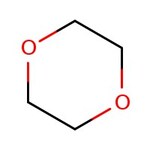
1,4-Dioxane, 99+%, stab. with ca 5-10ppm BHT
CAS: 123-91-1 | C4H8O2 | 88.106 g/mol
Have Questions?
Change view

Catalog number A14188.36
also known as A14188-36
Price (USD)
38.65
Online Exclusive
42.30Save 3.65 (9%)
Each
Quantity:
500 g
Price (USD)
38.65
Online Exclusive
42.30Save 3.65 (9%)
Each
Chemical Identifiers
CAS123-91-1
IUPAC Name1,4-dioxane
Molecular FormulaC4H8O2
InChI KeyRYHBNJHYFVUHQT-UHFFFAOYSA-N
SMILESC1COCCO1
View more
Specifications Specification Sheet
Specification SheetIdentification (FTIR)Conforms
Refractive Index1.4205-1.4235 @ 20?C
Appearance (Color)Clear, colorless
Assay (GC)≥99.0%
Water Content (Karl Fischer Titration)<0.5%
View more
1,4-Dioxane is used as a stabilizer for 1,1,1-trichloroethane and chlorinated solvents. It acts as a solvent for cellulose acetate, ethyl cellulose, benzyl cellulose, resins, oils, waxes, dyes, other organic and inorganic compounds. It acts as a substitute for tetrahydrofuran due to its higher boiling point and lower toxicity. Further, it is used as an internal standard for proton NMR spectroscopy in deuterium oxide. It plays an important role in liquid scintillation counting in biological procedures, and as a wetting and dispersing agent in textile processing. It is involved in the preparation of dimethylmagnesium by reacting with methylmagnesium bromide, and in the preparation of histological sections for microscopic examination.
This Thermo Scientific Chemicals brand product was originally part of the Alfa Aesar product portfolio. Some documentation and label information may refer to the legacy brand. The original Alfa Aesar product / item code or SKU reference has not changed as a part of the brand transition to Thermo Scientific Chemicals.
Applications
1,4-Dioxane is used as a stabilizer for 1,1,1-trichloroethane and chlorinated solvents. It acts as a solvent for cellulose acetate, ethyl cellulose, benzyl cellulose, resins, oils, waxes, dyes, other organic and inorganic compounds. It acts as a substitute for tetrahydrofuran due to its higher boiling point and lower toxicity. Further, it is used as an internal standard for proton NMR spectroscopy in deuterium oxide. It plays an important role in liquid scintillation counting in biological procedures, and as a wetting and dispersing agent in textile processing. It is involved in the preparation of dimethylmagnesium by reacting with methylmagnesium bromide, and in the preparation of histological sections for microscopic examination.
Solubility
Miscible with water, organic solvents, aromatic hydrocarbons and oils.
Notes
Hygroscopic. Incompatible with oxygen, oxidizing agents, halogens, reducing agents, perchlorates and trimethylaluminum.
1,4-Dioxane is used as a stabilizer for 1,1,1-trichloroethane and chlorinated solvents. It acts as a solvent for cellulose acetate, ethyl cellulose, benzyl cellulose, resins, oils, waxes, dyes, other organic and inorganic compounds. It acts as a substitute for tetrahydrofuran due to its higher boiling point and lower toxicity. Further, it is used as an internal standard for proton NMR spectroscopy in deuterium oxide. It plays an important role in liquid scintillation counting in biological procedures, and as a wetting and dispersing agent in textile processing. It is involved in the preparation of dimethylmagnesium by reacting with methylmagnesium bromide, and in the preparation of histological sections for microscopic examination.
Solubility
Miscible with water, organic solvents, aromatic hydrocarbons and oils.
Notes
Hygroscopic. Incompatible with oxygen, oxidizing agents, halogens, reducing agents, perchlorates and trimethylaluminum.
WARNING: Cancer – www.P65Warnings.ca.gov
RUO – Research Use Only
General References:
- Adamson, D. T.; Anderson, R. H.; Mahendra, S.; Newell, C. J. Evidence of 1,4-Dioxane Attenuation at Groundwater Sites Contaminated with Chlorinated Solvents and 1,4-Dioxane. Environ. Sci. Technol. 2015, 49 (11), 6510-6518.
- Rathi, P.; Jouyban, A.; Khoubnasabjafari, M.; Kale, M. Solubility of Etoricoxib in Aqueous Solutions of 1,4-Butanediol, 1,4-Dioxane, N,N-Dimethylacetamide, N,N-Dimethylformamide, Dimethyl Sulfoxide, and Ethanol at 298.2 K. J. Chem. Eng. Data 2015, 60 (7), 2128-2134.