Search
 Element Search
 Structure Search


Thermo Scientific Chemicals
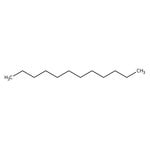
n-Dodecane, 99%
CAS: 112-40-3 | C12H26 | 170.34 g/mol
Have Questions?
Change view

Catalog number A14834.AP
also known as A14834-AP
Price (USD)
136.65
Online Exclusive
152.00Save 15.35 (10%)
Each
Quantity:
500 mL
Price (USD)
136.65
Online Exclusive
152.00Save 15.35 (10%)
Each
Chemical Identifiers
CAS112-40-3
IUPAC Namedodecane
Molecular FormulaC12H26
InChI KeySNRUBQQJIBEYMU-UHFFFAOYSA-N
SMILESCCCCCCCCCCCC
View more
Specifications Specification Sheet
Specification SheetAssay from Supplier's CofA≥98.5% (US-sourced material)
CommentMaterial sourced in UK and US
Identification (FTIR)Conforms (UK-sourced material)
Refractive Index1.4200-1.4230 @ 20°C (UK-sourced material)
Appearance (Color)Clear colorless
View more
n-Dodecane is used as a solvent and a distillation chaser. It finds application as a diluent for tributyl phosphate (TBP) in reprocessing plants and as a possible surrogate for kerosene-based fuels in jet. It is an active component of scintillator as well as used in lubricants and greases.
This Thermo Scientific Chemicals brand product was originally part of the Alfa Aesar product portfolio. Some documentation and label information may refer to the legacy brand. The original Alfa Aesar product / item code or SKU reference has not changed as a part of the brand transition to Thermo Scientific Chemicals.
Applications
n-Dodecane is used as a solvent and a distillation chaser. It finds application as a diluent for tributyl phosphate (TBP) in reprocessing plants and as a possible surrogate for kerosene-based fuels in jet. It is an active component of scintillator as well as used in lubricants and greases.
Solubility
Miscible with ethyl alcohol, ethyl ether, acetone, chloroform and carbon tetrachloride. Immiscible with water.
Notes
Hygroscopic. Incompatible with strong oxidizing agents.
n-Dodecane is used as a solvent and a distillation chaser. It finds application as a diluent for tributyl phosphate (TBP) in reprocessing plants and as a possible surrogate for kerosene-based fuels in jet. It is an active component of scintillator as well as used in lubricants and greases.
Solubility
Miscible with ethyl alcohol, ethyl ether, acetone, chloroform and carbon tetrachloride. Immiscible with water.
Notes
Hygroscopic. Incompatible with strong oxidizing agents.
RUO – Research Use Only
General References:
- Pei, Y.; Hawkes, E. R.; Kook, S.; Goldin, G. M.; Lu, T. Modelling n-dodecane spray and combustion with the transported probability density function method. Combust. Flame 2015, 162 (5), 2006-2019.
- Vo, Q. N.; Hawkins, C. A.; Dang, L. X.; Nilsson, M.; Nguyen, H. D. Computational Study of Molecular Structure and Self-Association of Tri-n-butyl Phosphates in n-Dodecane. J. Phys. Chem. B 2015, 119 (4), 1588-1597.