Search
 Element Search
 Structure Search


Thermo Scientific Chemicals
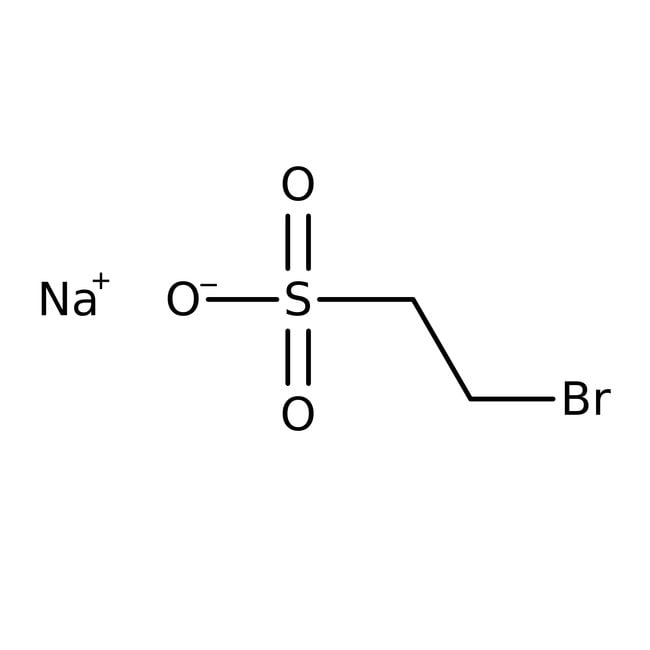
Sodium 2-bromoethanesulfonate, 98%
CAS: 4263-52-9 | C2H4BrNaO3S | 211.005 g/mol
Have Questions?
Change view


Catalog number A15076.22
also known as A15076-22
Price (USD)
113.00
Each
Quantity:
100 g
Price (USD)
113.00
Each
Chemical Identifiers
CAS4263-52-9
IUPAC Namesodium 2-bromoethane-1-sulfonate
Molecular FormulaC2H4BrNaO3S
InChI KeyHNFOAHXBHLWKNF-UHFFFAOYSA-M
SMILES[Na+].[O-]S(=O)(=O)CCBr
View more
Specifications Specification Sheet
Specification SheetAssay (Titration ex Bromide)≥97.5 to ≤102.5% (Dry wt. basis)
Identification (FTIR)Conforms
FormPowder or crystalline powder or granules
Appearance (Color)White to pale cream
Sodium 2-bromoethanesulfonate(BES) was used to investigate the effect of BES on inhibition of bacterial growth.
This Thermo Scientific Chemicals brand product was originally part of the Alfa Aesar product portfolio. Some documentation and label information may refer to the legacy brand. The original Alfa Aesar product / item code or SKU reference has not changed as a part of the brand transition to Thermo Scientific Chemicals.
Applications
Sodium 2-bromoethanesulfonate(BES) was used to investigate the effect of BES on inhibition of bacterial growth.
Solubility
Soluble in water and methanol.
Notes
Store in cool, dry place in tightly closed container. Store away from oxidizing agent.
Sodium 2-bromoethanesulfonate(BES) was used to investigate the effect of BES on inhibition of bacterial growth.
Solubility
Soluble in water and methanol.
Notes
Store in cool, dry place in tightly closed container. Store away from oxidizing agent.
RUO – Research Use Only
General References:
- Jeffrey M Boyd; Ashley Ellsworth; Scott A Ensign. Characterization of 2-bromoethanesulfonate as a selective inhibitor of the coenzyme m-dependent pathway and enzymes of bacterial aliphatic epoxide metabolism. Journal of Bacteriology, 2006, 188(23), 8062-8069.
- Yu Yang; Jialiang Guo; Zhiqiang Hu. Impact of nano zero valent iron (NZVI) on methanogenic activity and population dynamics in anaerobic digestion. Water Research, 2013, 47(17), 6790-6800.